


What are Employer of Record (EOR) services?
An Employer of Record (EOR) is a third-party organisation that legally employs staff on your behalf in a country where you have no legal entity. On paper, the EOR is the employer — it holds the employment contract, runs payroll, withholds taxes and social contributions, and carries the compliance risk. In practice, your team reports to you and does the same work as any other employee. Employer of record services let you hire full-time people in a new market in days instead of the months it takes to incorporate, and without the fixed cost of a local entity.
Companies use an EOR to test a market before committing, to hire a specific person who happens to live abroad, or to build a distributed team across many countries from a single point of contact. TopSource’s EOR services cover 180+ countries with locally compliant contracts and in-country experts on the ground.
Need help navigating local labour compliance?
Schedule a strategy callWhat does an Employer of Record do?
A good employer of record company takes on the full legal and administrative weight of employment so you can focus on managing the person, not the paperwork. Its core responsibilities are:
- Compliant employment contracts — drafted to local labour law, in the local language and currency, and customised to the role.
- Payroll and tax — calculating and paying salaries, withholding income tax and social contributions, and filing with the local authorities.
- Statutory and supplementary benefits — pension, leave, healthcare and any market-specific entitlements, plus bespoke benefits to stay competitive.
- Onboarding and offboarding — right-to-work checks, contracts and a compliant exit when the time comes.
- Ongoing compliance — keeping every contract and payslip current as local regulations change.
How does hiring through an EOR work?
The process is deliberately simple, because the EOR absorbs the complexity:
- You choose the person and the terms — salary, role, start date, benefits.
- The EOR issues a compliant local contract and the employee signs.
- The employee is onboarded onto the EOR’s local payroll, with all registrations handled for you.
- You manage the work; the EOR runs the admin — payroll, tax, benefits and compliance, month after month.
With TopSource, onboarding in established markets typically completes in 5–10 business days, and you keep a single point of contact backed by 24/5 phone support from in-country and regional experts.
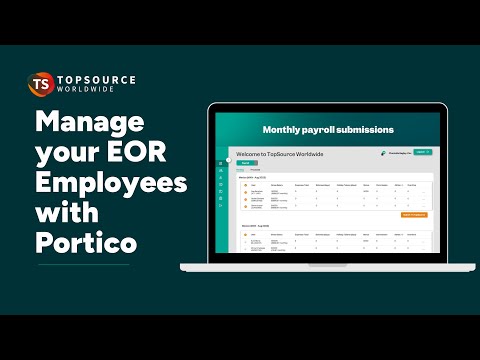
See it in action: the TopSource EOR platform
See how TopSource runs Employer of Record hiring and payroll on one platform:
Why use an Employer of Record?
An EOR solves three problems that otherwise slow international hiring to a crawl:
- Speed into new markets — hire in days, without waiting months to incorporate a legal entity or open local bank accounts.
- Compliance without a local team — the EOR carries the risk of getting contracts, payroll and tax right in a jurisdiction you don’t know.
- Access to talent anywhere — employ the right person wherever they live, instead of limiting hiring to countries where you already operate.
It also lowers the cost of leaving: winding down an EOR arrangement is far simpler than dissolving a legal entity if a market doesn’t work out.
EOR vs. setting up a legal entity
Opening your own entity gives you full control and can be cheaper per head at scale — but it takes months, needs local directors and bank accounts, and locks you into ongoing filing, accounting and tax obligations in every country. An EOR gives you almost all of the capability with none of the setup: you can be hiring in a week, and you can exit cleanly.
As a rule of thumb, an EOR wins when you have a handful of employees per country, are entering a market for the first time, or want to move fast. An entity starts to make sense once headcount in a single country grows large enough to justify the fixed cost and admin. Many companies use both — an EOR to enter, an entity later where they scale.
Employer of Record (EOR) vs. PEO
The two are often confused, but the legal relationship is different. A Professional Employer Organisation (PEO) works as a co-employer: you still need your own legal entity in the country, and the PEO shares HR and payroll responsibility with you. An EOR is the sole legal employer — no entity required on your side, and the EOR carries the full compliance liability.
In short: choose a PEO when you already have an entity and want to offload HR admin; choose an EOR when you want to hire in a country where you have no entity at all.
EOR vs. staffing agency
A staffing agency finds and supplies workers, usually for temporary or project work, and the relationship is typically short-term. An EOR does not recruit — you choose the person — and then employs them long-term and compliantly on your behalf. Use a staffing agency to source temporary headcount; use an EOR to employ people you’ve already chosen, as permanent members of your team, in a country where you have no entity.
Who uses an Employer of Record?
- Companies expanding abroad that want to test a market before investing in an entity.
- Businesses hiring a specific remote employee who lives in a country where they don’t operate.
- Fast-growing teams that need to hire across several countries quickly and from one place.
- Firms retaining talent through relocation, keeping a valued employee compliantly employed after they move abroad.
It spans start-ups making a first international hire and enterprises managing hundreds of employees across dozens of markets.
Can you hire contractors through an EOR?
An EOR employs employees, not independent contractors — that’s the point of it. But it’s often the right answer when a contractor should be an employee. If someone works like a full-time employee, misclassifying them as a contractor is a real compliance and tax risk in most countries. Converting them to an EOR employee removes that risk while keeping them on your team. If you genuinely need flexible contractor engagement, that’s a separate service; an EOR is for people you want to employ properly.
Which countries can you hire in with an EOR?
A capable EOR operates across most of the world’s economies. TopSource provides employer of record services in 180+ countries, from major markets like the UK, US, India, Germany and Australia to harder-to-reach jurisdictions where local presence and language matter most. Each country has its own contracts, statutory benefits, payroll rules and tax treatment — which is why in-country expertise, not just software, is what keeps you compliant. You can explore country-specific detail on our Employer of Record services pages.
How much does an Employer of Record cost?
EOR providers usually price in one of two ways: a flat fee per employee per month, or a percentage of each employee’s salary. A flat fee is more predictable and usually works out better as salaries rise; a percentage model can look cheaper for low salaries but scales up with them. On top of the provider fee, you budget for the employee’s actual salary, statutory employer costs (social contributions, mandatory benefits) and any supplementary benefits you offer.
The real cost depends on the country and the salary, so the honest answer is “it depends”. To model it for a specific market, use our Global Employee & EOR Cost Calculator or talk to an expert for a transparent quote.
How to choose the right EOR provider
Once you’ve decided an EOR is right, the providers start to look similar on the surface. These questions separate them:
- Do they own their local presence, or subcontract it? In-country experts and directly held entities mean better compliance and a single line of accountability.
- Can you actually reach a human? When a payroll or compliance question is urgent, chatbots don’t help. TopSource offers 24/5 phone support from real in-country and regional experts.
- Is the pricing transparent? Ask for the all-in cost, not a headline rate.
- How fast is onboarding? Established markets should be days, not weeks.
- Can they grow with you? A provider that also runs global payroll lets you consolidate as you scale.
Why choose TopSource as your Employer of Record
TopSource Worldwide supports over 1,500 organisations hiring in 180+ countries, with locally compliant, customisable contracts and bespoke benefits in every market. What sets us apart is the human side: 24/5 phone support from in-country and regional experts, onboarding in 5–10 business days in established markets, and a single point of contact who knows your account. We’re also more than an EOR — integrated global payroll and additional services mean you can consolidate as you grow instead of stitching vendors together.
Employer of Record: frequently asked questions
Is an EOR the legal employer of my staff? Yes. The EOR holds the employment contract and carries the legal and compliance responsibility, while your team does their day-to-day work for you.
Do I need a legal entity to use an EOR? No — that’s the main reason to use one. The EOR already has a compliant entity in the country, so you don’t need to set one up.
How quickly can I hire through an EOR? In established markets, onboarding through TopSource typically takes 5–10 business days, versus the months it can take to incorporate.
What’s the difference between an EOR and a PEO? A PEO co-employs and requires you to have your own local entity; an EOR is the sole legal employer and requires none.