


Summary:
- Most ‘ADP alternatives’ content targets small businesses; this guide is written for the enterprise and mid-market buyer evaluating ADP GlobalView or Celergo for multi-country payroll.
- Companies leave ADP over long implementations, opaque quote-only pricing, multi-year lock-in, change-control costs and interfaces that feel built for a different era.
- The differentiator worth weighing: an aggregator model that lets you keep the local providers you trust, with payroll journals posted straight into your GL and a named human support team — not another multi-month deployment onto a single platform.
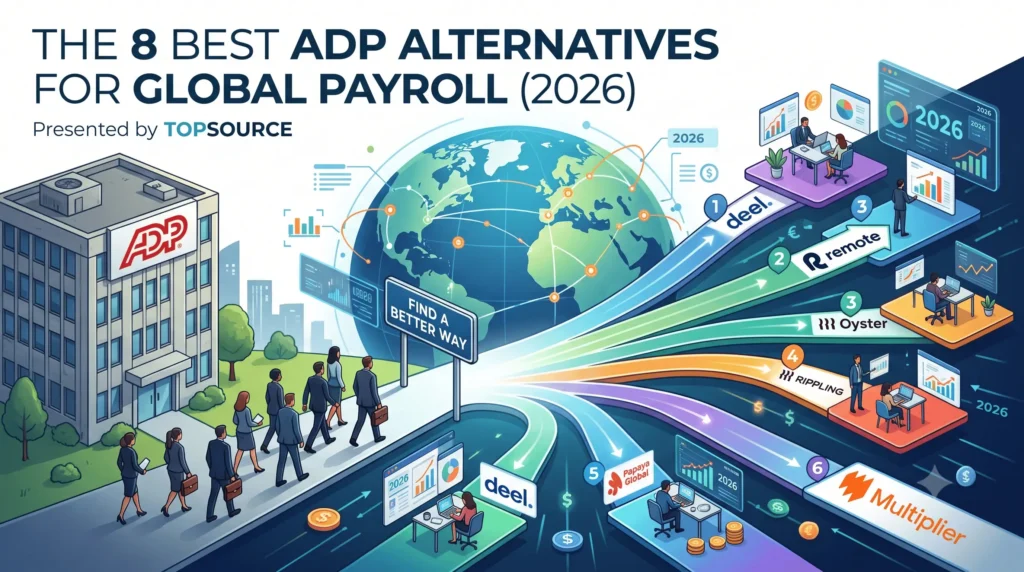
- The strongest ADP alternatives in 2026: TopSource Worldwide, Papaya Global, Safeguard Global, Neeyamo, CloudPay, Remote, Deel and Rippling.
Quick answer: If you’re evaluating ADP GlobalView or Celergo for global payroll, the best alternative depends on your priorities. For faster onboarding with GL-ready journals and the option to keep your existing local providers, TopSource Worldwide. For payroll plus embedded payments and analytics, Papaya Global. For very broad managed coverage, Safeguard Global or Neeyamo. For a single cloud managed platform, CloudPay. For owned-entity EOR and modern UX, Remote or Deel. This guide compares all eight on implementation speed, pricing, coverage, finance integration and support — for the enterprise buyer, not just SMBs.
ADP is the default many enterprises reach for, and GlobalView (built on SAP) and Celergo are capable global payroll platforms. But “capable” and “the best fit for your next five years” aren’t the same — and buyers regularly evaluate ADP alternatives once implementation timelines, contracts and change-control costs come into focus.
A note on scope: almost every “ADP alternatives” article online is aimed at small US businesses (Gusto, Paychex, OnPay). This one is written for the buyer nobody else serves — the enterprise or mid-market team running multi-country payroll and weighing GlobalView or Celergo. We’re a global payroll and EOR provider ourselves, so we’ll be clear about where we fit and where a rival is the better choice.
Why companies look for an ADP alternative
- Long implementations. Enterprise ADP deployments routinely run months; leaner providers go live in weeks. If you’re expanding now, that lag has a real cost.
- Opaque, quote-only pricing. No public pricing, a mandatory sales cycle and setup fees make it hard to compare — and easy to be surprised.
- Lock-in and change-control cost. Multi-year terms with exit penalties, and post-go-live changes or customisations that are slow and billed as extras under the global contract.
- Complexity and dated UX. Built for large enterprise; reviewers frequently describe the experience as clunky and desktop-first, with a steep learning curve for leaner teams.
- Module tax and commoditisation. Capabilities bundled free elsewhere can be paid add-ons, and some reviewers feel GlobalView doesn’t clearly differentiate from other global payroll platforms.
How we evaluated the alternatives
- Coverage & delivery model — country count, and managed vs platform vs aggregator (can you keep your own local providers?).
- Time to go live — weeks vs months.
- Finance integration — GL-ready payroll journals and ERP sync, or a report you re-key.
- Support model — named human team and phone, or portal/tickets.
- Pricing & contract terms — transparency, lock-in and change-control.
Details below reflect public information at the time of writing (July 2026); confirm current specifics with each provider.
The 8 best ADP alternatives at a glance
| Provider | Best for | Countries (claimed) | Model | Support |
|---|---|---|---|---|
| TopSource Worldwide | Faster onboarding, keep your local providers, GL journals | 164 | Managed + aggregator overlay | Named team + phone |
| Papaya Global | Payroll + embedded payments + analytics | 160+ | Platform + payments | Managed |
| Safeguard Global | Very broad managed coverage | 187 | Managed (own network) | Managed |
| Neeyamo | Long-tail country coverage at enterprise scale | 150+ | Tech + managed | Managed |
| CloudPay | Single cloud managed payroll platform | 150+ | Managed (own network) | Managed |
| Remote | Owned-entity EOR + modern UX | 100+ | Owns entities | Platform + support |
| Deel | Contractors + fast self-serve | 150+ | Platform + entities/partners | Platform |
| Rippling | HR + IT + payroll in one suite | Growing | Platform / native | Platform |
1. TopSource Worldwide
Best for: enterprise and mid-market teams that want consolidated multi-country payroll live in weeks, GL-ready journals, and the option to keep the local providers they already trust — instead of a multi-month deployment onto one platform.
TopSource runs managed global payroll and EOR across 164 countries via the Portico platform, rated 5/5 on Gartner Peer Insights. Against ADP’s known friction points, three things stand out:
- Keep the local providers you already trust. Rather than replacing your in-country payrolls with a single global platform, TopSource can overlay your existing providers and give you one consolidated view — no rip-and-replace, and far less to implement.
- Payroll journals posted straight into your GL, mapped to your codes, syncing with Workday, Oracle and NetSuite — no re-keying a report by hand.
- A named human team and a real phone line, with proactive account management — not a portal and a ticket queue.
How TopSource is different for global payroll
Payroll that closes the loop with finance, not just pays people.
| TopSource | Typical providers |
|---|---|
| ✓ Payroll journals posted straight into your GL | ✕ A report you re-key into journals by hand |
| ✓ Keep the local providers you already trust | ✕ Rip-and-replace onto their own network |
| ✓ Dedicated phone line, named team | ✕ Chat, tickets, AI as first line |
| ✓ One screen, every country, real time | ✕ Some countries routed through undisclosed partners |
| ✓ Weekly or biweekly proactive account management | ✕ Reactive support, you chase them |
When to pick TopSource over ADP: you want to go live in weeks, keep incumbent providers, get GL-ready journals and talk to a named human, without multi-year lock-in. When ADP still wins: you specifically want a single global HCM suite spanning HR, talent and payroll under one long-term enterprise contract, and you have the time and team to implement it. See our head-to-head TopSource vs ADP comparison.
Dreading another multi-month implementation?
Talk to a real payroll person — not a portal ticket. In 20 minutes we’ll show you how a keep-your-providers model goes live in weeks, with journals that post straight into your GL. No deck, no lock-in pitch.
2. Papaya Global
Best for: enterprises that want payroll, cross-border payments and BI-grade analytics in one platform.
Papaya covers 160+ countries with an AI validation engine, automatic journal-entry creation, embedded payment rails and drill-down analytics. It’s a modern, data-rich alternative to GlobalView.
Strengths: AI validation, GL journals, payments, analytics. Watch-outs: enterprise pricing and platform complexity; payments-first positioning. Pick Papaya over ADP for modern payroll + payments; ADP still wins if you need its full HCM breadth.
3. Safeguard Global
Best for: companies paying people across a very long list of countries who want it fully managed.
Safeguard runs managed payroll across 187 countries with a single calendar, consolidated reporting and go-live in weeks via pre-configured country templates.
Strengths: widest coverage, managed/consolidated, quick launch. Watch-outs: delivery runs through their network rather than keeping your own providers. Pick Safeguard over ADP for breadth and speed; ADP still wins on integrated HCM.
For a deeper look at this one, see our guide to the best Safeguard Global alternatives.
4. Neeyamo
Best for: large enterprises needing payroll in hard-to-reach, long-tail countries alongside the majors.
Neeyamo pairs a payroll technology stack with managed service and is known for reaching countries many rivals don’t, making it a common ADP alternative for global enterprises.
Strengths: long-tail coverage, enterprise focus, tech + service. Watch-outs: enterprise-oriented onboarding and UX. Pick Neeyamo over ADP for coverage of unusual markets; ADP still wins on brand-standard HCM integration.
5. CloudPay
Best for: enterprises wanting all payrolls unified on one managed cloud platform.
CloudPay delivers managed payroll across 150+ countries through a single platform, with real-time dashboards, pay-on-demand and HCM integrations (Workday, SAP SuccessFactors, Oracle).
Strengths: unified platform, strong accuracy stats, HCM integrations.
Watch-outs: like ADP, it consolidates onto its own delivery network rather than your providers. Pick CloudPay over ADP for a cleaner single platform; ADP still wins on suite breadth.
6. Remote
Best for: teams that also need to hire abroad without entities and want transparent pricing.
Remote owns entities in 100+ countries, runs payroll in-house, and offers transparent published pricing with a modern, self-serve experience — a sharp contrast to ADP’s enterprise UX.
Strengths: owned entities, transparent pricing, great tooling. Watch-outs: fewer countries than the managed giants; you migrate onto Remote. Pick Remote over ADP for EOR + modern experience; ADP still wins for very large in-house payroll estates.
7. Deel
Best for: teams that want to onboard contractors and employees quickly from one platform.
Deel is the self-serve leader, strong on contractors and quick global onboarding, with payroll and EOR across 150+ countries.
Strengths: ease of use, contractor tooling, breadth. Watch-outs: costs beyond the headline fee, chat/ticket support, and a contractor-first DNA for complex payroll. Pick Deel over ADP for speed and contractors; ADP still wins for deep enterprise payroll compliance.
8. Rippling
Best for: companies consolidating the whole employee lifecycle in one system.
Rippling unifies HRIS, IT and payroll, so a single record change updates everything. Global payroll and EOR are modules in that ecosystem.
Strengths: HR+IT+payroll integration, automation. Watch-outs: younger international footprint; module-based cost. Pick Rippling over ADP for unified HR+IT+payroll; ADP still wins on established multi-country payroll depth.
How to switch from ADP without disrupting payroll
- Map countries and headcount and confirm the new provider’s owned vs partner coverage in each.
- Review your ADP contract for notice periods and exit terms, and time the switch to a renewal boundary.
- Export data — employee records, YTD payroll, pay history and GL mappings — early; enterprise data extracts can take time.
- Communicate with employees to reassure on pay dates and continuity.
- Run a parallel cycle before cutover, ideally aligned to a tax-year boundary.
- Reconcile GL, journals and statutory filings country by country to preserve year-end continuity.
For the full landscape, see our best global payroll providers comparison and the multi-country payroll implementation guide. If you already run payroll in-house and just want it consolidated, our global payroll service can overlay your existing providers.
Consolidate your payroll without a rip-and-replace
Book a 20-minute Portico walkthrough: one consolidated view across every country, GL-ready journals, and a named team on the phone.
