


Summary:
- There is no single ‘best’ Deel alternative — the right choice depends on whether you optimise for contractor management, owned-entity EOR, or consolidated multi-country payroll that plugs into your finance systems.
- Companies most often leave Deel over pricing that grows past the headline fee, support that leans on chat and tickets, and a contractor-first model that gets thin for complex, multi-country payroll.
- For finance-led teams that already have trusted local payroll providers, an aggregator model (keep your providers, get one consolidated view and GL-ready journals) is a genuinely different approach that platform-only tools can’t match.
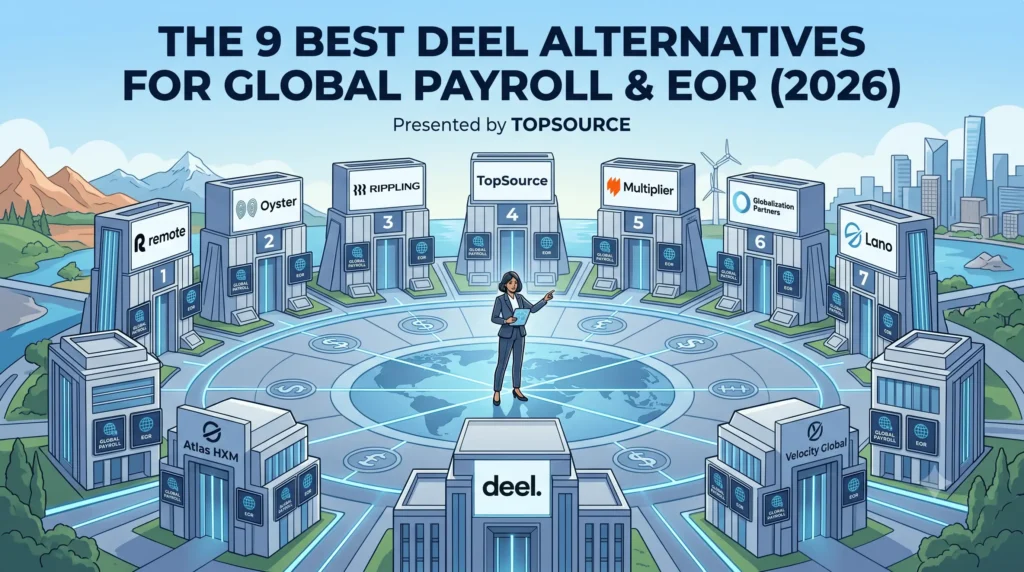
- The strongest alternatives in 2026: TopSource Worldwide, Remote, Rippling, Multiplier, Oyster, Globalization Partners, Papaya Global, Velocity Global (Pebl) and Safeguard Global.
Quick answer: The best Deel alternative depends on what you’re solving for. For consolidated multi-country payroll with payroll journals posted straight into your GL — and the option to keep the local providers you already trust — look at TopSource Worldwide. For owned-entity EOR with transparent pricing, Remote. For HR+IT+payroll in one system, Rippling. For fast SMB multi-country EOR, Multiplier or Oyster. For enterprise scale, Globalization Partners, Papaya Global or Safeguard Global. Below we compare all nine on coverage, model, pricing, support and compliance, with honest pros and cons.
Deel earned its place as a category leader by making it genuinely easy to onboard contractors and employees around the world from one slick platform. But “easy to start” and “right for how you run payroll at 200 people across 15 countries” are not the same question — and a lot of finance and people teams end up looking for a Deel alternative once they scale.
This guide is written by a global payroll and EOR provider (TopSource Worldwide), so we have a horse in this race — we’ll be upfront about where we fit and, just as importantly, where a rival is the better call. The goal is the most honest, complete comparison on the page: real pros and real cons for every option.
For a direct head-to-head, see our TopSource vs Deel comparison.
Why companies look for a Deel alternative
Deel is a strong product; these are the reasons teams still switch, drawn from public reviews and buyer feedback:
- Costs grow past the headline fee. The advertised per-employee or per-contractor price often doesn’t include FX margins, implementation and add-ons, so the invoice can land higher than the sales call implied. Model the all-in cost, not the sticker.
- Support leans on chat and tickets. As volume grows, buyers report slow or inconsistent responses and reps who don’t always know local labour nuance — painful when a payroll or compliance question is time-sensitive.
- Contractor-first DNA. Deel is excellent for contractors; complex, multi-country employee payroll — statutory journals, GL mapping, finance reporting — is not where a contractor-led tool is deepest.
- Partner reliance in some markets. Like most platforms, Deel owns entities in some countries and uses in-country partners in others; if audited, owned compliance matters to you, ask exactly which is which.
- No clean path off EOR. When headcount in a country justifies your own entity, most platforms have no incentive to help you graduate off EOR — the model earns more the longer you stay.
None of these makes Deel “bad.” They just mean it’s worth checking whether a different model fits your stage better.
How we evaluated the alternatives
Every provider below is assessed on the five things that actually decide a global payroll/EOR fit:
- Coverage & entity model — how many countries, and owned entities vs partner network.
- How they run payroll — self-serve platform, managed service, or an aggregator that lets you keep your existing local providers.
- Finance integration — do you get GL-ready payroll journals and ERP sync (Workday/Oracle/NetSuite), or a report you re-key by hand?
- Support model — a named human team and phone line, or chat/tickets/AI first.
- Pricing transparency & lock-in — published vs quote-only, and contract/renewal terms.
Pricing and ratings below reflect publicly available information at the time of writing (July 2026) — always confirm current figures with each provider.
The 9 best Deel alternatives at a glance
| Provider | Best for | Countries (claimed) | Model & entities | Support |
|---|---|---|---|---|
| TopSource Worldwide | Consolidated multi-country payroll + keep your local providers | 164 | Managed + aggregator overlay | Named team + phone |
| Remote | Owned-entity EOR, transparent pricing | 100+ | Owns entities | Platform + support |
| Rippling | HR + IT + payroll in one system | Growing | Platform / native | Platform |
| Multiplier | Fast SMB multi-country EOR | 150+ | Platform + entities/partners | 24/7 support |
| Oyster | SMBs prioritising UX & speed | 130+ | Platform + partners | Platform |
| Globalization Partners | Enterprise owned-entity EOR | 180+ | Owns entities | Sales-led |
| Papaya Global | Enterprise payroll + payments + BI | 160+ | Platform + payments | Managed |
| Velocity Global (Pebl) | Payment speed | 185+ | Platform + entities | Managed |
| Safeguard Global | Managed payroll across many countries | 187 | Managed (own network) | Managed |
1. TopSource Worldwide
Best for: finance-led teams paying employees across several countries who want one consolidated view, GL-ready journals, and human support — without migrating everything onto one vendor’s network.
TopSource runs global payroll and EOR across 164 countries, with the Portico platform as a single dashboard, and is rated 5/5 on Gartner Peer Insights by its customers. Its differentiator is a genuinely different model from the platform players:
- Keep the local payroll providers you already trust. Instead of forcing a rip-and-replace onto a single network, TopSource can sit over your existing in-country providers and give you one consolidated view — an aggregator overlay that platform-only tools structurally can’t offer.
- Payroll journals posted straight into your GL, mapped to your codes, with native sync to Workday, Oracle and NetSuite — payroll that closes the loop with finance, not just a report you re-key by hand.
- Dedicated, named human team and a real phone line — not a chatbot and a ticket queue as first line.
- EOR without the lock-in games — flexes with your actual headcount, transparent renewal, and it’ll even tell you when you no longer need EOR in a country.
How TopSource is different for global payroll
Payroll that closes the loop with finance, not just pays people.
| TopSource | Typical providers |
|---|---|
| ✓ Payroll journals posted straight into your GL | ✕ A report you re-key into journals by hand |
| ✓ Keep the local providers you already trust | ✕ Rip-and-replace onto their own network |
| ✓ Dedicated phone line, named team | ✕ Chat, tickets, AI as first line |
| ✓ One screen, every country, real time | ✕ Some countries routed through undisclosed partners |
| ✓ Weekly or biweekly proactive account management | ✕ Reactive support, you chase them |
How TopSource is different for EOR
Real support when you need it. No hidden fine print. No surprise renewal.
| TopSource | Typical providers |
|---|---|
| ✓ Flexes with your actual headcount | ✕ Locked in for 12 months regardless |
| ✓ Transparent renewal pricing | ✕ Auto 10% or market-rate uplift |
| ✓ Tells you when you don’t need EOR anymore | ✕ Earns more the longer you stay on it |
| ✓ Complex cases handled by an expert on the phone | ✕ Self-serve platform, AI-first support |
| ✓ Proven to go beyond the brief | ✕ Standard SLA, nothing more |
When to pick TopSource over Deel: you’re consolidating payroll across multiple countries, your finance team needs GL-ready journals and ERP reporting, you want to keep incumbent local providers, or you value talking to a named human. When Deel still wins: you’re mostly paying contractors, want instant self-serve onboarding, or want HR/IT and payroll in one consumer-grade app.
Not sure you even need to switch?
Talk to an actual payroll expert — a named human, not a chatbot. Twenty minutes, no deck, no pressure. We’ll tell you honestly whether Deel still fits, or whether keeping your local providers under one consolidated roof would serve you better.
2. Remote
Best for: teams that want owned-entity compliance and published, predictable pricing.
Remote owns its entities in 100+ countries and runs payroll in-house rather than through third parties, which gives tight compliance control. It’s one of the few players with transparent public pricing and a strong self-serve toolset (cost calculators, country explorers) plus compliance features like Watchtower and IP Guard.
Strengths: owned entities, published pricing, excellent tooling, fast onboarding. Watch-outs: fewer countries than the big aggregators, and the owned-entity model means you migrate onto Remote rather than keeping your own providers. Pick Remote over Deel for transparent pricing and owned-entity control; Deel still wins on breadth of integrations and contractor tooling. See our TopSource vs Remote comparison for the payroll angle.
3. Rippling
Best for: companies that want to run HRIS, device/IT management and payroll from a single source of truth.
Rippling’s edge is a native platform where an employee record change flows into payroll, benefits and IT automatically. Its global payroll and EOR are modules within that larger workforce ecosystem, with strong automation and an AI-forward “run in an hour” message.
Strengths: unmatched HR+IT+payroll integration, automation, US depth. Watch-outs: its international payroll footprint is younger than the specialists, country coverage isn’t clearly stated, and costs rise as you add modules. Pick Rippling over Deel to consolidate the whole employee lifecycle; Deel still wins on pure global coverage and contractors.
4. Multiplier
Best for: smaller and mid-size teams onboarding employees across many countries quickly.
Multiplier covers 150+ countries with a clean platform, a headline 99.95% accuracy claim, statutory automation and 24/7 human support. It’s a close functional rival to Deel for EOR and multi-country payments.
Strengths: broad coverage, quick onboarding, round-the-clock support. Watch-outs: less finance/GL depth than a payroll-first provider, and it’s platform-led rather than an aggregator. Pick Multiplier over Deel for speed and 24/7 support; Deel still wins on ecosystem breadth.
For a deeper look at this one, see our guide to the best Multiplier alternatives.
5. Oyster
Best for: lean teams that value a simple, well-designed hiring experience.
Oyster focuses on making cross-border hiring simple and fast, with EOR, contractor management and global payroll on an intuitive platform. It’s a favourite of smaller companies.
Strengths: clean UX, good contractor + EOR flow, transparent-ish pricing. Watch-outs: thinner enterprise payroll and finance-integration depth. Pick Oyster over Deel for simplicity at small scale; Deel still wins for larger, more complex operations.
For a deeper look at this one, see our guide to the best Oyster HR alternatives.
6. Globalization Partners (G-P)
Best for: enterprises that want a mature, owned-entity EOR with deep legal muscle.
G-P is one of the original global EOR players, covering 180+ countries with owned entities, 50+ currencies and an AI compliance assistant (Gia). It’s built for scale and legal defensibility.
Strengths: broad owned-entity footprint, mature compliance, enterprise credibility. Watch-outs: premium pricing, demo-gated, and it’s an EOR-first provider rather than a payroll aggregator. Pick G-P over Deel for enterprise EOR depth; Deel still wins on self-serve speed and contractor management.
For a deeper look at this one, see our guide to the best Globalization Partners (G-P) alternatives.
7. Papaya Global
Best for: large organisations that want payroll, embedded payments and BI-grade analytics in one place.
Papaya covers 160+ countries with an AI-powered validation engine (anomaly checks before money moves), automatic conversion of payroll data into journal entries, embedded payment rails and drill-down analytics. It’s the closest of this group to TopSource’s finance-grade angle.
Strengths: AI validation, GL journals, payments infrastructure, analytics. Watch-outs: enterprise pricing and complexity; it’s payments-and-platform-first. How TopSource differs: the option to keep your existing local providers and a named human support team rather than a purely platform-led relationship. Pick Papaya over Deel for enterprise payroll + payments; Deel still wins for contractor-heavy, self-serve teams.
8. Velocity Global (now Pebl)
Best for: teams where fast, reliable global payments are the priority.
Velocity Global’s platform (rebranding to Pebl) covers 185+ countries and leans into near-real-time settlement, flexible payment rails and AI payment routing, alongside EOR and payroll.
Strengths: payment speed, broad coverage, useful calculators. Watch-outs: a brand transition in progress, and a platform-led model. Pick Velocity/Pebl over Deel for payment speed; Deel still wins on product maturity and integrations.
For a deeper look at this one, see our guide to the best Velocity Global (now Pebl) alternatives.
9. Safeguard Global
Best for: companies that want a fully managed payroll service across a very wide country list.
Safeguard Global runs managed payroll across 187 countries with a single payroll calendar, consolidated reporting and bundled global benefits.
Strengths: very broad coverage, managed/consolidated, benefits included. Watch-outs: like most managed providers, delivery runs through their network rather than letting you keep your own providers. Pick Safeguard over Deel for managed multi-country payroll; Deel still wins on self-serve and contractors.
For a deeper look at this one, see our guide to the best Safeguard Global alternatives.
How to switch from Deel without disrupting payroll
Switching provider sounds daunting; done in the right order it’s routine. A safe migration checklist:
- Map countries and headcount and confirm which the new provider covers with owned entities vs partners.
- Check notice periods and contract exit on your current agreement, and time the switch to a renewal or quarter boundary.
- Export your data — employee records, contracts, year-to-date payroll, pay history and your GL mappings.
- Plan employee communications early: reassure staff on pay dates, contracts and continuity.
- Run one parallel cycle (old and new in tandem) before cutover to catch discrepancies.
- Reconcile GL/journals and statutory filings, and confirm year-end and prior-YTD continuity in each country.
A good provider runs this for you. If you’d like a second opinion on your specific country mix, our team will walk you through it — see our full best global payroll providers and best EOR providers comparisons, or the multi-country payroll implementation guide.
See what “keep your local providers” actually looks like
Book a 20-minute Portico walkthrough and see one consolidated view across every country — with payroll journals that post straight into your GL.
