


Summary:
- The near-term goal is equity: building the conditions that let representation improve, rather than assuming a level playing field already exists.
- Childcare is the recurring root cause in exit interviews, even though India requires daycare provision above a certain headcount.
- Deliberate design, such as shift timings aligned with school pickup, got women running entire production lines and close to 50% representation on a plant floor.
- Part of the gap starts upstream in education, so the answer is structural support for women entering the workforce, not lower hiring bars.
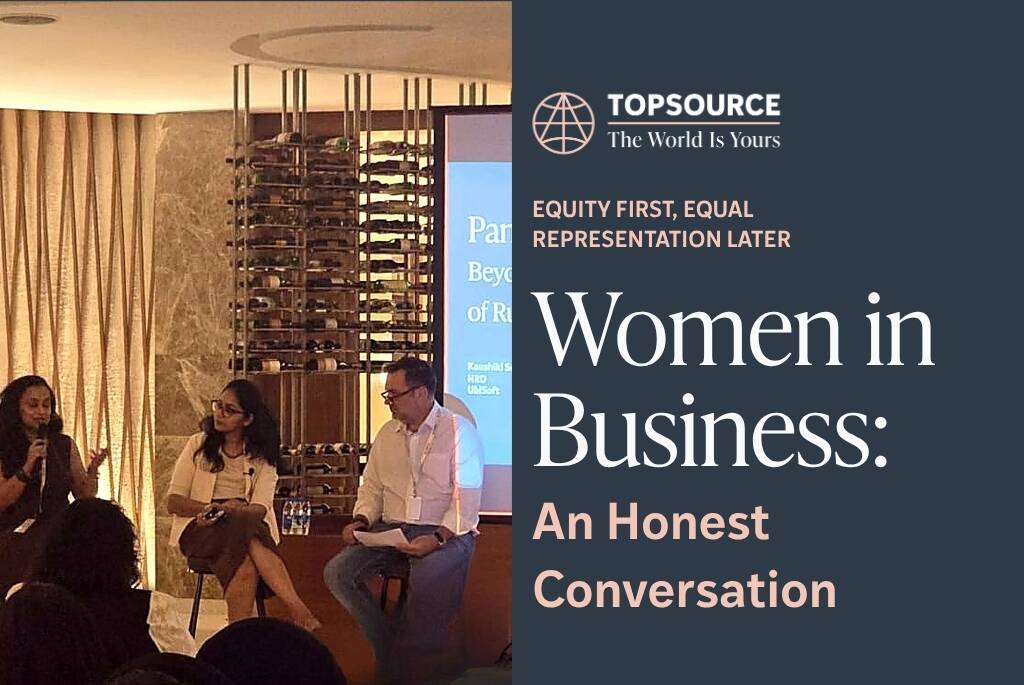
What does the representation of women in business actually look like today, from the perspective of leaders living it day to day? That question sat at the centre of a recent conversation between two senior HR leaders, one from TopSource and one from Ubisoft, and the answers were refreshingly candid rather than polished.
Equity first, equal representation later
The framing that came through was deliberately modest. Equal representation is, right now, a very far edge dream, and the more honest near term goal is equity: building the conditions that let representation actually improve, rather than assuming a level playing field already exists. Industries that have matured further along this curve globally have got there faster than India has, and a lot of that gap comes down to social and cultural context that can’t simply be legislated away.
The clearest example raised was childcare. India has a legal requirement for mandatory daycare provision in organisations above a certain headcount, yet actual compliance is inconsistent. That shows up in a familiar pattern across HR careers more broadly: the same root cause surfacing again and again in exit interviews, where there’s no one at home to look after a child, so she has to step back. This isn’t unique to one company or one industry. It’s a pattern that recurs across an entire career in HR, wherever you sit.
Hybrid work came up as a genuine, if partial, opportunity here. Not a fix in itself, but a tool that, used deliberately, can reduce one of the structural barriers keeping women out of the workforce after a career break.
What deliberate design actually looks like
Two examples stood out as illustrations of what a genuinely engineered approach to representation can achieve, as opposed to something that happens by accident.
In a manufacturing environment historically underrepresented by women, deliberate ecosystem building enabled women to independently run entire production lines. This wasn’t about lowering the bar on performance or qualifications. The real mechanism was redesigning practical constraints like shift timing, so a schedule could align with school pickup times.
At a liquor company, a similarly deliberate effort produced close to 50% female representation on the plant floor, again down to intentional design decisions rather than any general shift in culture.
Media and entertainment came up as a harder case. Bias and implicit harassment remain more present there, and much of it goes unreported. The #MeToo movement opened up a lot of these conversations, necessary but arriving too late for many people who had already left the workforce over experiences they felt they couldn’t keep managing. The shift underway now is that these issues are increasingly treated as a governance and ESG responsibility, rather than purely a policy line item or a diversity ratio to report on. That shift in accountability matters more than the language used around it.
The pipeline problem sits further upstream
One structural point worth flagging is that some of the representation gap isn’t a hiring stage problem at all. It starts with skewed gender ratios in fields like engineering education, long before a hiring decision is even on the table. That means entry level hiring pools are already imbalanced by the time a company’s HR function gets involved.
The right response to that isn’t to lower hiring bars. Hiring should still be merit based. It’s to be deliberate about creating what was described as a launch pad or a soft landing spot: additional structural support that helps women enter and stay in a workforce that wasn’t originally built around their constraints, without treating that support as any kind of compromise on quality.
A smaller point worth remembering
One observation from the conversation had nothing to do with policy at all. It was about how rarely people’s effort gets noticed on an ordinary hard week, the kind with back to back demands and no obvious finish line, and what it does when someone senior simply says so, out loud, before asking for anything else. It’s a small thing to build into how a team operates, and it costs nothing, but it was raised as one of the more effective things either leader had seen in years of trying to make a workplace feel more workable for women specifically, and for everyone more generally.
The common thread
Across the conversation, representation improves through specific, deliberate design decisions, whether that’s shift patterns, launch pad support structures, or governance accountability, rather than through general cultural sentiment alone. None of it is solved. Most of it is a matter of organisations deciding to treat it as a design problem worth solving, rather than a policy statement worth writing once and leaving alone.

