Payroll Services in Australia
Fully managed Australian payroll – STP reported to the ATO on or before every payday, superannuation paid within the 7 business days payday super now requires, award rates and classifications applied correctly, and payroll tax lodged in every state you employ in, with a named specialist a phone call away.
Run through your own Australian entity, with your global view consolidated in Portico.

TopSource rated 5/5 by our customers

What Australian payroll actually involves
Australian payroll is not one system – it is a federal system sitting on top of eight state and territory systems, and the two have never lined up. The ATO takes superannuation and PAYG; eight separate revenue offices take payroll tax at eight different rates and thresholds; eight workers’ compensation schemes and eight long service leave Acts run alongside them. Over 120 modern awards set minimum pay, and since 1 July 2026 superannuation has to reach the fund within 7 business days of every payday rather than 28 days after the quarter. Getting it right is a matter of running many small deadlines perfectly, not one big one.
Our Partners Globally









Calculate Your Employee Costs in Australia
Enter a gross salary to see the full monthly cost of an Australian employee – the 12% superannuation guarantee, payroll tax and workers’ compensation reflected in your total spend per employee.
Employment Cost Calculator
*Indicative figures only and not definitive legal advice. Local regulations change frequently. Consult an expertAustralia
| British Pound | Australia | |
|---|---|---|
| Base Salary (per month) | ||
| Employer Contributions | ||
| Total Cost (Annual) | ||
| Total Cost (Monthly) |
“Their expertise and understanding of the unique hiring, payment, and human resource practices in each country has been nothing short of outstanding. Our Client Success Manager, has done just that … ensured our success. Her availability and willingness to engage on a personal level has made all the difference.”

“Excellent service, especially from our account manager who has gone above and beyond to help us use the platform effectively. Our manager, significantly simplifies my workload. It is like having your own TopSource HR representative on your team.”
“TopSource has been our go-to resource for international hiring. They are responsive, thorough, respectful and knowledgeable. The Client Success team has provided us with the utmost customer service, and the more we use TopSource, the more, it gives us access to more resources and knowledge.”
Employer Costs in Australia Explained
Statutory employer costs in Australia have two layers. The federal layer is the superannuation guarantee – 12% of qualifying earnings, unchanged for 2026–27, now due within 7 business days of every payday. The state layer is payroll tax and workers’ compensation, both set by each state and territory: payroll tax at 4.75%–8.75% on annual wages above thresholds of $1m–$2.5m (your wages bill includes super and fringe benefits), and workers’ compensation premiums averaging 1.34%–1.93% of wages in 2026–27. An employer under the payroll tax threshold carries roughly 13.5% on top of salary. An employer over it carries roughly 19%–21%, depending on the state. On top of both sit award loadings, leave loading and any long service leave liability. Here’s the breakdown.
The superannuation guarantee rate is 12% of qualifying earnings for 2026–27 and is not scheduled to rise further. What changed on 1 July 2026 is the timing: contributions must be received by the fund within 7 business days of the day you pay qualifying earnings. A business day excludes weekends and any public holiday observed across a whole state or territory. A new employee’s first contribution, or the first to a newly chosen fund, gets 20 business days.
The maximum contributions base moved from quarterly to annual: $270,830 for 2026–27 (the $32,500 concessional cap divided by 12%). Once an employee’s qualifying earnings reach it, SG is no longer required for the rest of the year – though award or enterprise agreement super may still be.
Miss the deadline and the new super guarantee charge applies, assessed per payday: the outstanding shortfall, plus notional earnings at the general interest charge rate compounding daily from the 8th business day, plus an administrative uplift of 60% of those two combined (reducible by 20 points if the ATO has not assessed you in two years, and by up to 40 points for voluntary disclosure – so potentially to zero), plus a 25% choice loading capped at $1,200 per notice period per employee where choice-of-fund rules were not followed. Unlike the old SGC, the new charge is tax deductible. The practical consequence is that late super is now expensive within a fortnight rather than a quarter, and voluntary disclosure is worth real money.
Payroll tax is a state and territory tax, and each jurisdiction sets its own threshold, rate and lodgement rules. Taxable wages are broader than salary – they include employer superannuation contributions and the grossed-up value of fringe benefits, plus allowances, bonuses, commissions, termination payments and, in many cases, payments to contractors caught by the relevant contract provisions.
Three things catch employers out. Grouping: related entities with common control, common employees or traced interests are treated as one employer, so one threshold covers the whole group and every member is jointly and severally liable. Apportionment: employ in more than one state and your threshold is split across them in proportion to wages. Surcharges on large payrolls: Victoria adds 1% on national wages over $10m and 2% over $100m (taking the top marginal rate to 6.85%), Queensland’s mental health levy adds 0.25% over $10m and a further 0.5% over $100m, and the NT moves to 6.5% for national wages of $100m or more from 1 July 2026.
Most jurisdictions require monthly returns by the 7th and an annual reconciliation in late July. The ACT cut its threshold from $2m to $1.75m on 1 July 2026 and restructured to five rate bands – the largest single change of any jurisdiction this year, and one that pulled a number of mid-sized Canberra employers into the net for the first time.
Workers’ compensation is state-based, not federal. Victoria, NSW, Queensland and South Australia run public monopoly insurers; WA, Tasmania, the ACT and the NT are privately underwritten. Scheme average premium rates for 2026–27: Queensland 1.343% of wages (held flat for a second year), Victoria 1.8%, South Australia 1.85% (a fourth year unchanged), WA 1.931% (up from 1.823%). NSW has applied a premium freeze capping scheme-level average increases. Your actual rate is industry-classified and claims-experience rated, and premiums are declared against remuneration, so getting remuneration definitions right matters as much as the rate.
Long service leave is legislated separately in every state and territory: 8.67 weeks after 10 years in NSW, Victoria, Queensland, WA and Tasmania; 13 weeks after 10 years in South Australia and the NT; and 6.07 weeks after just 7 years in the ACT – the shortest qualifying period in the country. Pro rata payment on termination typically starts at 7 years.
If you operate in construction, contract cleaning, community services or security, a portable long service leave scheme may apply – NSW’s Long Service Corporation, CoINVEST and the Portable Long Service Authority in Victoria, QLeave, MyLeave, TasBuild, ACT Leave or NT Build – with credits following the worker between employers. It is a levy, not a provision, and it is missed more often than any other Australian payroll obligation.
From the first full pay period on or after 1 July 2026, the national minimum wage is $26.44 per hour, $1,004.90 per 38-hour week – a 6% increase, the first time it has passed $1,000 a week. Modern award minimum rates rose 4.75%, and the 2026 decision also began a three-year phase-out of C13 classifications. Casual employees receive a 25% loading in lieu of leave and notice, taking the casual minimum to $33.05 per hour.
The National Employment Standards give 4 weeks of paid annual leave (5 for defined shiftworkers), 10 days of paid personal/carer’s leave accruing at 1/26th of ordinary hours and carrying over each year, 2 days of compassionate leave per occasion, and 10 days of paid family and domestic violence leave available in full upfront and renewing each anniversary – which must never appear on a payslip. Annual leave loading of 17.5% is not an NES entitlement; it comes from the award or agreement, and most awards pay the greater of the 17.5% loading or the penalties the employee would otherwise have earned, compared across the whole leave period.
Government Paid Parental Leave reached 130 days (26 weeks) for children born or adopted from 1 July 2026, paid at the national minimum wage, with 20 days reserved for each partnered parent. Since 1 July 2025 the ATO also pays 12% superannuation on Government PPL, as a lump sum after year end – no employer action required, but worth knowing when employees ask.
Underpayment in Australia is rarely deliberate; it is almost always a classification or an annualised-salary reconciliation that was never done. Since 1 January 2025, intentional underpayment of wages is a criminal offence under section 327A of the Fair Work Act, carrying up to 10 years’ imprisonment and fines of the greater of $1.565m or three times the underpayment for individuals, and the greater of $7.825m or three times the underpayment for companies. Honest mistakes are not criminal – but the Fair Work Ombudsman’s cooperation agreements and the Voluntary Small Business Wage Compliance Code only help employers who can show their work.
That is what records are for. Payslips must be issued within one working day of payday, even for an employee on leave, and must itemise the ordinary hourly rate, hours at that rate, every loading and allowance separately, each deduction with the fund or account name, and the superannuation amount with the fund name. Employee records must be kept 7 years, in English, legible and accessible to a Fair Work Inspector. Where an employer has not kept records or issued payslips without reasonable excuse, a reverse onus of proof applies – the employer must disprove the underpayment alleged. In practice, records are the defence.
Two further traps. Annualised wage arrangements are only available where the specific award allows them, and require outer limits on penalty and overtime hours, time records signed or acknowledged by the employee each pay period, and reconciliation at least every 12 months and on termination. And since 26 August 2024, whether someone is an employee or a contractor is decided on “the real substance, practical reality and true nature of the working relationship” – not the wording of the contract – with the sham contracting defence tightened from recklessness to reasonableness.
Australian employer contribution rates, 2026–27
| Contribution | Rate | Applies to |
|---|---|---|
| Superannuation guarantee | 12% of qualifying earnings | All eligible employees – must reach the fund within 7 business days of payday |
| Maximum contributions base | $270,830 per year | SG not required on qualifying earnings above this amount for the rest of the year |
| Payroll tax | 4.75% – 8.75% | State and territory tax on your wages bill – includes super and fringe benefits (see table below) |
| Workers’ compensation | 1.343% – 1.931% scheme average | State and territory schemes – industry classified and claims-experience rated |
| Annual leave loading | 17.5% (typical) | Paid on annual leave where the award or agreement provides it – not an NES entitlement |
| Casual loading | 25% | Casual employees, in lieu of paid leave, notice and redundancy |
| Fringe benefits tax | 47% | Grossed-up value of non-cash benefits – FBT year runs 1 April to 31 March |
| Long service leave | 8.67 – 13 weeks | Accrues under state and territory legislation after 7 – 10 years’ service |
| PAYG withholding | 0% – 45% plus 2% Medicare levy | Withheld from the employee and remitted to the ATO – an employee cost, not an employer cost |
Payroll tax by state and territory, 2026–27
| State / Territory | Annual threshold | Rate | Notes |
|---|---|---|---|
| New South Wales | $1,200,000 | 5.45% | No levy or surcharge. Annual reconciliation 28 July |
| Victoria | $1,000,000 | 4.85% metro / 1.2125% regional | Threshold phases out between $3m and $5m. Surcharges add 1% over $10m and 2% over $100m of national wages – top marginal rate 6.85% |
| Queensland | $1,300,000 | 4.75% up to $6.5m; 4.95% above | Deduction reduces $1 for every $7 above $1.3m, nil at $10.4m. Regional employers get a 1% rate discount to 30 June 2030. Mental health levy adds 0.25% over $10m and a further 0.5% over $100m |
| South Australia | $1,500,000 | 0% – 4.95% variable to $1.7m; 4.95% above | Maximum deduction $600,000 |
| Western Australia | $1,000,000 | 5.5% | Diminishing threshold tapers to nil at $7.5m. Higher tiers apply to very large national payrolls |
| Tasmania | $1,250,000 | 4% from $1.25m to $2m; 6.1% above $2m | Annual adjustment return 21 July |
| Australian Capital Territory | $1,750,000 (reduced from $2m on 1 July 2026) | 6.75% ($1.75m–$20m), rising through five bands to 8.75% above $150m | Universities capped at 6.85%. No June monthly return; reconciliation 28 July |
| Northern Territory | $2,500,000 | 5.5%; 6.5% from 1 July 2026 where national wages are $100m or more | Highest threshold in Australia |
In all eight jurisdictions, taxable wages include employer superannuation contributions and the grossed-up value of fringe benefits, and grouping provisions treat related entities as a single employer sharing one threshold.
Rates and thresholds shown are for the 2026–27 financial year and were verified on 27 August 2026. Australian rates change on 1 July, and FBT on 1 April. This page is general information, not tax or legal advice.
How our Australian payroll service works
Why TopSource for Australian Payroll
TopSource for payroll, Employer of Record or any other of our services represents a simpler, more reliable and transparent option.
We don’t hide fees or sneak price increases. We run Australian payroll in-house, not brokered to a local sub-processor – the same team that files your STP answers your calls, in your time zone. You get a named account manager, one consolidated monthly invoice covering salaries, taxes and fees, and one live Portico view of Australia beside every other country we run for you. Portico syncs with your time-tracking, leave and HR systems via API – set up by our onboarding team, not left to yours. GDPR, SOC 2 and ISO 27001 certified.

Other services
Accelerating your growth in Australia and beyond
TopSource goes far beyond payroll, acting as your end-to-end partner in global workforce management. From Employer of Record (EOR) services and seamless entity setup to localized accountancy and fractional HR support, we cover every aspect of international employment.

Meet our experts for Australia
Whether you’re entering the market or scaling operations, our specialists provide the insight and guidance you need to succeed in one of the world’s most dynamic and regulated employment landscapes. With TopSource, you’re backed by real experts, every step of the way.

Beyond a payroll serviceA globalization accelerator
Payroll platform
Global payroll simplified
Your intuitive hub for paying global teams. Simple, powerful, and designed to scale with you — no complexity, just clarity.
Audit
Eliminate barriers to growth
Avoid compliance issues across your global workforce and uncover opportunities to improve profitability. On a quarterly basis we’ll help you audit your global talent strategy to ensure it aligns with your business goals.
Intelligence
Build a data-driven talent strategy
Grow confidently and profitably with access to the latest TopSource insights & data on hiring markets, salary benchmarking & benefits.
Advisory
Expert guidance that turns complexity into clarity.
Whether you’re managing a global acquisition or entering a new market, you get clear guidance to navigate complex decisions, avoid delays, and accelerate your global expansion.



Australian payroll: frequently asked questions
Global Payroll runs through your existing Australian entity, holding an ABN and registered for PAYG withholding. If you don’t have an entity yet, our Employer of Record in Australia employs your people on your behalf, so you can hire before incorporating – and move onto Global Payroll once the entity is live.
It depends on whether you are over the payroll tax threshold in the states where you employ. Under it, statutory employer costs run to roughly 13.5% on top of salary: the 12% superannuation guarantee plus workers’ compensation, which averages 1.343% to 1.931% of wages by scheme in 2026–27.
Over the threshold, add payroll tax at 4.75% to 8.75% depending on the state, and the total lands at roughly 19% to 21%. Note that your payroll tax wages bill includes your superannuation contributions and the grossed-up value of fringe benefits, so it is wider than salary. On top of all of it sit award loadings, the 17.5% annual leave loading where the award provides it, and long service leave accruing in the background.
Until 30 June 2026, superannuation guarantee contributions were due 28 days after the end of each quarter. From 1 July 2026 they must be received by the employee’s fund within 7 business days of the day you pay qualifying earnings. Received, not sent – clearing time is your problem, which is why super now has to run in the same cycle as the pay run rather than after it.
A business day excludes weekends and any public holiday observed across a whole state or territory. A new employee’s first contribution, or the first to a newly chosen fund, gets 20 business days. Miss the deadline and the new super guarantee charge is assessed per payday, with notional earnings compounding daily from the 8th business day and an administrative uplift on top – so late super is now expensive within a fortnight rather than a quarter. Voluntary disclosure can reduce the uplift substantially.
There is no national payroll tax – there are eight. You register in each state or territory where you employ and where your wages exceed that jurisdiction’s threshold. Thresholds range from $1,000,000 in Victoria and Western Australia to $2,500,000 in the Northern Territory, and rates from 4.75% to 8.75%.
Two rules catch employers out. Grouping treats related entities with common control or common employees as a single employer, so one threshold covers the whole group and every member is jointly and severally liable. Apportionment splits your threshold across states in proportion to wages, so employing across borders reduces the allowance in each. Most jurisdictions want monthly returns by the 7th and an annual reconciliation in late July.
Australia has more than 120 modern awards, and coverage is decided by the industry your business operates in and the work the employee actually does – not by the job title on the contract. Within the award it is the classification level that sets the legal minimum rate, along with penalty rates, overtime, allowances and loadings.
Getting classification wrong is the single most common source of underpayment in Australia, and since 1 January 2025 intentional underpayment is a criminal offence. Annualised wage arrangements are only available where the specific award allows them, and require outer limits on hours, time records acknowledged by the employee each pay period, and reconciliation at least every 12 months and on termination. We map every employee before the first pay run and reconcile annualised salaries against actual hours.
Long service leave is an Australian entitlement to extended paid leave after a long period with one employer, legislated separately in every state and territory rather than federally.
Entitlements are 8.67 weeks after 10 years in NSW, Victoria, Queensland, Western Australia and Tasmania; 13 weeks after 10 years in South Australia and the Northern Territory; and 6.07 weeks after just 7 years in the ACT, the shortest qualifying period in the country. Pro rata payment on termination typically starts at 7 years. In construction, contract cleaning, community services and security, a portable scheme may apply instead, with credits following the worker between employers – it is a levy rather than a provision, and it is the obligation most often missed.
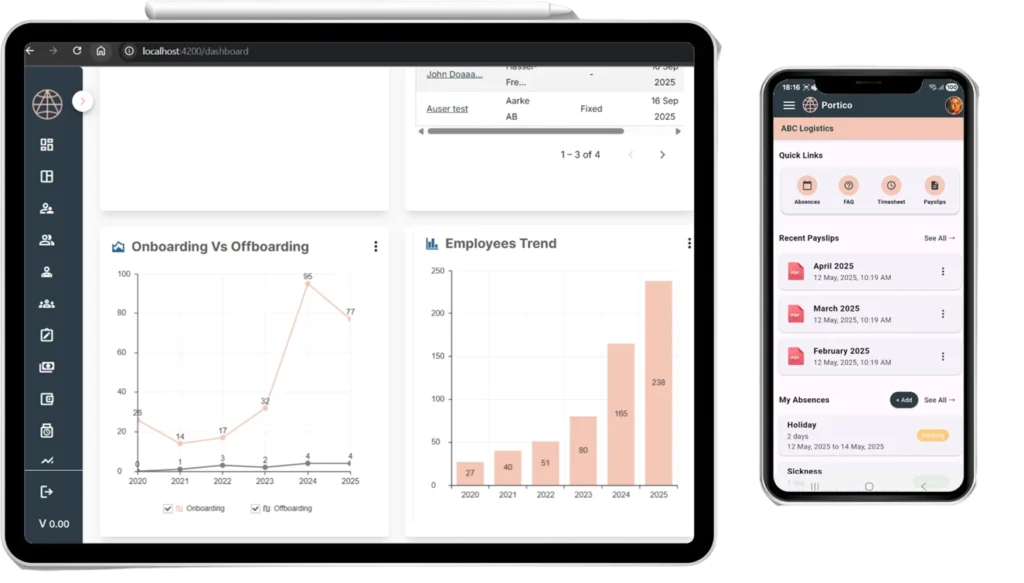
Yes. Superannuation, payroll tax across each state you employ in, and long service leave liability – which accrues quietly for years before it is paid – are standardised into the same consolidated reporting as your other countries, giving you a clearer, forward-looking view of Australian labour cost alongside your broader workforce spend.
Looking at other markets too?
We help organizations employ and pay teams in 164 countries.