Payroll Services in Spain
Fully managed Spanish payroll – social security calculated on the capped base and filed through SILTRA every month, the convenio colectivo that binds you identified and applied, the two pagas extraordinarias handled properly, and IRPF withheld and reconciled, with a named specialist a phone call away.
Run through your own Spanish entity, with your global view consolidated in Portico.

TopSource rated 5/5 by our customers

What Spanish payroll actually involves
Spanish payroll has a reputation for being difficult, and the reason is specific: the statute is only half of it. The Estatuto de los Trabajadores sets the floor, and then a collective agreement you never signed sets your actual pay tables, your actual annual hours and your actual sick-pay liability. Add fourteen payments a year instead of twelve, employer contributions that stop at €61,214, income tax scales that differ by autonomous community and are separate systems entirely in the Basque Country and Navarra, and a working-time register that has to be produced on demand – and precision matters more than volume. In 2026 there is an added complication: three of the year’s rules arrived late and applied retroactively.
Our Partners Globally









Calculate Your Employee Costs in Spain
Enter a gross salary to see the full monthly cost of a Spanish employee – employer social security, the two extra payments and the contribution cap all reflected in your total spend per employee.
Employment Cost Calculator
*Indicative figures only and not definitive legal advice. Local regulations change frequently. Consult an expertSpain
| British Pound | Spain | |
|---|---|---|
| Base Salary (per month) | ||
| Employer Contributions | ||
| Total Cost (Annual) | ||
| Total Cost (Monthly) |
“Their expertise and understanding of the unique hiring, payment, and human resource practices in each country has been nothing short of outstanding. Our Client Success Manager, has done just that … ensured our success. Her availability and willingness to engage on a personal level has made all the difference.”

“Excellent service, especially from our account manager who has gone above and beyond to help us use the platform effectively. Our manager, significantly simplifies my workload. It is like having your own TopSource HR representative on your team.”
“TopSource has been our go-to resource for international hiring. They are responsive, thorough, respectful and knowledgeable. The Client Success team has provided us with the utmost customer service, and the more we use TopSource, the more, it gives us access to more resources and knowledge.”
Employer Costs in Spain Explained
Employer social security in Spain is roughly 32% of gross salary for an office role on an indefinite contract in 2026 – 23.60% for common contingencies, 5.50% for unemployment, 0.20% to the wage guarantee fund, 0.60% for professional training, 0.75% for the MEI, plus an occupational accident premium set by your activity, from 1.50% for office work to 7.15% at the top of the tariff. The employee pays 6.50%. The critical detail is that contributions are capped: they are calculated on a base of no more than €5,101.20 a month, €61,214.40 a year, and above that only the solidarity contribution applies. So the effective employer rate falls from 32% on a €45,000 salary to about 20% on €100,000 – Spain is comparatively expensive for junior hires and comparatively cheap for senior ones. On top of contributions sit the two extra payments, the convenio’s pay tables and sick-pay top-up, and 30 calendar days of holiday. Here’s the breakdown.
For an indefinite full-time contract in 2026 the employer pays 23.60% for contingencias comunes, 5.50% for unemployment, 0.20% to FOGASA, 0.60% for professional training and 0.75% for the MEI – 30.65% before occupational risk. On top sits the AT y EP premium, set by activity: 1.50% for purely office work, around 6.70% for construction, up to 7.15% at the top of the tariff. An office role on an indefinite contract therefore costs about 32.15% of gross salary. A fixed-term contract pays 6.70% for unemployment instead of 5.50%, taking it to roughly 33.35%. The employee pays 6.50%.
Contributions are calculated on a base capped at €5,101.20 per month – up from €4,909.50 in 2025, a 3.9% rise made up of the 2.7% pension revalorisation plus the fixed 1.2 percentage points the 2023 pension reform adds every year to 2050. Above the cap the solidarity contribution applies instead, in three bands: 1.15% total on earnings to 10% above the cap, 1.25% to 50% above it, and 1.46% beyond – of which the employer pays 0.96%, 1.04% and 1.22%. Those bands rise every year to 2045, when they reach 5.50%, 6.00% and 7.00%. The MEI follows the same pattern, from 0.90% in 2026 to 1.20% in 2029.
The change that caught employers out in 2026 was the new AT y EP tariff, rebased from CNAE-2009 to CNAE-2025 and moved into disposición adicional 61ª of the LGSS. Employers that had not notified their CNAE-2025 code to the Tesorería General before 1 January 2026 were automatically assigned the highest rate among their possible codes – and a later notification takes effect only from the following month, with no retroactive correction. If your Spanish entity has never been asked for its CNAE-2025 code, that is worth checking this week.
A convenio colectivo de eficacia general binds every employer and every worker inside its functional and territorial scope. You do not sign it, join it or opt into it – it applies because of what your business does and where it does it. In 2026 there are more than 2,700 agreements with economic effects, covering over 8.6 million workers, and the average agreed increase for the year is around 3%. Sectoral agreements prevail over company agreements on pay in subcontracting, and ultraactividad means an expired agreement survives while it is renegotiated.
What the convenio sets is most of what a payroll actually costs: minimum pay tables by professional group, almost always well above the statutory minimum wage; annual hours, frequently below the 40-hour statutory week; the number and timing of extra payments; seniority payments; shift, travel and tool allowances; the sick-pay top-up; and often notice and severance terms better than the Estatuto de los Trabajadores.
Applying the wrong one is expensive and there is no good-faith defence, because the applicable agreement is determined objectively by activity rather than by the employer’s choice. Salary shortfalls can be claimed for a year per employee with 10% annual interest, contribution bases are regularised up to four years back with surcharges and interest, and the Inspección de Trabajo can fine €751 to €7,500 – commonly treating each affected employee as a separate infraction. Every downstream figure moves too: extra payments, holiday pay, sick-pay top-up and severance are all calculated off the convenio rate.
Income tax withholding is progressive and personal. The state scale for 2026 is unchanged – 19% to €12,450, then 24%, 30%, 37%, 45% and 47% above €300,000, as used in the AEAT withholding algorithm. But each autonomous community sets its own half of the scale, so the same salary produces a different net in Madrid and in Valencia, and the Basque provinces of Álava, Bizkaia and Gipuzkoa and the Comunidad Foral de Navarra run entirely separate tax systems under their own economic agreements, with their own scales, their own forms and their own deadlines.
Withholding is set from each employee’s Modelo 145 declaration of personal and family circumstances, remitted on Modelo 111 – quarterly by the 20th of April, July, October and January, or monthly for large companies with prior-year turnover above €6,010,121.04 – and reconciled annually on Modelo 190 in January. Non-residents without a permanent establishment go on Modelo 216 and 296. For 2026 a new deduction of €590.89 keeps employees on the minimum wage out of income tax altogether, tapering away by about €20,000.
For inbound hires there is the régimen especial de trabajadores desplazados – the Beckham Law. It taxes Spanish employment income at 24% up to €600,000 and 47% above it, for the year of relocation plus the following five, provided the employee was not resident in Spain in the previous five tax years. Since the 2022 startups law it also covers remote workers for foreign employers, company directors, qualifying entrepreneurs and highly qualified professionals, and extends to a spouse and children under 25. It is elected on Modelo 149 and declared on Modelo 151 – and it is a genuine recruitment argument for senior international hires, so it is worth knowing before you make the offer, not after.
The minimum wage for 2026 is €1,221 per month across 14 payments – €17,094 a year – set by Real Decreto 126/2026 and applied retroactively from 1 January. It is a floor that almost no convenio sits on. Holiday is a minimum of 30 calendar days a year, cannot be replaced by payment except on termination, and the employee must know their dates at least two months in advance.
Birth and childcare leave was extended to 19 weeks per parent by Real Decreto-ley 9/2025: six mandatory weeks immediately after the birth, eleven flexible weeks until the child is twelve months, and two paid weeks carved out of the eight-week parental leave, usable until the child is eight. Single-parent families get 32 weeks. It is an individual, non-transferable right per parent, paid at 100% of the base reguladora by the INSS – so no salary from you, but your employer contributions continue. The remaining six weeks of parental leave are unpaid unless the convenio improves them, which is a distinction a great deal of commentary gets wrong.
Then there is the list of paid leaves in article 37.3 of the Estatuto: fifteen calendar days for marriage or registered partnership, five days for the serious illness, hospitalisation or home-rest surgery of a relative to the second degree or a cohabitant needing care, two days for a death and four where travel is required, one day for moving house, an hour a day of nursing leave until the child is nine months, and up to four days where a civil-protection or severe-weather instruction prevents the employee reaching work. Each one is paid, each one has to be recorded, and several were added or extended in the last three years.
There are three routes and the cost of each is fixed by statute. A despido objetivo – economic, technical, organisational or production grounds, ineptitude or failure to adapt – pays 20 days’ salary per year of service, capped at 12 months, with 15 days’ notice, a written letter stating the cause and the compensation available at the same time. A despido improcedente, meaning one a court finds unjustified, pays 33 days per year capped at 24 months for service after 12 February 2012, and 45 days per year for service before it, with a combined ceiling of 42 months. A despido disciplinario that is upheld pays nothing. A dismissal found null means reinstatement, back pay and possible damages.
Where a dismissal is unfair it is the employer who chooses between paying compensation and reinstating – except for employee representatives, where the employee chooses. Defects in the letter or the process make an otherwise sound dismissal unfair, which is why the paperwork matters more in Spain than the reasoning. The employee has 20 working days to file.
One point to watch. In 2024 the European Committee of Social Rights found that Spain’s capped, tariff-based unfair-dismissal compensation breaches article 24 of the European Social Charter, and the Committee of Ministers has repeated the call for reform. No legislation has followed, and in July 2025 the Tribunal Supremo held that article 24 is not directly applicable, closing off court-awarded top-ups above the statutory tariff. So the numbers above are the numbers – but this is live, and any budget for a multi-year Spanish workforce should assume the tariff may be revisited.
Every exit also needs a finiquito: outstanding salary to the leaving date, the pro rata share of both extra payments, accrued untaken holiday, and any notice or end-of-contract indemnity. Signing it does not waive the employee’s right to claim if they mark it “no conforme”.
Spanish employer contribution rates, 2026
| Contribution | Employer | Employee | Total | Applies to |
|---|---|---|---|---|
| Contingencias comunes | 23.60% | 4.70% | 28.30% | Pensions, common illness, maternity – on the capped base |
| Desempleo – contrato indefinido | 5.50% | 1.55% | 7.05% | Unemployment insurance, indefinite contracts |
| Desempleo – contrato temporal | 6.70% | 1.60% | 8.30% | Fixed-term contracts, full or part time |
| FOGASA | 0.20% | — | 0.20% | Wage guarantee fund |
| Formación profesional | 0.60% | 0.10% | 0.70% | Vocational training |
| MEI | 0.75% | 0.15% | 0.90% | Intergenerational equity mechanism – rises to 1.20% by 2029 |
| AT y EP | By activity | — | By activity | Occupational accident and disease – 1.50% office work, ~6.70% construction, 7.15% maximum |
| Employer total, indefinite office role | ≈ 32.15% | 30.65% fixed plus a 1.50% AT y EP premium | ||
| Employee total, indefinite contract | 6.50% | Withheld from gross pay, separate from IRPF | ||
Contribution bases, the cap and the solidarity contribution, 2026
| Item | 2026 figure | Notes |
|---|---|---|
| Base mínima – grupo 1 (graduates, engineers) | €1,989.30 / month | Minimum contribution base by professional group |
| Base mínima – grupos 4 to 7 | €1,424.40 / month | Tracks the minimum wage plus one sixth |
| Base máxima – all groups | €5,101.20 / month (€61,214.40 / year) | Up from €4,909.50 in 2025: 2.7% revalorisation plus a fixed 1.2 points |
| Solidarity contribution – band 1 | 1.15% total (0.96% employer / 0.19% employee) | On monthly pay from €5,101.21 to €5,611.32 |
| Solidarity contribution – band 2 | 1.25% total (1.04% employer / 0.21% employee) | On monthly pay from €5,611.33 to €7,651.80 |
| Solidarity contribution – band 3 | 1.46% total (1.22% employer / 0.24% employee) | On monthly pay above €7,651.80. All three bands rise annually to 2045 |
| Salario mínimo interprofesional | €1,221 / month × 14 pagas = €17,094 / year | Real Decreto 126/2026, retroactive to 1 January 2026 |
| Contratos de muy corta duración (<30 days) | €33.62 one-off | Additional contribution on termination, up from €32.60 |
| Kilometraje, tax exempt | €0.26 / km | Plus justified tolls and parking |
| Dietas, Spain | €26.67 / day without overnight; €53.34 with | Manutención; lodging exempt against receipts |
| Dietas, abroad | €48.08 / day without overnight; €91.35 with | Manutención; lodging exempt against receipts |
Rates are set by Orden PJC/297/2026 and Real Decreto-ley 3/2026, both of which took effect from 1 January 2026 although they were published in the spring. The occupational accident tariff was rebased from CNAE-2009 to CNAE-2025 with effect from 1 January 2026; employers that had not notified their new activity code were assigned the highest applicable rate, correctable only prospectively.
Rates and thresholds shown are for the 2026 calendar year and were verified on 27 August 2026. Spanish contribution rates and the minimum wage are reset annually, sometimes retroactively. This page is general information, not tax or legal advice.
How our Spanish payroll service works
Why TopSource for Spanish Payroll
TopSource for payroll, Employer of Record or any other of our services represents a simpler, more reliable and transparent option.
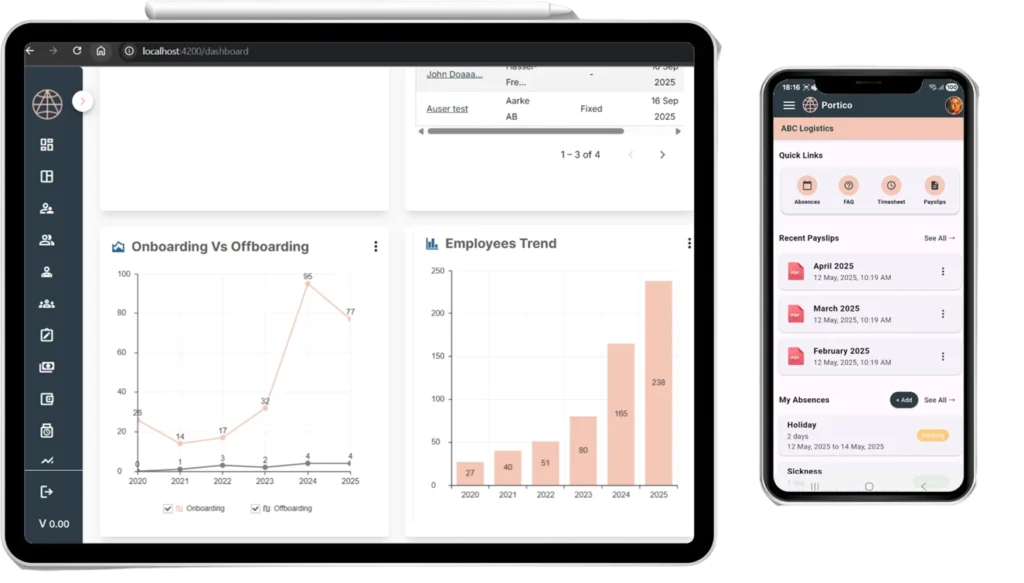
We don’t hide fees or sneak price increases. We run Spanish payroll in-house, not brokered to a local gestoría – the same team that transmits your RNT and RLC answers your calls, in English and Spanish. You get a named account manager, one consolidated monthly invoice covering salaries, contributions and fees, and one live Portico view of Spain beside every other country we run for you. Portico syncs with your time-tracking, leave and HR systems via API – set up by our onboarding team, not left to yours. GDPR, SOC 2 and ISO 27001 certified.

Other services
Accelerating your growth in Spain and beyond
TopSource goes far beyond payroll, acting as your end-to-end partner in global workforce management. From Employer of Record (EOR) services and seamless entity setup to localized accountancy and fractional HR support, we cover every aspect of international employment.

Meet our experts for Spain
Whether you’re entering the market or scaling operations, our specialists provide the insight and guidance you need to succeed in one of the world’s most dynamic and regulated employment landscapes. With TopSource, you’re backed by real experts, every step of the way.

Beyond a payroll serviceA globalization accelerator
Payroll platform
Global payroll simplified
Your intuitive hub for paying global teams. Simple, powerful, and designed to scale with you — no complexity, just clarity.
Audit
Eliminate barriers to growth
Avoid compliance issues across your global workforce and uncover opportunities to improve profitability. On a quarterly basis we’ll help you audit your global talent strategy to ensure it aligns with your business goals.
Intelligence
Build a data-driven talent strategy
Grow confidently and profitably with access to the latest TopSource insights & data on hiring markets, salary benchmarking & benefits.
Advisory
Expert guidance that turns complexity into clarity.
Whether you’re managing a global acquisition or entering a new market, you get clear guidance to navigate complex decisions, avoid delays, and accelerate your global expansion.



Spanish payroll: frequently asked questions
Global Payroll runs through your existing Spanish entity, registered with the Tesorería General de la Seguridad Social and holding a código de cuenta de cotización. If you don’t have an entity yet, our Employer of Record in Spain employs your people on your behalf, so you can hire before incorporating – and move onto Global Payroll once the entity is live.
Employer social security is about 32.15% of gross salary for an office role on an indefinite contract: 23.60% common contingencies, 5.50% unemployment, 0.20% FOGASA, 0.60% professional training, 0.75% MEI, plus a 1.50% occupational accident premium for office work. A fixed-term contract pays 6.70% for unemployment instead of 5.50%, taking it to roughly 33.35%.
The critical detail is the cap. Contributions are calculated on a base of no more than €5,101.20 a month – €61,214.40 a year – and above it only the solidarity contribution applies, at 0.96% to 1.22% for the employer. So the effective employer rate falls from around 32% on a €45,000 salary to about 20% on €100,000: Spain is comparatively expensive for junior hires and comparatively cheap for senior ones.
A convenio colectivo de eficacia general is a collective agreement that binds you automatically, because of what your business does and where it does it. You do not sign it or join it. In 2026 more than 2,700 agreements carry economic effects, covering over 8.6 million workers.
It matters because it sets most of what payroll actually costs: pay tables by professional group that sit well above the minimum wage, annual hours often below the 40-hour week, the number and timing of extra payments, seniority, allowances and the sick-pay top-up. Applying the wrong one has no good-faith defence – the applicable agreement is determined objectively by activity. Shortfalls can be claimed for a year per employee with 10% interest, contribution bases regularised four years back, and the Inspección de Trabajo can fine €751 to €7,500, commonly per employee affected. We identify your convenio before the first pay run.
Spanish employees receive two statutory extra payments on top of twelve monthly salaries – fourteen payments a year – usually in June or July and at Christmas.
Prorating them across twelve payments is lawful only where your convenio permits it. Where the convenio forbids it, the prorated amounts count as ordinary salary and the two pagas are still owed on top – meaning you pay them twice. It is one of the most expensive mistakes a foreign employer makes in Spain, and it is checked before your first pay run.
For ordinary illness the employee receives nothing for the first three days. Days 4 to 15 are paid at 60% of the base reguladora by the employer, at its own cost and not reclaimable from Social Security. From day 16 Social Security takes over, though the payment usually still runs through your payroll as pago delegado and is offset against your contributions.
Most convenios then require the employer to top the benefit up, often to 100% of salary, for a defined period. That top-up is a real and frequently unbudgeted cost, and it is set by your convenio rather than by statute.
The régimen especial de trabajadores desplazados taxes Spanish employment income at a flat 24% up to €600,000 and 47% above it, for the year of relocation plus the following five, provided the employee was not resident in Spain in the previous five tax years.
Since the 2022 startups law it also covers remote workers employed by foreign companies, company directors, qualifying entrepreneurs and highly qualified professionals, and it extends to a spouse and children under 25. It is elected on Modelo 149 and declared on Modelo 151. For senior international hires it is a genuine recruitment argument – worth knowing before you make the offer, not after.
Yes. Spanish extra-payment accruals, the contribution cap and convenio-driven costs, which are easy to under-forecast, are standardised into the same consolidated reporting as your other countries, giving you a clearer, forward-looking view of Spanish labour cost alongside your broader workforce spend.
Looking at other markets too?
We help organizations employ and pay teams in 164 countries.