Payroll Outsourcing in Argentina
Fully managed Argentine payroll: social security contributions and the monthly F.931 return, income tax withheld on ARCA’s 2026 tables, the aguinaldo in June and December and the new severance fund from November, with a named specialist a phone call away.

TopSource rated 5/5 by our customers

What Argentine payroll actually involves
Argentine payroll combines employer social security contributions with health insurance, a 13th salary paid in two halves and income tax (Ganancias) withheld on tables that ARCA updates twice a year. The Labour Modernisation Law of March 2026 changed the severance rules, created a severance fund that starts in November 2026 and cut contributions on qualifying new hires.
Our Partners Globally









Calculate Your Employee Costs in Argentina
Enter 12 months of gross salary to see the employer cost of an Argentine employee in 2026 at a large services or commerce company: 20.40% social security and 6% health insurance with no ceiling, plus the aguinaldo and its contributions. Other private employers pay 18% instead of 20.40%. Workplace accident insurance (ART), priced by each insurer, is not included.
Employment Cost Calculator
*Indicative figures only and not definitive legal advice. Local regulations change frequently. Consult an expertArgentina
| British Pound | Argentina | |
|---|---|---|
| Base Salary (per month) | ||
| Employer Contributions | ||
| Total Cost (Annual) | ||
| Total Cost (Monthly) |
“Their expertise and understanding of the unique hiring, payment, and human resource practices in each country has been nothing short of outstanding. Our Client Success Manager, has done just that … ensured our success. Her availability and willingness to engage on a personal level has made all the difference.”

“Excellent service, especially from our account manager who has gone above and beyond to help us use the platform effectively. Our manager, significantly simplifies my workload. It is like having your own TopSource HR representative on your team.”
“TopSource has been our go-to resource for international hiring. They are responsive, thorough, respectful and knowledgeable. The Client Success team has provided us with the utmost customer service, and the more we use TopSource, the more, it gives us access to more resources and knowledge.”
Employer Costs in Argentina Explained
An Argentine employee costs about 36.9% on top of 12 months’ salary at a large services or commerce company once the aguinaldo is counted, or 34.3% at the 18% rate. Employer contributions apply to the whole salary with no ceiling, so the share does not fall as pay rises. Employee contributions and income tax are withheld from pay. Here’s the breakdown.
Employers pay social security contributions on the whole salary with no ceiling: 20.40% for private employers whose main activity is services or commerce and whose annual sales exceed the limit for a medium-sized company, and 18% for all other private employers. They fund the pension system (SIPA), the pensioners’ health institute (INSSJP, known as PAMI), family allowances and the National Employment Fund. Employers also pay 6% to the employee’s health insurance fund (obra social). A fixed ARS 7,003.68 a month per employee comes off the social security base, an amount set in 2019 and never updated.
Employees contribute 17%: 11% to the pension system, 3% to INSSJP and 3% to their obra social. Their contributions stop at a maximum monthly base that ANSES updates every month and raises by 50% in June and December for the aguinaldo. Every employee must also be covered by workplace accident insurance from an ART insurer, at a rate the insurer sets for the activity.
Every employee earns the sueldo anual complementario (SAC), known as the aguinaldo: a 13th salary paid in two instalments, each worth half of the best monthly salary of the semester, due by 30 June and 18 December. It carries the same contributions as salary.
Annual vacation is 14 calendar days for up to five years of service, 21 days up to ten years, 28 days up to twenty years and 35 days after that, taken between 1 October and 30 April unless both sides agree otherwise. Each vacation day is paid at one twenty-fifth of the monthly salary rather than one thirtieth. Since the 2026 reform, vacation can be split into periods of at least seven days by agreement, with 30 days’ written notice. Overtime is paid at 50% extra on working days and 100% on Saturdays after 1 pm, Sundays and public holidays.
Law 27.802, published on 6 March 2026, rewrote large parts of the Employment Contract Law. Severance is still one month of the best monthly salary per year of service, but the base now excludes payments that are not monthly, such as the aguinaldo, vacation pay and annual bonuses. The cap of three times the average salary of the applicable collective agreement cannot cut the base below 67% of the employee’s salary. Employers no longer owe notice during the probation period, which has been six months since 2024 and can run to eight or twelve months under collective agreements for smaller companies.
The law also created the Labour Assistance Fund (FAL). From the November 2026 payroll, employers pay 1% of salaries, or 2.5% for SMEs, into an account with a fund manager of their choice through the monthly F.931 return, and pay the same amount less in social security contributions. After six months of contributions the fund can pay severance for employees registered for at least 12 months. For workers hired under the RIFL incentive, the FAL contribution is still due but there is no matching discount.
For an employee on ARS 3,000,000 a month at a large services company, the employer pays ARS 612,000 of social security and ARS 180,000 of health insurance: ARS 3,792,000 a month. Thirteen payments a year, counting the aguinaldo, make an annual cost of ARS 49,296,000, or 36.9% on top of 12 months’ salary. At the 18% rate the same employee costs ARS 3,720,000 a month, 34.3% on top. Workplace accident insurance comes on top and depends on the insurer.
The national minimum wage (salario mínimo, vital y móvil) is ARS 391,200 a month for full-time work from 1 October 2026, rising every month to ARS 437,000 in April 2027 under Resolution 4/2026. Collective agreements (convenios colectivos) set their own minimum pay for each job category in their sector.
Employers withhold income tax (Ganancias) every month on a cumulative basis, using the nine-band scale and personal deductions that ARCA updates in January and July in line with inflation. For 2026 an employee’s annual deductions include a non-taxable allowance of ARS 6,019,671 and a special deduction for employees of ARS 28,894,423, plus amounts for a spouse and children, and the top rate of 35% applies above ARS 70,984,968 of net taxable income. Employees report their own deductions to the employer through ARCA’s SiRADIG system.
Employers register each employee in ARCA’s Simplificación Registral system before the first day of work, file the monthly F.931 return and pay contributions in the first half of the following month, and pay salaries into a bank salary account within four working days of the end of the month. Sick pay comes from the employer for up to three months per illness, or six with family dependants, doubling after five years of service. Maternity leave is 90 days, paid by social security rather than the employer.
Argentine employer contributions and payroll costs, 2026
| Contribution | Employer | Employee | Applies to |
|---|---|---|---|
| Pension system (SIPA) and related funds | 20.40% or 18% | 11% | 20.40% for large services and commerce employers |
| Pensioners’ health institute (INSSJP) | Included above | 3% | Employee share up to the monthly cap |
| Health insurance (obra social) | 6% | 3% | Whole salary; employee share up to the cap |
| Labour Assistance Fund (FAL) | 1% or 2.5% | — | From November 2026, offset against contributions |
| Workplace accident insurance (ART) | Set by the insurer | — | Every employee |
| Aguinaldo (13th salary) | Half the best monthly salary, twice a year | — | Due 30 June and 18 December |
| Income tax (Ganancias) | — | 5% to 35% | Withheld monthly on ARCA’s tables |
Argentine income tax scale for 2026
| Annual net taxable income (ARS) | Fixed tax (ARS) | Plus, on the excess |
|---|---|---|
| Up to 2,336,954 | 0 | 5% |
| 2,336,954 to 4,673,907 | 116,848 | 9% |
| 4,673,907 to 7,010,861 | 327,174 | 12% |
| 7,010,861 to 10,516,292 | 607,608 | 15% |
| 10,516,292 to 21,032,583 | 1,133,423 | 19% |
| 21,032,583 to 31,548,875 | 3,131,518 | 23% |
| 31,548,875 to 47,323,312 | 5,550,265 | 27% |
| 47,323,312 to 70,984,968 | 9,809,363 | 31% |
| Above 70,984,968 | 17,144,476 | 35% |
Employer cost of monthly salaries in Argentina, 2026
| Monthly salary | Social security 20.40% | Health insurance 6% | Monthly cost | Annual cost with aguinaldo | On top of 12 months’ salary |
|---|---|---|---|---|---|
| ARS 1,500,000 | ARS 306,000 | ARS 90,000 | ARS 1,896,000 | ARS 24,648,000 | 36.9% |
| ARS 3,000,000 | ARS 612,000 | ARS 180,000 | ARS 3,792,000 | ARS 49,296,000 | 36.9% |
| ARS 6,000,000 | ARS 1,224,000 | ARS 360,000 | ARS 7,584,000 | ARS 98,592,000 | 36.9% |
The income tax scale is ARCA’s annual 2026 table, rounded to the peso. The cost table uses the 20.40% rate for large services and commerce employers before the fixed ARS 7,003.68 monthly deduction; at the 18% rate the cost is 34.3% on top of 12 months’ salary. Workplace accident insurance is not included. These are TopSource calculations from the verified 2026 rates.
Rates, scales and amounts shown are for 2026 and were verified on 5 October 2026 against Law 27.541, Law 27.802, Decree 315/2026, ARCA’s 2026 income tax tables, Resolution 4/2026 on the minimum wage and published tax sources. This page is general information, not tax or legal advice.
How our Argentine payroll service works
Why Outsource Your Argentina Payroll to TopSource
TopSource for payroll, Employer of Record or any other of our services represents a simpler, more reliable and transparent option.
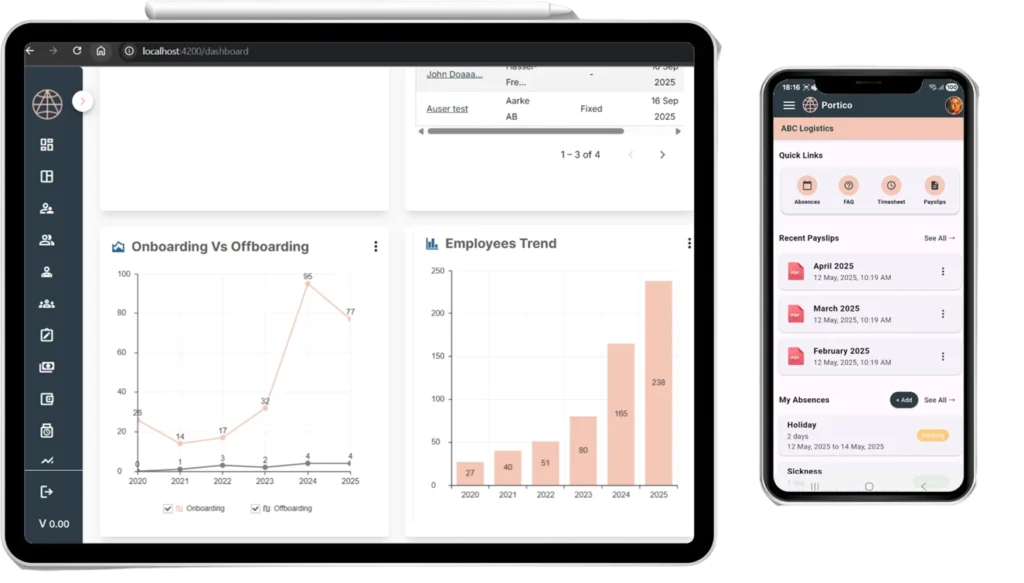
We don’t hide fees or sneak price increases. We run Argentine payroll in-house and file under your own CUIT rather than a bureau’s, so the same team that files your monthly F.931 returns answers your calls. You get a named account manager, one consolidated monthly invoice covering salaries, contributions, taxes and fees, and one live Portico view of Argentina beside every other country we run for you. Portico syncs with your time-tracking, leave and HR systems via API – set up by our onboarding team, not left to yours. GDPR, SOC 2 and ISO 27001 certified.

Other services
Accelerating your growth in Argentina and beyond
TopSource goes far beyond payroll, acting as your end-to-end partner in global workforce management. From Employer of Record (EOR) services and seamless entity setup to localized accountancy and fractional HR support, we cover every aspect of international employment.

Meet our experts for Argentina
Whether you’re entering the market or scaling operations, our specialists provide the insight and guidance you need to succeed in one of the world’s most dynamic and regulated employment landscapes. With TopSource, you’re backed by real experts, every step of the way.

Beyond a payroll serviceA globalization accelerator
Payroll platform
Global payroll simplified
Your intuitive hub for paying global teams. Simple, powerful, and designed to scale with you — no complexity, just clarity.
Audit
Eliminate barriers to growth
Avoid compliance issues across your global workforce and uncover opportunities to improve profitability. On a quarterly basis we’ll help you audit your global talent strategy to ensure it aligns with your business goals.
Intelligence
Build a data-driven talent strategy
Grow confidently and profitably with access to the latest TopSource insights & data on hiring markets, salary benchmarking & benefits.
Advisory
Expert guidance that turns complexity into clarity.
Whether you’re managing a global acquisition or entering a new market, you get clear guidance to navigate complex decisions, avoid delays, and accelerate your global expansion.



Argentine payroll FAQs
Large private employers in services and commerce pay 20.40% social security and 6% health insurance, 26.4% in total. All other private employers pay 18% plus 6%, 24% in total. Employer contributions apply to the whole salary with no ceiling, and workplace accident insurance (ART) is extra.
Employees contribute 17% of salary: 11% to the pension system, 3% to INSSJP and 3% to their health insurance fund. Employee contributions stop at a maximum monthly base that ANSES updates every month.
The aguinaldo, or sueldo anual complementario, is a 13th salary paid in two instalments due by 30 June and 18 December. Each is half of the best monthly salary of the semester, and it carries the same contributions as salary.
The FAL, created by Law 27.802, helps employers pay severance. From the November 2026 payroll, employers pay 1% of salaries, or 2.5% for SMEs, into an account they hold with an authorised fund manager, and their social security contributions fall by the same amount.
Law 27.802 of March 2026 took the aguinaldo, vacation pay and other non-monthly payments out of the severance base, removed notice during probation, allowed vacation to be split into periods of at least seven days and created the FAL severance fund. It also cut employer social security to 5% for 48 months on qualifying hires made between May 2026 and April 2027.
Employment income is taxed on a nine-band scale from 5% to 35%. For 2026 the top rate applies above ARS 70,984,968 of annual net taxable income, after deductions that include a non-taxable allowance of ARS 6,019,671 and a special deduction for employees of ARS 28,894,423.
The national minimum wage is ARS 391,200 a month for full-time work from 1 October 2026, rising each month to ARS 437,000 in April 2027 under Resolution 4/2026. Collective agreements set their own minimum pay for each job category.
Dismissal without cause after probation costs one month of the best monthly, normal and habitual salary per year of service or fraction over three months, with a minimum of one month. The base is capped at three times the average salary of the collective agreement, but never below 67% of the employee’s salary. Notice of one or two months, or pay in lieu, also applies.
Employers file the monthly F.931 return and pay social security contributions to ARCA in the first half of the following month, on a date set by the last digit of their CUIT. From the November 2026 period the same return also carries the FAL contribution.
Registering as an employer with ARCA requires a local entity, such as an Argentine company or a registered branch. Without one, the usual route is an Employer of Record. TopSource can run payroll for your Argentine entity or employ your team through our Employer of Record service.
Looking at other markets too?
We help organizations employ and pay teams in 164 countries.