Payroll Services in Ireland
Fully managed Irish payroll – PRSI applied at the right rate on both sides of the 1 October 2026 step, PAYE and USC submitted to Revenue on or before every pay date, the monthly statement of account reviewed and accepted rather than left to be deemed, and My Future Fund contributions remitted to NAERSA on the pay run rather than a month later, with a named specialist a phone call away.
Filed under your own Revenue registration, not a provider’s, with your global view consolidated in Portico.

TopSource rated 5/5 by our customers

What Irish payroll actually involves
Irish payroll is administratively light and technically sharp. There is one tax authority, one social insurance system, one currency and no regional variation – no state taxes, no provincial insurances, no collective bargaining structure that binds an employer by sector. What there is instead is a set of thresholds that behave unusually. Employer PRSI has no ceiling but does have a cliff at €552 a week, where crossing the line re-rates the whole period. USC has a cliff too, at €13,000 of total income. The tax year is the calendar year, but PRSI rates step on 1 October. There is no payroll return, because the real-time submission is the return and it is deemed filed on the 14th whether you look at it or not. And since 1 January 2026 there is a second statutory system running alongside Revenue, with its own notifications and its own remittance cycle. Get the thresholds and the two cycles right and Irish payroll is genuinely straightforward. Get them wrong and the errors are quiet ones.
Our Partners Globally









Calculate Your Employee Costs in Ireland
Enter a gross annual salary to see the full employer cost of an Irish employee – employer PRSI and the My Future Fund auto-enrolment contribution, included in your total spend per employee. There is no employer PRSI ceiling, so the effective rate stays flat as salary rises rather than falling away as it does in most of Europe. For a 2026 budget use the blended employer rate of 11.2875%, which is nine months at 11.25% and three at 11.40%.
Employment Cost Calculator
*Indicative figures only and not definitive legal advice. Local regulations change frequently. Consult an expertIreland
| British Pound | Ireland | |
|---|---|---|
| Base Salary (per month) | ||
| Employer Contributions | ||
| Total Cost (Annual) | ||
| Total Cost (Monthly) |
“Their expertise and understanding of the unique hiring, payment, and human resource practices in each country has been nothing short of outstanding. Our Client Success Manager, has done just that … ensured our success. Her availability and willingness to engage on a personal level has made all the difference.”

“Excellent service, especially from our account manager who has gone above and beyond to help us use the platform effectively. Our manager, significantly simplifies my workload. It is like having your own TopSource HR representative on your team.”
“TopSource has been our go-to resource for international hiring. They are responsive, thorough, respectful and knowledgeable. The Client Success team has provided us with the utmost customer service, and the more we use TopSource, the more, it gives us access to more resources and knowledge.”
Employer Costs in Ireland Explained
Employer statutory cost in Ireland is about 12.8% of salary for a Class A1 employee in 2026, and unlike most countries it does not fall as salary rises. Employer PRSI is 11.25% until 30 September 2026 and 11.40% from 1 October, charged on the whole of reckonable pay with no upper ceiling at all – where Spain’s employer contribution falls from roughly 32% to under 9% as its ceiling bites, and the United States falls from about 9% to 6%, Ireland stays flat. Auto-enrolment adds 1.5% of gross earnings from the first euro to €80,000, which is the only reason the effective rate declines above that point. Below the €552 weekly threshold the employer rate is 9.00% rising to 9.15%, giving a total of about 10.5% – so the single largest structural feature of Irish employer cost is a 2.3-point step that falls entirely on part-time and lower-paid employment. What is not in these figures is worth saying too: there is no employer-funded long-term sick pay, and no employer obligation whatsoever to pay for maternity, paternity, parent’s or adoptive leave. Here’s the breakdown.
Employer PRSI in Ireland is charged at one of two rates, and which one applies is decided by the employee’s gross earnings in the pay period. Until 30 September 2026 the higher rate is 11.25% on weekly earnings above €552, and the lower rate is 9.00% at or below it. From 1 October 2026 those become 11.40% and 9.15% under the Government’s multi-year PRSI roadmap, which the Department of Social Protection’s Advance Notice for 2026 states will raise all PRSI rates by a further 0.15 percentage points on that date. The employee Class A rate moves from 4.20% to 4.35% at the same time. The 1% National Training Fund Levy is inside those employer figures, not on top of them – it is collected as part of the employer PRSI charge and payroll software does not split it out.
The steps after this one are legislated, not forecast, and that is worth knowing for a five-year model. The Social Welfare (Miscellaneous Provisions) Act 2024 sets out the successive rates in a table and commences each one in turn: employer Class A1 goes to 11.55% on 1 October 2027 and 11.75% on 1 October 2028, the lower employer rate to 9.30% and then 9.50%, and the employee rate to 4.50% and then 4.70%. Those are the published figures with the 1% National Training Fund Levy included. An Irish headcount model built on 11.25% is wrong by half a point by 2028, and every one of those Octobers is a mid-year rate change driven by pay date.
The €552 weekly threshold rose from €527 on 1 January 2026, and the Department of Social Protection said plainly why: the National Minimum Wage was going to €14.15 an hour on the same date, and the threshold was lifted to keep full-time minimum-wage employment out of the higher employer band. The arithmetic is tighter than that sounds. €14.15 × 39 hours is €551.85 – fifteen cent of headroom. For a large part of the retail, hospitality, security, cleaning and care workforce, anything at all in a given week tips the employee into the higher band: an hour of overtime, a Sunday premium, a shift allowance, a commission payment, the €1.27 hourly board offset where meals are provided, or a fortnight’s holiday pay paid in a single week.
What makes this expensive rather than merely annoying is that the threshold is a cliff. Cross it and the higher rate applies to the entire period’s earnings, not the excess. At €551 a week the employer pays €49.59 of PRSI; at €553 it pays €62.21. The €2 rise has cost €12.62, a marginal employer PRSI rate of 631%. There is no annual smoothing and no year-end reconciliation of employer PRSI, so an employer that overpays because of a lumpy bonus does not get it back. The practical response is to spread notional pay evenly across all pay periods rather than applying an annual benefit in kind in one month – an employer that applies health insurance or a small car benefit in a single period pushes otherwise-lower-rate employees into the higher band for that period, on all of their earnings.
The split year matters most outside payroll. Revenue’s rule is that a payment is reported when it is made, regardless of when it was earned, and the PRSI rate follows the same logic. A fortnightly period running 21 September to 4 October and paid on 9 October is charged entirely at 11.40%, September days included, with no apportionment. Payroll software handles this correctly. What breaks is the accrual: an employer PRSI accrual built from period-worked data rather than pay-date data will understate the September-worked, October-paid liability, and it will do so again in October 2027 and October 2028. A bonus pay date moved from late September to early October adds 0.15 points of employer and employee PRSI to the whole payment.
Employer PRSI plus auto-enrolment is roughly 12.8% on top of salary for a Class A1 employee in 2026, and it barely moves with salary because Ireland has no employer PRSI ceiling. There is no upper earnings limit and no cap: 11.25% rising to 11.40% applies to the whole of reckonable pay however high it goes. That is unusual. Spain’s employer contribution falls from about 32% to under 9% as the contribution ceiling bites; the United States falls from about 9% to 6%. Ireland does not fall, and the only reason the effective rate declines at all above €80,000 is that the auto-enrolment contribution stops there.
The 2026 auto-enrolment layer adds 1.5% of gross earnings from the first euro to €80,000, for employees aged 23 to 60 earning €20,000 or more a year who are not already in a qualifying scheme. That is a maximum of €1,200 per employee this year. It is not a static cost: the employer rate steps to 3% in the fourth year of the scheme, 4.5% in the seventh and 6% from the tenth, so an employer modelling Irish headcount over a five-year horizon should be modelling 3%, not 1.5%.
Below the threshold the picture is different and better. An employee on €26,000 – €500 a week, comfortably under €552 – attracts employer PRSI at 9.00% rising to 9.15%, and the total employer statutory cost is about 10.5% of salary. Cross into Class A1 and it jumps to about 12.8%. That 2.3-point step is the largest single structural feature of Irish employer cost, and it falls entirely on part-time and lower-paid employment.
Two things are not in any of those figures. Employer PRSI is not charged on statutory redundancy payments, which are exempt from income tax, USC and PRSI. And Ireland has no employer-funded statutory sick pay beyond the five days under the Sick Leave Act 2022, and no employer obligation at all to pay for maternity, paternity, parent’s or adoptive leave – the State pays those benefits at €299 a week and the employer’s cost is whatever top-up it chooses to offer. Compared with jurisdictions where the employer funds long-term sickness, that is a material saving, and it is rarely in the comparison.
Auto-enrolment contributions began on 1 January 2026. The Automatic Enrolment Retirement Savings System Act 2024 was commenced by S.I. No. 439/2025, the National Automatic Enrolment Retirement Savings Authority was established by S.I. No. 475/2025, and the scheme is branded My Future Fund. Phase one runs for three years at 1.5% employee, 1.5% employer and a 0.5% State top-up, giving 3.5% of gross earnings in total. It escalates to 3%/3%/1% in the fourth year, 4.5%/4.5%/1.5% in the seventh, and 6%/6%/2% from the tenth.
Anyone importing UK assumptions will get three things wrong. First, there is no qualifying earnings band. UK contributions are calculated on the slice of earnings between a lower and an upper limit; Irish contributions are calculated on gross earnings from the first euro up to €80,000. The €20,000 figure decides whether an employee is enrolled, not what the contribution is charged on – an employee on €21,000 pays 1.5% of €21,000, which is €315, not 1.5% of €1,000. Second, there is no tax relief on employee contributions: they come out of net pay after PAYE, USC and PRSI, and the State top-up of €1 for every €3 replaces relief. For a 40% taxpayer that is materially worse than an occupational scheme or PRSA, and payroll and HR should expect to explain it repeatedly. Third, the €80,000 ceiling applies in the pay period in which cumulative earnings breach it, and the excess is not refunded, so a high earner with a large first-quarter bonus can stop contributing in March.
The change that has caught employers out is the exemption test. An employment is exempt where the employee already contributes to a pension through payroll – but since 1 January 2026 that exemption is subject to minimum contribution standards. A defined contribution scheme or PRSA must provide an employer contribution of at least 1.5% of gross pay or €1,200 a year, whichever is lower, and a combined employer and employee contribution of at least 3.5% or €2,800, whichever is lower. A legacy scheme with a 1% employer contribution no longer exempts anybody: the employee is auto-enrolled and the employer pays My Future Fund contributions on top of the existing scheme unless the scheme is upgraded. Defined benefit schemes remain exempt where they confer a long-term benefit based on continuing employment, including non-contributory ones.
Operationally it is a second parallel system, and that is the part most implementation plans missed. Contributions are driven by an Automatic Enrolment Payroll Notification retrieved from NAERSA – the auto-enrolment analogue of a Revenue Payroll Notification – and they must be remitted at the same time the employee is paid, which is a different cycle from the Revenue payment on the 14th or 23rd of the following month. Two notification feeds, two remittances, two portals. Employers who built a single diary entry for statutory remittances have missed one. Opting out is only possible in months seven and eight of participation, with a further two-month window six months after each rate increase; outside those windows an employee can suspend but not opt out, and suspension stops the employer contribution too. Taking any action that hinders participation, including inducing an employee to opt out, is an offence.
Irish payroll withholds three things from the employee: income tax at 20% up to the standard rate cut-off point and 40% above it, the Universal Social Charge on a four-band scale, and employee PRSI. For 2026 the standard rate band is €44,000 for a single person, €48,000 for a single person child carer and €53,000 for a one-income married couple, with a transferable increase of up to €35,000 for two-income couples giving a maximum of €88,000. The main credits are €2,000 for a single person and €2,000 for the employee PAYE credit. Bands and credits were unchanged from 2025.
USC for 2026 runs at 0.5% on the first €12,012, 2% to €28,700, 3% to €70,044 and 8% above that, with a full exemption below €13,000 of total income. The 2% ceiling was lifted from €27,382 specifically so that a full-time worker on the €14.15 minimum wage stays out of the 3% band. Note that the €13,000 exemption is a cliff, not an allowance – exceed it and USC is charged from the first euro. A reduced two-band scale of 0.5% and 2% applies to over-70s and full medical card holders with total income of €60,000 or less, extended to the end of 2027 in Budget 2026; the employee has to contact Revenue to have it applied, so it arrives as an amended RPN mid-year rather than automatically.
All of it is driven by the Revenue Payroll Notification. The RPN carries the employee’s credits, standard rate cut-off point, USC rates and cut-offs, any local property tax deducted at source, pay and deductions from a previous ceased employment in the same year, and any exclusion order in force. Compliant payroll software retrieves the latest RPN over Revenue’s API before every run. Where none is available, the emergency basis applies: with a PPSN, a weekly cut-off of €846.16 and no credits for the first four weeks, then 40% on everything; without a PPSN, 40% from day one, and 8% USC throughout.
Two failure modes recur. The first is the stale RPN: Revenue issues amended notifications continuously, and a run processed from a cached file applies superseded credits – most visibly where a medical card USC reduction, a mid-year marriage or a second employment has just been notified. The second is the employment ID collision. Where an employee has, or has had, more than one employment with the same employer, each needs a distinct employment ID; reusing one merges the two employments and corrupts the cumulative basis. And a point that generates more HR escalations than anything else in Irish payroll: Illness Benefit is taxed centrally by reducing the employee’s credits and cut-off on the RPN, not through payroll. An employee paid full salary through a long absence will see net pay fall with gross pay unchanged, retrospectively across the year on the cumulative basis, and will be certain payroll has made an error. It has not.
Statutory sick leave is five paid days a year, and the increase did not happen. The Sick Leave Act 2022 set out a path to seven and then ten days, but in April 2025 the Minister for Enterprise, Tourism and Employment announced the entitlement would remain at five, on the basis that five days strikes the right balance. The rate is 70% of normal daily earnings capped at €110 a day, after 13 weeks’ service, on a certified basis only. It is taxable payroll pay and goes through the pay run normally – unlike Illness Benefit, which cannot run concurrently with it. Employers who pay five days of statutory sick leave and also let the employee claim Illness Benefit for the same days have created an overpayment the employee will be asked to repay.
Annual leave is four working weeks, calculated as the greater of three statutory computations under section 19 of the Organisation of Working Time Act 1997: four weeks where the employee works at least 1,365 hours in the leave year, one-third of a working week for each month in which they work at least 117 hours, or 8% of hours worked capped at four weeks. There are ten public holidays, and Ireland has no statutory substitute-day mechanism – St Stephen’s Day falls on Saturday 26 December in 2026, and employees who do not normally work Saturdays are entitled to one-fifth of a week’s pay or a day in lieu at the employer’s choice, not an automatic Monday off. Many employers grant a substitute day contractually; that is a contractual benefit, not a statutory one.
Working time records are the most consequential record-keeping obligation in Irish employment law, and the reason is section 25(4) of the 1997 Act: where no records are kept, the burden of proof in a Workplace Relations Commission working-time claim shifts to the employer. In practice the employee’s account is accepted unless the employer can produce records in the form prescribed by S.I. No. 473 of 2001, retained for three years. Separately, statutory sick leave records must be kept for four years, with a fine up to €2,500 for failure, and domestic violence leave records for three.
On benefits, two rules do most of the work. The small benefit exemption allows up to five non-cash benefits a year with a combined value not exceeding €1,500, and it is the first five in chronological order that qualify – a €50 voucher in January uses one of the five and cannot be swapped later for a €500 one. And company car benefit in kind changed on 1 January 2026: Finance Act 2025 introduced a new Category A1 for zero-emission vehicles at 15% of original market value falling to 6% at high business mileage, and put the temporary OMV reduction on a statutory taper of €10,000 in 2026, €5,000 in 2027 and €2,500 in 2028. The additional electric vehicle reduction is €20,000 in 2026 and €10,000 in 2027, and it ends on 31 December 2027. An EV with an OMV of €45,000 and 20,000 business kilometres has a cash equivalent of €2,250 in 2026 and €6,375 in 2028 – a legislated increase that most fleet budgets have not absorbed. Finally, where employees hold employment permits, the Minimum Annual Remuneration thresholds rose on 1 March 2026 to €36,605 for a General Employment Permit and €40,904 for a Critical Skills Permit with a relevant degree, tested on basic salary excluding bonuses and benefits – so a reduction in hours or a move to a lower grade puts the permit at risk, and payroll is usually the first function to see it.
Irish employer contribution rates, 2026
| Contribution | Employer | Employee | Applies to |
|---|---|---|---|
| Employer PRSI – Class A1 | 11.25% to 30 Sep 2026, then 11.40% | — | Weekly earnings above €552. Includes the 1% National Training Fund Levy |
| Employer PRSI – Class A0/AX/AL | 9.00% to 30 Sep 2026, then 9.15% | — | Weekly earnings from €38 up to €552 |
| Employee PRSI – Class A | — | 4.20% to 30 Sep 2026, then 4.35% | Nil at or below €352 a week. No upper ceiling |
| PRSI employee credit | — | Up to €12 a week | Subclass AX only, €352.01 to €424.00. Tapers by one-sixth of earnings above €352.01 |
| Employer PRSI – Class J | 0.70% to 30 Sep 2026, then 0.85% | Nil | Reckonable pay under €38 a week, subsidiary employment, and people born before 1 January 1958 |
| Auto-enrolment – My Future Fund | 1.5% | 1.5% | Gross earnings from the first euro to €80,000. Ages 23 to 60 earning €20,000 or more. State adds 0.5% |
| Universal Social Charge | — | 0.5% / 2% / 3% / 8% | Bands at €12,012, €28,700 and €70,044. Full exemption below €13,000 of total income |
| Income tax | — | 20% / 40% | Standard rate cut-off €44,000 single, €53,000 one-income married, up to €88,000 two-income |
| Statutory sick pay | 70% of daily pay, capped €110/day | — | Five days a year after 13 weeks’ service, certified only. Sick Leave Act 2022 |
| Maternity, paternity, parent’s, adoptive | No statutory obligation | — | State pays €299 a week. Employer top-up is discretionary |
| Statutory redundancy | Two weeks per year plus one bonus week | — | Weekly earnings ceiling €600. Exempt from income tax, USC and PRSI |
| Total employer statutory cost | ≈ 10.5% below the threshold, ≈ 12.8% above | — | No employer PRSI ceiling. See the cost table below |
The 1 October 2026 PRSI step, in one table
| Item | To 30 September 2026 | From 1 October 2026 | Note |
|---|---|---|---|
| Employer PRSI Class A1 | 11.25% | 11.40% | Blended full-year rate 11.2875% |
| Employer PRSI lower rate | 9.00% | 9.15% | Applies to weekly earnings from €38 to €552 |
| Employee PRSI Class A | 4.20% | 4.35% | No upper ceiling on employee PRSI either |
| Employer PRSI Class J | 0.70% | 0.85% | Subsidiary employment and pre-1958 births |
| Class S self-employed | 4.20% | 4.35% | Blended 4.2375% for 2026 income, filed in 2027 |
| Employer PRSI threshold | €552 a week | €552 a week | Unchanged by the October step. Rose from €527 on 1 January 2026 |
| Trigger | Pay date on or before 30 September 2026 | Pay date on or after 1 October 2026 | Period worked is irrelevant. No apportionment |
| Next step – 1 October 2027 | — | +0.15 points | Employer A1 reaches 11.55%. Legislated by the Social Welfare (Miscellaneous Provisions) Act 2024 |
| Next step – 1 October 2028 | — | +0.20 points | Employer A1 reaches 11.75%, the lower rate 9.50% and the employee rate 4.70% |
| What to do about it | Pay discretionary bonuses on or before 30 September | Rebuild accruals on a pay-date basis | And budget 11.2875%, not 11.25% |
What an employee actually costs, by salary
| Salary | Weekly equivalent | Employer PRSI | Auto-enrolment | Total | Effective rate |
|---|---|---|---|---|---|
| €26,000 | €500.00 | €2,349.75 | €390.00 | €2,739.75 | 10.54% |
| €28,704 | €552.00 | €2,594.12 | €430.56 | €3,024.68 | 10.54% |
| €30,000 | €576.92 | €3,386.25 | €450.00 | €3,836.25 | 12.79% |
| €40,000 | €769.23 | €4,515.00 | €600.00 | €5,115.00 | 12.79% |
| €50,000 | €961.54 | €5,643.75 | €750.00 | €6,393.75 | 12.79% |
| €70,000 | €1,346.15 | €7,901.25 | €1,050.00 | €8,951.25 | 12.79% |
| €100,000 | €1,923.08 | €11,287.50 | €1,200.00 | €12,487.50 | 12.49% |
| €150,000 | €2,884.62 | €16,931.25 | €1,200.00 | €18,131.25 | 12.09% |
Employer PRSI is the blended 2026 rate – nine months at 11.25% or 9.00% and three at 11.40% or 9.15%, which is 11.2875% for Class A1 and 9.0375% below the threshold. The €28,704 row is €552 × 52, and it is there to show the cliff: one euro more and the effective rate moves from 10.54% to 12.79%. Above €80,000 the effective rate falls only because auto-enrolment stops – employer PRSI itself never does. Figures assume twelve equal monthly payments with no bonus or notional pay moving the subclass in any period, and auto-enrolment applying in full. Employer PRSI subclass is decided on the gross earnings of each pay period alone, with no annual smoothing and no year-end reconciliation, so an employer that pays the higher rate because of a bonus does not recover it. The monthly equivalent of the €552 weekly threshold is €2,392 and the fortnightly equivalent is €1,104; employers who move an employee between pay frequencies mid-year, or who run an off-cycle payment, are the ones who most often get the subclass wrong.
Rates, thresholds and benefit amounts shown are for the 2026 calendar year and were verified on 8 September 2026. PRSI rates change on 1 October 2026 and both sets are shown. USC bands, tax credits, the National Minimum Wage and State benefit rates change on 1 January following Budget day, which is 6 October 2026 for the 2027 year. Employment permit remuneration thresholds changed on 1 March 2026 and are on a published roadmap of further increases. This page is general information, not tax or legal advice.
How our Irish payroll service works
Why TopSource for Irish Payroll
TopSource for payroll, Employer of Record or any other of our services represents a simpler, more reliable and transparent option. If you would rather not employ staff in Ireland directly, our Employer of Record in Ireland can employ them on your behalf.
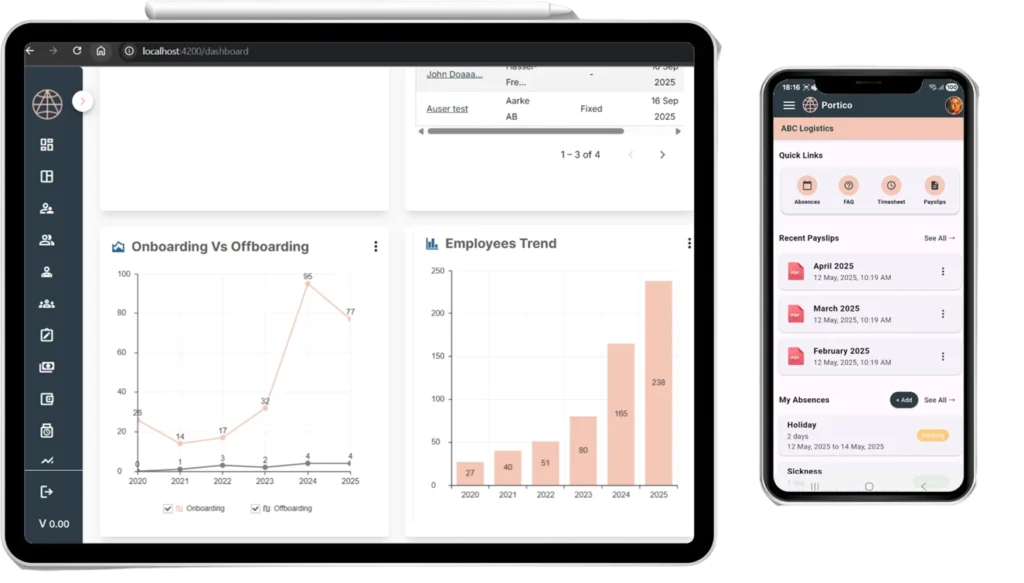
We don’t hide fees or sneak price increases. We run Irish payroll in-house and file under your own Revenue employer registration rather than a provider’s, so the same team that accepts your monthly statement answers your calls. You get a named account manager, one consolidated monthly invoice covering salaries, PRSI, taxes and fees, and one live Portico view of Ireland beside every other country we run for you. Portico syncs with your time-tracking, leave and HR systems via API – set up by our onboarding team, not left to yours. GDPR, SOC 2 and ISO 27001 certified.

Other services
Accelerating your growth in Ireland and beyond
TopSource goes far beyond payroll, acting as your end-to-end partner in global workforce management. From Employer of Record (EOR) services and seamless entity setup to localized accountancy and fractional HR support, we cover every aspect of international employment.

Meet our experts for Ireland
Whether you’re entering the market or scaling operations, our specialists provide the insight and guidance you need to succeed in one of the world’s most dynamic and regulated employment landscapes. With TopSource, you’re backed by real experts, every step of the way.

Beyond a payroll serviceA globalization accelerator
Payroll platform
Global payroll simplified
Your intuitive hub for paying global teams. Simple, powerful, and designed to scale with you — no complexity, just clarity.
Audit
Eliminate barriers to growth
Avoid compliance issues across your global workforce and uncover opportunities to improve profitability. On a quarterly basis we’ll help you audit your global talent strategy to ensure it aligns with your business goals.
Intelligence
Build a data-driven talent strategy
Grow confidently and profitably with access to the latest TopSource insights & data on hiring markets, salary benchmarking & benefits.
Advisory
Expert guidance that turns complexity into clarity.
Whether you’re managing a global acquisition or entering a new market, you get clear guidance to navigate complex decisions, avoid delays, and accelerate your global expansion.



Irish payroll FAQs
Employer PRSI is 11.25% of gross pay for Class A1 employees until 30 September 2026 and 11.40% from 1 October 2026, on weekly earnings above €552. Below that threshold the employer rate is 9.00% rising to 9.15%. Both figures include the 1% National Training Fund Levy. There is no upper ceiling – the rate applies to the whole of reckonable pay however high the salary. The correct blended employer rate for the full 2026 calendar year is 11.2875%.
All PRSI rates rise by 0.15 percentage points on 1 October 2026 under the Government’s multi-year PRSI roadmap, confirmed in the Department of Social Protection’s Advance Notice for 2026. It is a pre-existing roadmap commitment rather than a Budget 2026 measure, and the further steps are already legislated by the Social Welfare (Miscellaneous Provisions) Act 2024: employer Class A1 goes to 11.55% on 1 October 2027 and 11.75% on 1 October 2028. The rate that applies is determined by the pay date, not the period worked, so a September payroll paid on 1 October is charged entirely at the new rate with no apportionment.
The employer PRSI threshold is €552 of gross earnings a week, rising from €527 on 1 January 2026. It is a cliff rather than a marginal band: cross it and the higher employer rate applies to all of that period’s earnings, not just the excess. At €551 a week the employer pays €49.59; at €553 it pays €62.21. The monthly equivalent is €2,392 and the fortnightly equivalent is €1,104. A full-time employee on the €14.15 minimum wage working 39 hours earns €551.85, which is fifteen cent below the line.
My Future Fund is Ireland’s auto-enrolment retirement savings scheme, live since 1 January 2026 under the Automatic Enrolment Retirement Savings System Act 2024. The employer pays 1.5% of gross earnings for the first three years, matched by the employee, with a 0.5% State top-up. Contributions are calculated from the first euro of gross earnings up to €80,000 a year – a maximum of €1,200 per employee in 2026 – for employees aged 23 to 60 earning €20,000 or more. The employer rate rises to 3% in year four, 4.5% in year seven and 6% from year ten.
Only if it meets the minimum contribution standards that took effect on 1 January 2026. A defined contribution scheme or PRSA must provide an employer contribution of at least 1.5% of gross pay or €1,200 a year, whichever is lower, and a combined employer and employee contribution of at least 3.5% or €2,800, whichever is lower. A legacy scheme paying 1% from the employer no longer exempts anyone – the employee is auto-enrolled and the employer pays My Future Fund contributions in addition, unless the scheme is upgraded. Defined benefit schemes remain exempt, including non-contributory ones.
A payroll submission must reach Revenue on or before the date employees are paid, and that submission is the return – there is no separate P30 or P35. Revenue generates a monthly statement of account by the 5th of the following month; if the employer has not accepted it by close of business on the 14th it is deemed to be the statutory return. Payment is due on the 14th, or the 23rd for ROS filers paying online. Corrections made after the statement is accepted or deemed produce an amended return and may attract interest, which runs at 0.0274% a day on employer income tax, PRSI and USC – roughly 10% a year.
The National Minimum Wage is €14.15 an hour for employees aged 20 and over from 1 January 2026, set by S.I. No. 472 of 2025 under the National Minimum Wage Act 2000. Sub-rates are €12.74 at age 19, €11.32 at age 18 and €9.91 under 18 – 90%, 80% and 70% of the full rate. The 60%-of-median Living Wage that was to replace the minimum wage in 2026 has not been delivered and there is no Living Wage statutory instrument; the National Minimum Wage remains the statutory floor.
Irish employers must provide five paid sick days a year at 70% of normal daily earnings, capped at €110 a day, for employees with at least 13 weeks’ continuous service, on a certified basis only. The entitlement stayed at five days – the increase to seven and then ten days set out in the Sick Leave Act 2022 was not commenced, and in April 2025 the Minister confirmed it would remain at five. Statutory sick pay is taxable payroll pay and cannot run concurrently with Illness Benefit, which is paid by the State after three waiting days and taxed by reducing the employee’s tax credits.
The statutory minimum is four working weeks a year, plus ten public holidays. Entitlement is the greater of three computations under section 19 of the Organisation of Working Time Act 1997: four weeks where the employee works at least 1,365 hours in the leave year; one-third of a working week for each calendar month in which they work at least 117 hours; or 8% of hours worked, capped at four weeks. Leave pay is paid in advance at the normal weekly rate, accrues during certified sick leave and family leave, and must be paid out on termination.
Statutory redundancy is two weeks’ gross pay for each year of service plus one additional week, subject to a ceiling of €600 a week on reckonable earnings, after two years of continuous insurable employment. A 20-year employee therefore receives 41 × €600, or €24,600, which is the practical maximum. Statutory redundancy is exempt from income tax, USC and PRSI. The €600 ceiling has been unchanged for many years and sits well below average earnings, so enhanced schemes are the norm among larger employers.
Looking at other markets too?
We help organizations employ and pay teams in 164 countries.