Payroll Services in Hong Kong
Fully managed Hong Kong payroll – MPF run on eMPF now that every trustee has moved onto it, every statutory payment calculated on the twelve-month average with the disregarding provisions applied properly, the IR56 series filed on the IRD’s calendar, and the post-May 2025 long service liability provisioned rather than discovered.

TopSource rated 5/5 by our customers

What Hong Kong payroll actually involves
Hong Kong payroll is simpler than most and distinctive in ways that catch foreign employers out. There is no PAYE at all – the employer withholds no tax and the employee is assessed directly and pays their own bill, so a Hong Kong payroll is really gross-pay administration plus MPF plus statutory reporting. The employer’s only mandatory contribution is 5% into the Mandatory Provident Fund, capped at HK$1,500 a month, so statutory cost falls away sharply as salary rises. Against that, almost every statutory payment is calculated on twelve months of average wages rather than on basic salary. And three structural things changed recently: MPF offsetting was abolished on 1 May 2025, the continuous contract test changed on 18 January 2026, and eMPF replaced the trustees’ separate platforms in May 2026. None of it is hard. Almost all of it is recent.
Our Partners Globally









Calculate Your Employee Costs in Hong Kong
Enter a gross annual salary to see the employer’s mandatory MPF contribution in Hong Kong for 2026: 5% of relevant income, capped at HK$1,500 a month or HK$18,000 a year. It is the only statutory employer contribution. Compulsory employees’ compensation insurance is priced by the insurer and is not included, and neither is the severance and long service liability that has accrued since 1 May 2025.
Employment Cost Calculator
*Indicative figures only and not definitive legal advice. Local regulations change frequently. Consult an expertHong Kong
| British Pound | Hong Kong | |
|---|---|---|
| Base Salary (per month) | ||
| Employer Contributions | ||
| Total Cost (Annual) | ||
| Total Cost (Monthly) |
“Their expertise and understanding of the unique hiring, payment, and human resource practices in each country has been nothing short of outstanding. Our Client Success Manager, has done just that … ensured our success. Her availability and willingness to engage on a personal level has made all the difference.”

“Excellent service, especially from our account manager who has gone above and beyond to help us use the platform effectively. Our manager, significantly simplifies my workload. It is like having your own TopSource HR representative on your team.”
“TopSource has been our go-to resource for international hiring. They are responsive, thorough, respectful and knowledgeable. The Client Success team has provided us with the utmost customer service, and the more we use TopSource, the more, it gives us access to more resources and knowledge.”
Employer Costs in Hong Kong Explained
Employer statutory cost in Hong Kong is 5% of relevant income into the MPF, capped at HK$1,500 a month – so it falls from 5% of salary at the bottom of the range to 0.75% at HK$2.4 million, because the contribution stops rising while the salary does not. The maximum relevant income is HK$30,000 a month and has not changed since June 2014. There is no social security contribution beyond MPF, no employer health levy, no statutory thirteenth month and no tax withholding. The cost that did change is one nobody had before: since 1 May 2025 an employer can no longer offset severance or long service payment with its mandatory MPF contributions for service from that date, so an un-offsettable liability of up to HK$15,000 per year of service now accrues. Compulsory employees’ compensation insurance sits on top and is priced by the insurer, not by statute. Here’s the breakdown.
Hong Kong’s mandatory employer cost is 5% of relevant income into the Mandatory Provident Fund, and it caps. The maximum relevant income is HK$30,000 a month, so employer and employee contributions each stop at HK$1,500 a month – HK$18,000 a year. That maximum has been unchanged since 1 June 2014 and the minimum of HK$7,100 since November 2013. Both are under statutory review, but no new figures have been adopted, and numbers circulating in the press are proposals rather than law.
Because the contribution caps, the employer’s MPF cost as a percentage of salary falls away above HK$360,000 a year: 5.00% up to that point, 3.75% at HK$480,000, 2.50% at HK$720,000, 1.50% at HK$1.2 million and 0.75% at HK$2.4 million. On statutory cash cost alone, Hong Kong is one of the cheapest places to employ a senior person.
One asymmetry catches small employers every time. Where relevant income is below HK$7,100 a month, the employee contributes nothing – but the employer still pays its 5%. The same shape applies at the start of employment: the employee makes no contribution for the first 30 days, and enrolment can wait 60 days, but the employer’s liability accrues from day one.
Two exemptions matter commercially. Employees aged under 18 or 65 and over are outside MPF, as are members of MPF-exempted ORSO schemes. And people who come to Hong Kong to work for not more than 13 months, or who are covered by an overseas retirement scheme, can be exempt – which is why many secondees sit outside MPF. That exemption has to be claimed rather than assumed.
On 1 May 2025 Hong Kong abolished the use of employer mandatory MPF contributions to offset severance payment and long service payment. It is the largest change to Hong Kong payroll economics in a generation, and it is not retrospective. It did not remove the employer’s existing offset entitlement – it froze it. Service before 1 May 2025 remains offsettable, indefinitely. Service from that date onward is not.
That produces a two-portion calculation with two different wage bases in the same sum. The pre-transition portion uses the last full month’s wages immediately before 1 May 2025 – the April 2025 figure – permanently frozen, times two-thirds, for years before the transition. The post-transition portion uses the last full month’s wages before termination, on the same two-thirds basis, for years from 1 May 2025. Both use a monthly wage ceiling of HK$22,500, giving HK$15,000 per year of service, and the two together are capped at HK$390,000.
The trap in the cap is which portion it squeezes. Where the two portions together exceed HK$390,000, the excess comes off the post-transition portion – the part the employer cannot offset. So the cap does not relieve the new exposure; it relieves the grandfathered one. What an employer now has to provision for is an accruing, un-offsettable liability of up to HK$15,000 for every post-transition year of service: ten years is HK$150,000 per employee at any salary above HK$270,000.
Two things make this harder in practice. The pre-transition portion cannot be calculated at all without the April 2025 monthly wage for every employee in service then, and employers who did not capture it have a data-recovery problem that gets harder every year. And the Government’s 25-year subsidy scheme shares part of the post-transition cost, most generously in its first years – but only if the employer claims it.
Every significant statutory payment in Hong Kong is calculated on the employee’s average wages over the preceding twelve months. Holiday pay and annual leave pay use the twelve-month average daily wage. Sickness allowance, maternity leave pay and paternity leave pay use four-fifths of it. The end-of-year payment and payment in lieu of notice use the twelve-month average. None of them uses basic salary, and none of them uses the current month.
What counts as wages is broader than most foreign employers assume: all remuneration, earnings, allowances, tips and service charges capable of expression in money, including commission and attendance allowances. Overtime counts where it is constant, or where its monthly average over the preceding twelve months is at least 20% of average monthly wages. Excluded are the employer’s MPF contributions, genuinely discretionary bonuses, the value of accommodation, food or medical care, and expense reimbursements.
The commission point is the classic Labour Tribunal claim. A salesperson’s annual leave pay and holiday pay must include twelve months of commission, and paying basic salary only is unlawful underpayment.
The disregarding provisions are the part that actually goes wrong. When computing the twelve-month average, the employer must exclude both the period and the wages paid for it for any time the employee was not paid, or was paid less than full wages – rest days, holidays, annual leave, sickness days, maternity and paternity leave and similar. Leave a part-paid sick month in the denominator and the average comes out too low, so every downstream entitlement is underpaid. Both halves have to come out.
Hong Kong has no pay-as-you-earn system. The employer does not deduct salaries tax and does not remit it. The employee is assessed directly and pays their own tax, normally in two instalments, on a year of assessment running 1 April to 31 March. What the employer does instead is report – and, in exactly one situation, withhold.
Salaries tax is charged at the lower of two calculations. The progressive rates run 2%, 6%, 10%, 14% and then 17% on the remainder, in bands of HK$50,000 of net chargeable income after allowances. The standard rate applies to net income with no allowances and has been two-tiered since 2024/25: 15% on the first HK$5 million and 16% above that. The basic allowance rose from HK$132,000 to HK$145,000 for 2026/27, so any source still showing HK$132,000 is out of date for the current year.
The reporting cycle is fixed. The IRD issues the BIR56A on the first working day of April and the employer files it with an IR56B for every employee within one month. An IR56E is due within three months of a new employee starting and an IR56F one month before an employee leaves. An IR56M covers payments to people who are not employees – consultants, freelancers and sub-contractors.
The departing-employee rule is the one withholding obligation and the most operationally dangerous item on this page. An employee leaving Hong Kong for more than a month requires an IR56G at least one month before departure – and from then the employer must withhold all money payable to that person, final pay and bonus included, for one month or until the IRD issues a letter of release, whichever is earlier. An employer that pays the leaver out anyway can be held liable for the unpaid tax.
The statutory floor in Hong Kong is low and the market rate is not. Annual leave starts at 7 days after a year of service and rises one day a year to 14 days at nine years, while market practice for a professional role is well above that. There is one rest day in every seven. Notice is one month where the contract is silent.
Holidays are where foreign employers make an expensive contractual error, because Hong Kong has two lists. General holidays are the bank-holiday list of 17 days, used by banks, schools and public offices – and granted by most white-collar contracts. Statutory holidays are the Employment Ordinance minimum: 15 in 2026, rising to 16 in 2028 and 17 in 2030, when the two lists converge. A payroll configured to the statutory list against a contract promising general holidays is underpaying.
Sickness allowance is not an annual allotment that resets. Employees accumulate paid sickness days at two a month in the first year and four a month after that, up to 120 days held at any time, and a sickness day qualifies only as part of an absence of four or more consecutive days. A payroll system with a resetting annual entitlement is structurally wrong for Hong Kong.
Maternity leave is 14 weeks at four-fifths of the twelve-month average daily wage for an employee with at least 40 weeks’ continuous employment. The employer pays all fourteen weeks and then reclaims weeks 11 to 14 from the Government, capped at HK$80,000 – so it is cash-flow negative first, and employers who never file the claim lose the money. Paternity leave is five days on the same four-fifths basis.
Hong Kong employer contribution rates, 2026
| Contribution | Employer | Employee | 2026 detail |
|---|---|---|---|
| MPF mandatory contribution | 5% | 5% | Of relevant income. Maximum relevant income HK$30,000 a month |
| MPF – maximum per side | HK$1,500 a month | HK$1,500 a month | HK$18,000 a year each. Unchanged since 1 June 2014 |
| MPF – below the minimum | 5% still due | Nil | Below HK$7,100 a month the employee pays nothing; the employer still pays 5% |
| MPF – enrolment deadline | — | — | Within 60 days. Employer liability starts on day one |
| MPF – contribution day | — | — | The 10th of each month, for the previous month |
| MPF – employee contribution holiday | — | Nil for 30 days | First 30 days of employment |
| Salaries tax withholding | None | — | No PAYE. The employee is assessed directly by the IRD |
| Salaries tax – progressive rates | — | 2/6/10/14/17% | On net chargeable income, in bands of HK$50,000 |
| Salaries tax – standard rate | — | 15% / 16% | 15% on the first HK$5 million of net income, 16% above. The lower calculation applies |
| Basic allowance | — | HK$145,000 | From 2026/27, up from HK$132,000 |
| Employees’ compensation insurance | Market-priced | — | Compulsory. Minimum cover HK$100 million up to 200 employees, HK$200 million above |
| Statutory minimum wage | HK$43.1 an hour | — | From 1 May 2026, up from HK$42.1. Now reviewed every year |
| Severance / long service payment | 2/3 of monthly wage per year | — | Wage capped at HK$22,500, so HK$15,000 per year. Overall maximum HK$390,000 |
| SP/LSP – service from 1 May 2025 | Not offsettable | — | Cannot be offset by employer mandatory MPF contributions |
| SP/LSP – service before 1 May 2025 | Offsettable | — | At the frozen April 2025 wage. Grandfathered indefinitely |
Severance and long service payment after 1 May 2025 – the two-portion calculation
| Element | Pre-transition portion | Post-transition portion | Why it matters |
|---|---|---|---|
| Service counted | Before 1 May 2025 | From 1 May 2025 onward | The split is by date, not by contract |
| Wage base | Last full month before 1 May 2025, frozen | Last full month before termination | Two different wage bases in one sum |
| Formula | 2/3 × wage × years | 2/3 × wage × years | Incomplete years pro-rated in both |
| Monthly wage ceiling | HK$22,500, so HK$15,000 a year | HK$22,500, so HK$15,000 a year | The same cap applies to both |
| Offsettable by employer mandatory MPF? | Yes, indefinitely | No | This is the whole reform |
| Offsettable by employer voluntary MPF or gratuities? | Yes | Yes | Unaffected, and routinely forgotten |
| Overall maximum HK$390,000 exceeded | Unaffected | The excess comes off here | The cap bites on the part the employer cannot offset |
| Government subsidy | None | 25-year scheme from 1 May 2025 | Post-transition portion only, and only if claimed |
| Record the employer must hold | The April 2025 wage for everyone in service then | Ordinary wage records | Without it the first portion cannot be computed |
Employer MPF by salary, 2026
| Annual salary | Employer MPF | % of salary | SP/LSP accrual per year of service |
|---|---|---|---|
| HK$180,000 | HK$9,000 | 5.00% | HK$10,000 |
| HK$360,000 | HK$18,000 | 5.00% | HK$15,000 |
| HK$480,000 | HK$18,000 | 3.75% | HK$15,000 |
| HK$720,000 | HK$18,000 | 2.50% | HK$15,000 |
| HK$1,200,000 | HK$18,000 | 1.50% | HK$15,000 |
| HK$2,400,000 | HK$18,000 | 0.75% | HK$15,000 |
Relevant income for MPF includes wages, salary, leave pay, fees, commission, bonus, gratuity, perquisites and allowances, but excludes severance and long service payment. The salary table shows employer MPF at 5% of relevant income capped at HK$18,000 a year, and the severance or long service accrual for each post-transition year of service at two-thirds of monthly wages capped at HK$22,500. The accrual is a provision, payable only on qualifying termination. Employees’ compensation insurance is compulsory but priced by the insurer against the activity, so it is not included. These are TopSource calculations from the 2026 rates, not published figures.
Rates, thresholds and statutory amounts shown are for 2026 and, for tax, the 2026/27 year of assessment, and were verified on 24 September 2026. The statutory minimum wage now changes every 1 May, announced in February, and statutory holidays step up to 16 in 2028 and 17 in 2030. The MPF minimum and maximum relevant income levels are under statutory review. Employees’ compensation insurance is compulsory but market-priced. This page is general information, not tax or legal advice.
How our Hong Kong payroll service works
Why TopSource for Hong Kong Payroll
TopSource for payroll, Employer of Record or any other of our services represents a simpler, more reliable and transparent option. If you would rather not employ staff in Hong Kong directly, our Employer of Record in Hong Kong can employ them on your behalf.
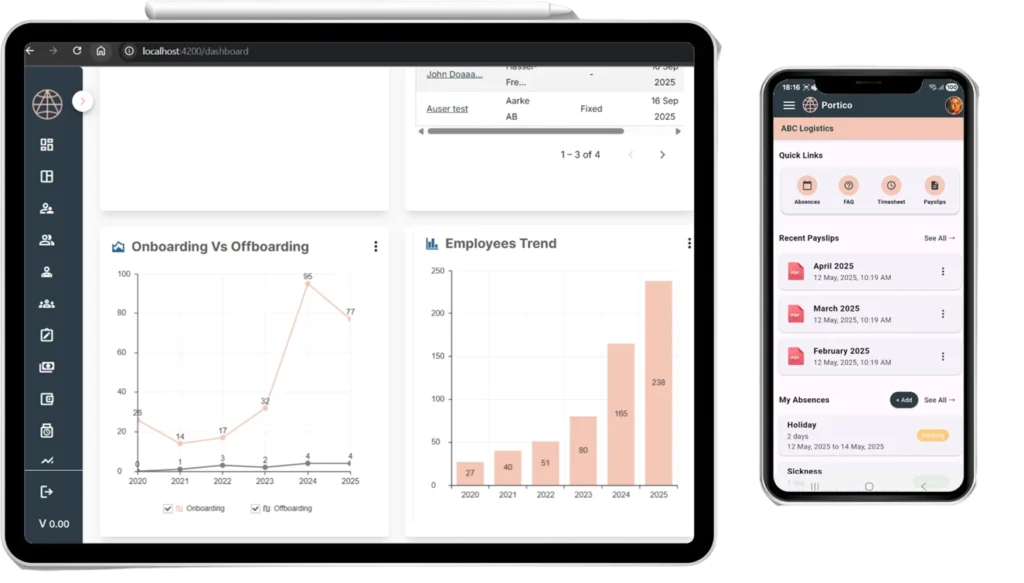
We don’t hide fees or sneak price increases. We run Hong Kong payroll in-house and file under your own employer’s file with the Inland Revenue Department rather than a pooled bureau registration, so the same team that submits your IR56B answers your calls. You get a named account manager, one consolidated monthly invoice covering salaries, MPF, insurance and fees, and one live Portico view of Hong Kong beside every other country we run for you. Portico syncs with your time-tracking, leave and HR systems via API – set up by our onboarding team, not left to yours. GDPR, SOC 2 and ISO 27001 certified.

Other services
Accelerating your growth in Hong Kong and beyond
TopSource goes far beyond payroll, acting as your end-to-end partner in global workforce management. From Employer of Record (EOR) services and seamless entity setup to localized accountancy and fractional HR support, we cover every aspect of international employment.

Meet our experts for Hong Kong
Whether you’re entering the market or scaling operations, our specialists provide the insight and guidance you need to succeed in one of the world’s most dynamic and regulated employment landscapes. With TopSource, you’re backed by real experts, every step of the way.

Beyond a payroll serviceA globalization accelerator
Payroll platform
Global payroll simplified
Your intuitive hub for paying global teams. Simple, powerful, and designed to scale with you — no complexity, just clarity.
Audit
Eliminate barriers to growth
Avoid compliance issues across your global workforce and uncover opportunities to improve profitability. On a quarterly basis we’ll help you audit your global talent strategy to ensure it aligns with your business goals.
Intelligence
Build a data-driven talent strategy
Grow confidently and profitably with access to the latest TopSource insights & data on hiring markets, salary benchmarking & benefits.
Advisory
Expert guidance that turns complexity into clarity.
Whether you’re managing a global acquisition or entering a new market, you get clear guidance to navigate complex decisions, avoid delays, and accelerate your global expansion.



Hong Kong payroll FAQs
Employer statutory cost in Hong Kong is 5% of relevant income into the MPF, capped at HK$1,500 a month – HK$18,000 a year – because the maximum relevant income is HK$30,000 a month. So it falls from 5% of salary at the bottom of the range to 0.75% at HK$2.4 million, because the contribution stops rising while the salary does not. Compulsory employees’ compensation insurance sits on top, priced by the insurer. Since 1 May 2025 there is also an accruing severance and long service liability of up to HK$15,000 per year of service that can no longer be offset by employer MPF contributions, and it should be provisioned.
No. The maximum relevant income is still HK$30,000 a month, unchanged since 1 June 2014, and the minimum is HK$7,100, unchanged since November 2013 – so mandatory contributions still cap at HK$1,500 a month on each side. Both levels are under statutory review, but no new figures have been adopted. Figures circulating in the press are proposals, not law, and should not be used for budgeting.
From 1 May 2025 an employer can no longer use its mandatory MPF contributions to offset severance or long service payment for service from that date – but the change is not retrospective. Service before 1 May 2025 remains offsettable, indefinitely, calculated on the last full month’s wages before the transition date, permanently frozen. Service from 1 May 2025 uses the wage at termination and cannot be offset. Employer voluntary contributions and gratuities still offset both portions. Where the two together exceed the HK$390,000 maximum, the excess comes off the post-transition portion – the part the employer cannot offset.
No. Hong Kong has no pay-as-you-earn system: the employer does not deduct salaries tax and does not remit it to the Inland Revenue Department. The employee is assessed directly and pays their own tax, normally in two instalments, on a year of assessment running 1 April to 31 March. The employer reports through the IR56 series and deducts MPF rather than tax. A new hire’s first tax bill can arrive more than eighteen months after they start, so telling employees what is coming is part of running Hong Kong payroll properly.
The 713 rule is the requirement, in force since 13 July 2007, that statutory entitlements in Hong Kong are calculated on the employee’s average wages over the preceding twelve months rather than on basic salary or current pay. It covers holiday pay, annual leave pay, sickness allowance, maternity and paternity leave pay, the end-of-year payment and payment in lieu of notice. Wages include commission and overtime that is constant or averages at least 20% of monthly pay. Any period paid at less than full wages must be excluded – both the days and the wages paid for them.
The IR56 series is how a Hong Kong employer reports remuneration, since there is no tax withholding. The IRD issues the BIR56A on the first working day of April and the employer files it within one month with an IR56B for every employee. An IR56E is due within three months of a new employee starting, an IR56F one month before an employee leaves, and an IR56G one month before an employee leaves Hong Kong for more than a month – which also triggers a duty to withhold money payable to them. An IR56M reports payments to people who are not employees.
Yes, and the minimum cover is high. Every employer must hold employees’ compensation insurance covering its liability under the Employees’ Compensation Ordinance and at common law, with minimum cover of HK$100 million per event for up to 200 employees and HK$200 million above that. Employing anyone without it is an offence carrying a fine of HK$100,000 and up to two years’ imprisonment. It is bought from a commercial insurer and priced against the activity, so there is no generic rate.
It depends which list applies, and Hong Kong has two. Statutory holidays are the Employment Ordinance minimum and there are 15 in 2026, rising to 16 in 2028 and 17 in 2030, when the two lists converge. General holidays are the bank-holiday list of 17 days, used by banks, schools and public offices, and they are what most white-collar contracts grant. A contract that promises public holidays has almost certainly granted the longer list, and a payroll configured to the statutory 15 against such a contract is underpaying.
The statutory minimum wage is HK$43.1 an hour from 1 May 2026, up from HK$42.1. The more important change is structural: Hong Kong has moved from a two-yearly review to an annual formula-based one, and the 2026 rate was the first set under it. Employers can now expect a change every 1 May, announced in February. The monthly wage above which an employer need not keep total-hours records also rose, to HK$17,600.
Maternity leave is 14 weeks, with up to four further unpaid weeks for illness arising from pregnancy. An employee with at least 40 weeks of continuous employment before the leave is paid at four-fifths of her twelve-month average daily wage. The employer pays all fourteen weeks and then reclaims weeks 11 to 14 from the Government, capped at HK$80,000 – so it is a cash-flow event before it is a cost, and employers who never file the claim lose the money. Dismissing an employee from confirmation of pregnancy to the end of maternity leave is an offence carrying a fine of HK$100,000 plus compensation.
Looking at other markets too?
We help organizations employ and pay teams in 164 countries.