Payroll Services in Colombia
Fully managed Colombian payroll – the PILA filed on the business-day deadline your NIT dictates, prestaciones sociales carried as provisions so the January and February deadlines never arrive as a surprise, the 42-hour week and the new night and Sunday surcharges applied at the right rates, and the electronic payroll document transmitted to DIAN on time, with a named specialist a phone call away.
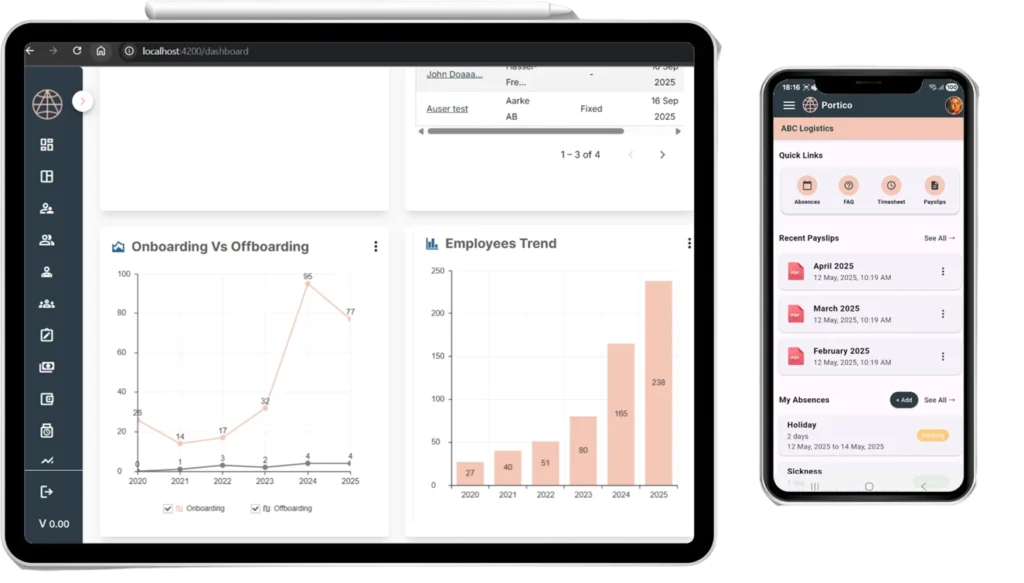
Run through your own Colombian entity, with your global view consolidated in Portico.

TopSource rated 5/5 by our customers

What Colombian payroll actually involves
Colombian payroll has changed more in the last eighteen months than in the previous ten years. The working week fell to 42 hours on 15 July 2026 with no reduction in pay, so every hourly rate rose about 4.8% overnight. Night work now starts at 7pm rather than 9pm. The Sunday surcharge has gone from 75% to 90% and reaches 100% next July. The apprenticeship contract became a full employment contract. And underneath all of that sits the structural feature that decides Colombian workforce cost: an exoneration that removes 13.5 percentage points of employer contribution for every employee earning under ten minimum wages, and switches off the moment they cross it. Colombia is not an expensive country to employ in. It is a country where the cost depends on details that moved recently.
Our Partners Globally









Calculate Your Employee Costs in Colombia
Enter a gross salary to see the full annual cost of a Colombian employee – social security, parafiscales and prestaciones sociales included in your total spend per employee. Watch the ten-minimum-wage line: crossing it adds 13.5 percentage points.
Employment Cost Calculator
*Indicative figures only and not definitive legal advice. Local regulations change frequently. Consult an expertColombia
| British Pound | Colombia | |
|---|---|---|
| Base Salary (per month) | ||
| Employer Contributions | ||
| Total Cost (Annual) | ||
| Total Cost (Monthly) |
“Their expertise and understanding of the unique hiring, payment, and human resource practices in each country has been nothing short of outstanding. Our Client Success Manager, has done just that … ensured our success. Her availability and willingness to engage on a personal level has made all the difference.”

“Excellent service, especially from our account manager who has gone above and beyond to help us use the platform effectively. Our manager, significantly simplifies my workload. It is like having your own TopSource HR representative on your team.”
“TopSource has been our go-to resource for international hiring. They are responsive, thorough, respectful and knowledgeable. The Client Success team has provided us with the utmost customer service, and the more we use TopSource, the more, it gives us access to more resources and knowledge.”
Employer Costs in Colombia Explained
Employer costs in Colombia are roughly 38% on top of salary for an employee earning less than ten minimum wages, and roughly 52% at or above that threshold. The difference is the exoneración de aportes under article 114-1 of the tax code, which relieves qualifying employers of the 8.5% health contribution and the 2% SENA and 3% ICBF parafiscales for lower-paid staff. What remains in both cases is pension at 12%, the family compensation fund at 4% and occupational risk insurance from 0.348%, plus prestaciones sociales of about 21.8% – a prima de servicios, cesantías, 12% interest on those cesantías, and 15 working days of vacation. The threshold in 2026 is COP 17,509,050 a month, and crossing it is a cliff rather than a slope: a pay rise of COP 210,000 a year can add COP 28.7 million to the annual cost of employing someone. Here’s the breakdown.
Ley 2466 de 2025 was published on 25 June 2025 and is the largest change to Colombian employment law in two decades. Three provisions move payroll directly. The night work window moved from 9pm–6am to 7pm–6am – deferred six months, so it took effect on 25 December 2025. The premium stayed at 35%, but two extra hours of every evening shift now attract it. The Sunday and holiday surcharge, previously 75%, rises in steps: 80% from 1 July 2025, 90% from 1 July 2026, and 100% from 1 July 2027. And overtime remains 25% by day and 75% at night, which now compounds differently because the night window is wider.
The reform also made the indefinite contract the legal default and capped fixed-term contracts at four years in total, with renewals beyond the fourth requiring a minimum of one year and any excess converting the contract to indefinite. Worth auditing your contract population against that, because conversion is automatic rather than something the employer elects.
The change with the largest hidden cost is the apprenticeship contract. The contrato de aprendizaje is now a special fixed-term employment contract rather than a training arrangement, which means apprentices receive full social security, cesantías, interest, prima and proportional vacation. Apprentice pay rose from 50% to 75% of the minimum wage in the academic phase and from 75% to 100% in the productive phase, and monetising an unfilled apprenticeship place now costs 1.5 minimum wages rather than one. Decreto 0223 de 2026, of 5 March, regulates the transition and requires existing apprentices to migrate.
Two procedural changes matter for anyone managing people. Dismissal for cause now requires a documented disciplinary process – written charge, disclosure of the evidence, at least five days for the employee to respond, and a reasoned decision – and the internal work rules must be updated to match. And the harassment standard changed: a single incident now suffices where the law previously required persistent conduct, which widens exposure to constructive dismissal claims.
Colombian employer contributions have two possible shapes depending on what each individual earns. The full set is health at 8.5%, pension at 12%, SENA at 2%, ICBF at 3%, the family compensation fund at 4%, and occupational risk insurance from 0.348% to 8.7% by risk class – around 30% in total for a low-risk employer. But article 114-1 of the tax code, originating in Ley 1607 de 2012, exonerates employers from health, SENA and ICBF for each employee earning less than ten minimum wages. For those employees the employer pays only pension, the compensation fund and occupational risk: about 16.5%.
That produces a cliff rather than a slope, and it is the single most important number in Colombian workforce planning. The threshold in 2026 is COP 17,509,050 a month. Below it, employer contributions plus prestaciones run at roughly 38% of salary. At or above it, they jump to roughly 52%. A pay rise of COP 210,000 a year that takes someone from just under the threshold to exactly ten minimum wages adds about COP 28.7 million to the annual cost of employing them – a multiplier of roughly 136 times the rise itself.
The exoneration is not universal. It applies to companies and other legal persons that are income tax filers, to natural-person employers with two or more employees, and to régimen SIMPLE taxpayers and cooperatives. It does not apply to entities in the special tax regime, which covers most non-profits, nor to natural persons with fewer than two employees. Pension, the compensation fund and occupational risk are never exonerated for anyone.
On the employee side, health and pension are 4% each. Employees earning four minimum wages or more pay an additional solidarity contribution to the pension fund, rising from 1% to 2% across bands. The contribution base has a floor of one minimum wage and a ceiling of 25 – COP 43,772,625 a month in 2026.
Prestaciones sociales are statutory benefits paid in addition to salary, and they are where foreign parents most often under-provision. The prima de servicios is 30 days’ salary a year, paid in two equal instalments due by 30 June and 20 December. Cesantías are one month’s salary a year – 8.33% – but they are not paid to the employee: they are deposited into a severance fund by 14 February, and late deposit costs one day’s salary per day of delay. On top of the cesantías themselves, the employer pays interest at 12% a year on the accrued balance, and that interest goes directly to the employee by 31 January. Vacation is 15 working days a year.
Together those come to about 21.8% of salary – prima 8.33%, cesantías 8.33%, interest 1.0% and vacation 4.17%. Note that the prima and cesantías bases include the auxilio de transporte, which vacation does not, so the three do not calculate off the same figure. There is also the dotación: two sets of work clothing and footwear three times a year, due 30 April, 31 August and 20 December, for employees earning up to two minimum wages with at least three months’ service.
The 31 January and 14 February deadlines are the two that catch people. They fall in the same window as year-end reporting, they are easy to miss on a first Colombian payroll cycle, and the cesantías penalty accrues daily.
There is an alternative structure for senior staff. A salario integral, available where pay is at least thirteen minimum wages – COP 22,761,765 a month in 2026 – bundles ten minimum wages of salary with a prestacional factor of at least 30%, and that factor replaces cesantías, interest, prima and surcharges. It does not replace vacation, which remains payable separately, and the contribution base becomes 70% of the integral salary. It simplifies senior payroll considerably, but the threshold sits above the exoneration cliff, so anyone on a salario integral is by definition outside the exoneration.
Ley 2101 de 2021 cut the maximum working week from 48 hours to 42 in annual steps: 47 hours from July 2023, 46 from 2024, 44 from 2025 and 42 from 15 July 2026. The final step is now in force. Crucially, the law prohibited reducing pay to match, so the effect was to raise the hourly rate: the divisor used to derive an hourly rate from a monthly salary fell from 220 to 210, which lifted every hourly rate by about 4.8% on 15 July. Any payroll still running the 220 divisor is underpaying overtime and surcharges.
The maximum ordinary day remains eight hours, and the week may be distributed over five or six days by agreement, provided a rest day is given and pay is not affected. Two flexible arrangements exist: a jornada flexible of daily blocks between four and nine hours with no overtime premium, provided the weekly average is 42 hours; and successive shifts of six-hour days and 36-hour weeks without night or holiday surcharges. Overtime is capped at two hours a day and twelve a week.
The surcharge stack is now: 35% for night work between 7pm and 6am, 90% for Sunday and holiday work rising to 100% in July 2027, 25% for daytime overtime and 75% for night overtime, with the Sunday and holiday multipliers compounding on top. For a business running evening or weekend shifts, the combined effect of the wider night window and the rising Sunday rate is a materially higher hourly cost than in 2024, with no change in headcount or salary.
The Ministry of Labour is actively inspecting the working-hours reduction and unpaid overtime under its 2025 inspection framework, and fines run from one to 5,000 minimum wages. That upper bound is COP 8,754,525,000 in 2026, which is not a realistic assessment for a routine breach but does indicate the range the inspectorate has available.
Income tax withholding runs on the UVT, a tax unit revalued each year – COP 52,374 for 2026, set by DIAN Resolución 000238 of 15 December 2025. The monthly table under article 383 of the tax code exempts the first 95 UVT of depurated base, which is COP 4,975,530 a month, then runs at 19%, 28%, 33%, 35%, 37% and 39%. Employers may use Procedimiento 1, computing on each month’s actual earnings, or Procedimiento 2, applying a fixed percentage set twice yearly in June and December from the previous twelve months’ average – which is materially better for employees with variable pay, but must be elected and kept for the semester.
The base is heavily deductible before the rate applies: 25% of employment income is exempt, capped at 790 UVT a year; dependants relief is 10% of gross capped at 32 UVT a month; mortgage interest up to 100 UVT a month; prepaid health up to 16 UVT; and mandatory health and pension contributions are fully deductible. All of it is then subject to a global cap of 40% of gross income and 1,340 UVT a year.
Filing has two channels. Social security and parafiscales go through the PILA, a single monthly electronic return via a licensed operator, on a deadline set by the last two digits of your NIT – from the second business day of the following month for 00–07 through to the sixteenth for 94–99. Separately, the electronic payroll document must be generated and transmitted to DIAN within the first ten business days of the month following the payroll period, twelve times a year regardless of how often you actually pay. Non-compliance risks the payroll cost being disallowed as a deduction, which is a far larger exposure than the penalty itself. The annual certificado de ingresos y retenciones is due to each employee by 31 March.
On termination without cause, indemnity for an indefinite contract depends on which side of ten minimum wages the employee sits: below it, 30 days’ salary for the first year and 20 days for each additional year; at or above it, 20 days for the first year and 15 for each additional year. Fixed-term contracts pay out the remainder of the term. Beyond that, several categories cannot be dismissed without prior authorisation – pregnancy and lactation require a labour inspector’s approval, with 60 days’ salary as an additional indemnity if breached; employees with a limiting health condition require Ministry authorisation, with 180 days’ salary; union officers require a judge’s permission. And failing to pay wages and prestaciones at termination triggers the sanción moratoria of one day’s salary for every day of delay, for up to 24 months.
Colombian employer contribution rates, 2026
| Contribution | Employer | Employee | Applies to |
|---|---|---|---|
| Salud (health) | 8.5% – exonerated below 10 SMMLV | 4% | Employer share exonerated per employee under art. 114-1 ET |
| Pensión | 12% | 4% | Never exonerated. Employee pays an extra 1%–2% solidarity contribution at 4 SMMLV and above |
| SENA | 2% – exonerated below 10 SMMLV | — | Parafiscal. Exonerated on the same test as health |
| ICBF | 3% – exonerated below 10 SMMLV | — | Parafiscal. Exonerated on the same test as health |
| Caja de Compensación Familiar | 4% | — | Never exonerated, for any employee, by any employer |
| ARL (occupational risk) | 0.348% – 8.7% by risk class | — | Employer only. Class I initial rate 0.522%; Class V initial 6.96%. Affiliation must be effective the day before work starts |
| Total employer contributions | ≈ 16.5% below 10 SMMLV; ≈ 30.0% at or above | 8% + solidarity | ARL Class I assumed. The 13.5-point gap is the exoneration cliff |
| Prima de servicios | 30 days’ salary a year | — | Two instalments, due 30 June and 20 December. CST art. 306, Ley 1788 de 2016 |
| Cesantías | 8.33% (one month a year) | — | Deposited to a severance fund by 14 February. Late deposit costs one day’s salary per day |
| Intereses sobre cesantías | 12% a year on the balance | — | Paid directly to the employee by 31 January. Ley 52 de 1975 |
| Vacaciones | 15 working days a year | — | CST art. 186. Calculated on ordinary salary, excluding the auxilio de transporte |
| Retención en la fuente | — | 0% to 39% | Exempt to 95 UVT a month (COP 4,975,530). UVT 2026 = COP 52,374 |
Colombian thresholds, working time and surcharges, 2026
| Item | 2026 figure | Notes |
|---|---|---|
| Salario mínimo (SMMLV) | COP 1,750,905 a month | COP 58,363.50 daily. Decreto 1469 de 2025, re-fixed by transitory Decreto 0159 de 2026. A 23.0% increase |
| Auxilio de transporte | COP 249,095 a month | Decreto 1470 de 2025. Payable to employees earning up to 2 SMMLV. Included in the prima and cesantías base |
| Exoneration threshold | 10 SMMLV = COP 17,509,050 | Below this, per employee, the employer is exonerated from health, SENA and ICBF |
| Salario integral threshold | 13 SMMLV = COP 22,761,765 | 10 SMMLV salary plus a prestacional factor of at least 30%. Contribution base is 70% of the total |
| Contribution base floor and ceiling | 1 to 25 SMMLV | COP 1,750,905 to COP 43,772,625 a month |
| Working week | 42 hours from 15 July 2026 | Final step of Ley 2101 de 2021. Hourly divisor fell from 220 to 210 – every hourly rate rose about 4.8% |
| Night work window | 7:00pm to 6:00am | Moved from 9:00pm by Ley 2466 de 2025, effective 25 December 2025. Premium unchanged at 35% |
| Sunday and holiday surcharge | 90% from 1 July 2026 | Was 75%; 80% from July 2025, 90% now, 100% from 1 July 2027 |
| Prestaciones sociales total | ≈ 21.8% of salary | Prima 8.33% + cesantías 8.33% + interest 1.0% + vacation 4.17% |
| Total employer loading | ≈ 38% below the cliff; ≈ 52% at or above | ARL Class I |
The two cost structures, side by side
| Component | At or above 10 SMMLV | Below 10 SMMLV | Note |
|---|---|---|---|
| Salud (health) | 8.5% | — | Exonerated below 10 SMMLV |
| Pensión | 12.0% | 12.0% | Never exonerated |
| SENA | 2.0% | — | Exonerated below 10 SMMLV |
| ICBF | 3.0% | — | Exonerated below 10 SMMLV |
| Caja de Compensación | 4.0% | 4.0% | Never exonerated |
| ARL, Class I | 0.52% | 0.52% | 0.522% initial rate. Class V is 6.96% |
| Contributions subtotal | 30.02% | 16.52% | The 13.5-point gap is the exoneration |
| Prima de servicios | 8.33% | 8.33% | 30 days’ salary a year |
| Cesantías | 8.33% | 8.33% | One month a year, to the fund by 14 February |
| Intereses sobre cesantías | 1.00% | 1.00% | 12% of the balance, to the employee by 31 January |
| Vacaciones | 4.17% | 4.17% | 15 working days |
| Total employer loading | 51.85% | 38.35% | At or above 10 SMMLV / below 10 SMMLV |
The cliff, worked through: raising a Colombian employee from 9.99 to exactly ten minimum wages costs about COP 210,000 a year in salary and about COP 28.7 million a year in employer cost – a multiplier of roughly 136. Any pay review that moves someone across COP 17,509,050 a month should either stop short of it or clear it by enough to be worth the step. The tables assume occupational risk Class I at the 0.522% initial rate; Class V adds 6.44 points to every total. The rate depends on the CIIU activity code in your RUT: the statutory band runs from 0.348% to 8.7%, but in practice the initial rate for the class applies on affiliation. The exoneration is tested per employee and per employer – entities in the special tax regime, which covers most non-profits, and natural persons with fewer than two employees do not qualify at all, whatever their staff earn.
Rates, thresholds and surcharges shown are current at 28 August 2026. The minimum wage and the UVT reset on 1 January; the working week changed on 15 July 2026; the Sunday and holiday surcharge rises again on 1 July 2027; and the pension reform takes effect on 1 April 2027. This page is general information, not tax or legal advice.
How our Colombian payroll service works
Why TopSource for Colombian Payroll
TopSource for payroll, Employer of Record or any other of our services represents a simpler, more reliable and transparent option.
We don’t hide fees or sneak price increases. We run Colombian payroll in-house, not brokered to a local firm – the same team that files your PILA answers your calls, in English and Spanish. You get a named account manager, one consolidated monthly invoice covering salaries, contributions and fees, and one live Portico view of Colombia beside every other country we run for you. Portico syncs with your time-tracking, leave and HR systems via API – set up by our onboarding team, not left to yours. GDPR, SOC 2 and ISO 27001 certified.

Other services
Accelerating your growth in Colombia and beyond
TopSource goes far beyond payroll, acting as your end-to-end partner in global workforce management. From Employer of Record (EOR) services and seamless entity setup to localized accountancy and fractional HR support, we cover every aspect of international employment.

Meet our experts for Colombia
Whether you’re entering the market or scaling operations, our specialists provide the insight and guidance you need to succeed in one of the world’s most dynamic and regulated employment landscapes. With TopSource, you’re backed by real experts, every step of the way.

Beyond a payroll serviceA globalization accelerator
Payroll platform
Global payroll simplified
Your intuitive hub for paying global teams. Simple, powerful, and designed to scale with you — no complexity, just clarity.
Audit
Eliminate barriers to growth
Avoid compliance issues across your global workforce and uncover opportunities to improve profitability. On a quarterly basis we’ll help you audit your global talent strategy to ensure it aligns with your business goals.
Intelligence
Build a data-driven talent strategy
Grow confidently and profitably with access to the latest TopSource insights & data on hiring markets, salary benchmarking & benefits.
Advisory
Expert guidance that turns complexity into clarity.
Whether you’re managing a global acquisition or entering a new market, you get clear guidance to navigate complex decisions, avoid delays, and accelerate your global expansion.



Colombian payroll FAQs
Employer costs in Colombia are roughly 38% on top of salary for an employee earning less than ten minimum wages, and roughly 52% at or above that threshold. The difference is the article 114-1 exoneration, which relieves employers of the 8.5% health contribution and the 5% SENA and ICBF parafiscales for lower-paid employees. Both figures combine social security and parafiscales – about 16.5% or 30% depending on the exoneration – with prestaciones sociales of about 21.8%, assuming the lowest occupational risk class.
The Colombian minimum wage for 2026 is COP 1,750,905 a month, or COP 58,363.50 a day, a 23.0% increase on 2025. It was set by Decreto 1469 de 2025 and re-fixed by transitory Decreto 0159 de 2026 after the original decree was provisionally suspended by the Consejo de Estado in February 2026; the suspension was revoked in July 2026 and the figure never changed. The auxilio de transporte is COP 249,095 a month, payable to employees earning up to two minimum wages.
The maximum working week in Colombia has been 42 hours since 15 July 2026, the final step of the reduction from 48 hours under Ley 2101 de 2021. Pay could not be reduced to match, so the divisor used to calculate an hourly rate from a monthly salary fell from 220 to 210 – raising every hourly rate by about 4.8%. The maximum ordinary day remains eight hours, and the week may be spread over five or six days by agreement.
Night work in Colombia runs from 7:00pm to 6:00am, and attracts a premium of 35%. The window moved from 9:00pm to 7:00pm under Ley 2466 de 2025, with effect from 25 December 2025. The premium rate itself did not change, but two additional hours of every evening shift now attract it, which raises the cost of shift-based operations without any change in headcount or salary.
The Sunday and holiday surcharge in Colombia is 90% as at August 2026. Ley 2466 de 2025 raised it from 75% in phases: 80% from 1 July 2025, 90% from 1 July 2026, and 100% from 1 July 2027. Overtime rates are separate and unchanged at 25% by day and 75% at night, and the Sunday and holiday multipliers compound on top of those.
Prestaciones sociales are statutory benefits Colombian employers must pay in addition to salary, totalling about 21.8%. They are a prima de servicios of 30 days’ salary a year in two instalments due 30 June and 20 December; cesantías of one month’s salary a year deposited into a severance fund by 14 February; interest on those cesantías at 12% a year paid directly to the employee by 31 January; and 15 working days of paid vacation. Late deposit of cesantías costs one day’s salary for each day of delay.
The exoneración de aportes under article 114-1 of the Colombian tax code relieves employers of the 8.5% health contribution and the 2% SENA and 3% ICBF parafiscales for each employee earning less than ten minimum wages – under COP 17,509,050 a month in 2026. It applies per employee, so at or above that figure all three become payable for that individual, adding 13.5 percentage points of employer cost. It is available to income-tax-filing companies, natural-person employers with two or more employees, and régimen SIMPLE taxpayers, but not to non-profits in the special tax regime.
No. Ley 2381 de 2024, which creates a four-pillar pension system, is not in force. In Sentencia C-264 de 2026, handed down in August 2026, the Constitutional Court held that around 90% of the law is procedurally sound but returned nine articles to the Chamber of Representatives for correction – the Chamber has 30 days from notification to do so – and fixed entry into force at 1 April 2027. Employers should continue with the existing system: 12% employer and 4% employee, plus the solidarity contribution at four minimum wages and above. The Court will also begin hearing more than a hundred substantive challenges from April 2027, so this is settled on procedure, not on content.
A salario integral is an alternative pay structure available where remuneration is at least thirteen minimum wages a month – COP 22,761,765 in 2026 – composed of at least ten minimum wages of salary plus a prestacional factor of at least 30%. That factor replaces cesantías, interest on cesantías, the prima de servicios and surcharges, which simplifies senior payroll considerably. It does not replace vacation, which remains payable as 15 working days, and the contribution base becomes 70% of the integral salary.
In practice yes. Enrolling employees with an EPS, AFP, ARL and family compensation fund and filing the PILA all require a Colombian NIT, so an employer needs either a Colombian company – usually an SAS, which needs one shareholder and no minimum capital – or a registered branch of a foreign company. A branch is mandatory where the foreign company carries out permanent activities in Colombia. If you would rather not hold an entity, an Employer of Record in Colombia engages the employee through an existing Colombian one.
Looking at other markets too?
We help organizations employ and pay teams in 164 countries.