Payroll Services in Saint Lucia
Fully managed Saint Lucian payroll – PAYE deducted on the right tax codes, NIC contributions filed by the 7th, and your company registered as an employer even without a local entity, with a named specialist a phone call away.

TopSource rated 5/5 by our customers

What Saint Lucian payroll actually involves
Saint Lucian payroll has low employer costs and short deadlines. The detail that catches foreign employers is administrative: two registrations, two different monthly due dates, and a rule that a non-resident employer pays through a local representative.
Our Partners Globally









Calculate Your Employee Costs in Saint Lucia
Enter a gross annual salary to see the employer cost of a Saint Lucian employee: 5% National Insurance on insurable earnings up to XCD 5,000 a month, which caps the employer contribution at XCD 3,000 a year. Redundancy pay and sick pay top-ups are not included.
Employment Cost Calculator
*Indicative figures only and not definitive legal advice. Local regulations change frequently. Consult an expertSaint Lucia
| British Pound | Saint Lucia | |
|---|---|---|
| Base Salary (per month) | ||
| Employer Contributions | ||
| Total Cost (Annual) | ||
| Total Cost (Monthly) |
“Their expertise and understanding of the unique hiring, payment, and human resource practices in each country has been nothing short of outstanding. Our Client Success Manager, has done just that … ensured our success. Her availability and willingness to engage on a personal level has made all the difference.”

“Excellent service, especially from our account manager who has gone above and beyond to help us use the platform effectively. Our manager, significantly simplifies my workload. It is like having your own TopSource HR representative on your team.”
“TopSource has been our go-to resource for international hiring. They are responsive, thorough, respectful and knowledgeable. The Client Success team has provided us with the utmost customer service, and the more we use TopSource, the more, it gives us access to more resources and knowledge.”
Employer Costs in Saint Lucia Explained
A Saint Lucian employee costs 5% on top of pay up to XCD 5,000 a month, the employer share of National Insurance, which caps at XCD 3,000 a year. Above the ceiling the rate falls: 3.13% at XCD 8,000 a month and 2.08% at XCD 12,000. There is no payroll tax, housing levy or mandatory 13th salary. The costs that sit outside the percentage are the first two days of each sickness, the top-up of sick pay above NIC benefit, and redundancy pay after two years of service. Here’s the breakdown.
National Insurance is 10% of insurable earnings, split 5% from the employer and 5% from the employee, on the first XCD 5,000 a month. The maximum is XCD 250 a month from each side. Insurable earnings include basic pay, overtime, commission, cost-of-living allowances, shift pay, holiday pay and service charge; Christmas bonuses, annual production bonuses and severance pay are excluded.
An employer must register with the National Insurance Corporation within seven days of hiring its first employee, and each employee must give the employer their NIC number. The monthly C3 schedule, listing each employee and their contributions, is due with the payment on or before the 7th of the following month. Late contributions attract a surcharge of 1.25% for every month they remain unpaid, and employers can be prosecuted for unpaid contributions and missing returns.
Resident individuals have a personal allowance of XCD 25,000 a year. Chargeable income above it is taxed at 15% on the first XCD 15,000, 20% on the next XCD 15,000 and 30% above XCD 30,000, the rates in force since income year 2023. Non-resident employees receive no personal allowance.
Each employee completes a TD-AU-1 declaration within 14 days of starting, which sets their tax code, and the employer deducts tax from each payment using the official tables, after the employee’s NIC contribution. Where no declaration is given, the basic code applies. Tax deducted in a month is paid to the Inland Revenue Department with the monthly return within 15 days after the end of the month. At year end each employee receives a TD5 certificate, and the employer’s annual return with copies of every TD5 is due within one month. Failing to deduct or pay over tax carries a 10% penalty, and the employer is personally liable for tax it did not deduct.
Anyone who pays remuneration in Saint Lucia must register with the Inland Revenue Department as an employer within 30 days after the end of the month in which they started paying, and with the National Insurance Corporation within seven days of hiring. The tax authority issues a taxpayer identification number with an account number for each tax.
A foreign company can employ in Saint Lucia without a local entity, but the Income Tax Act expects payroll to run through someone on the ground. For a non-resident employer, the “representative employer” is the agent responsible for paying remuneration on its behalf, and that agent must do everything the Act requires of an employer. The foreign employer remains liable. In practice this means appointing a local payroll agent or using an Employer of Record, and confirming the registration documents with the Inland Revenue Department before the first pay date.
The national minimum wage is XCD 6.52 an hour, or XCD 1,131 a month, under the Labour (Minimum Wage) Order 2024, in force since 1 October 2024. It excludes overtime, service charge, commission and bonuses.
The Labour Act sets 8 ordinary hours a day and 40 a week, with overtime paid at no less than one and a half times the hourly wage, or double on Sundays and public holidays. Vacation leave is 14 working days a year for up to five years of service and 21 working days after that, and accrued leave is paid out on termination. Saint Lucia has 13 public holidays.
Sick pay is shared with NIC. After six months of service, the employer pays full wages for the first two days of each sickness and then full wages less the NIC sickness benefit for up to three months. NIC pays 65% of average insurable earnings from the fourth day, for up to 26 weeks. Maternity leave is at least 13 weeks, with a NIC allowance of 65% for up to three months and a XCD 600 grant.
Probation can last up to 12 weeks. After that, the employer must give one week’s notice for under two years of service, two weeks from two years, four weeks from five years and six weeks after ten years, or pay in lieu. Redundancy pay applies after two years of continuous service: one week’s basic pay for each of the first three years, two weeks for each year from four to seven and three weeks for each year after seven, with a week’s pay capped at XCD 350.
Foreign nationals need a work permit from the Work Permit Unit of the Department of Labour, unless they are citizens of an OECS member state. Permits last up to a year and are tied to one employer, the employer must show it tried to recruit locally, and the application fee is XCD 100, with the permit fee paid after approval.
Saint Lucian employer contribution rates, 2026
| Contribution | Employer | Employee | Applies to |
|---|---|---|---|
| National Insurance | 5% | 5% | First XCD 5,000 of monthly insurable earnings |
| Income tax (PAYE) | — | 15% / 20% / 30% | Chargeable income after the XCD 25,000 allowance |
| Sick pay | Days 1–2 in full, then top-up | — | After six months of service, up to three months |
| Vacation leave | 14 or 21 working days | — | 21 days after five years of service |
| Redundancy pay | 1 to 3 weeks per year | — | After two years; week capped at XCD 350 |
| Payroll tax or levy | None | — | No housing or health levy on payroll |
Income tax on employment income, 2026
| Annual salary | Employee NIC | Chargeable income | Income tax | Effective rate |
|---|---|---|---|---|
| XCD 25,000 | XCD 1,250 | XCD 0 | XCD 0 | 0.00% |
| XCD 40,000 | XCD 2,000 | XCD 13,000 | XCD 1,950 | 4.88% |
| XCD 60,000 | XCD 3,000 | XCD 32,000 | XCD 5,850 | 9.75% |
| XCD 100,000 | XCD 3,000 | XCD 72,000 | XCD 17,850 | 17.85% |
| XCD 150,000 | XCD 3,000 | XCD 122,000 | XCD 32,850 | 21.90% |
Employer NIC by monthly salary, 2026
| Monthly salary | Annual salary | Employer NIC a year | Effective rate |
|---|---|---|---|
| XCD 1,131 | XCD 13,572 | XCD 679 | 5.00% |
| XCD 3,000 | XCD 36,000 | XCD 1,800 | 5.00% |
| XCD 5,000 | XCD 60,000 | XCD 3,000 | 5.00% |
| XCD 8,000 | XCD 96,000 | XCD 3,000 | 3.13% |
| XCD 12,000 | XCD 144,000 | XCD 3,000 | 2.08% |
The tax table assumes a resident employee with employment income only, the XCD 25,000 personal allowance and employee NIC deducted before tax, as the Inland Revenue Department’s PAYE calculator does; other allowances would lower the tax. XCD 1,131 is the national minimum wage. These are TopSource calculations from the verified rates.
Rates, thresholds and statutory amounts shown were verified on 16 September 2026. Income tax bands and the personal allowance have applied since income year 2023, and the NIC ceiling of XCD 5,000 a month is the rate published by the National Insurance Corporation. This page is general information, not tax or legal advice.
How our Saint Lucian payroll service works
Why TopSource for Saint Lucian Payroll
TopSource for payroll, Employer of Record or any other of our services represents a simpler, more reliable and transparent option.
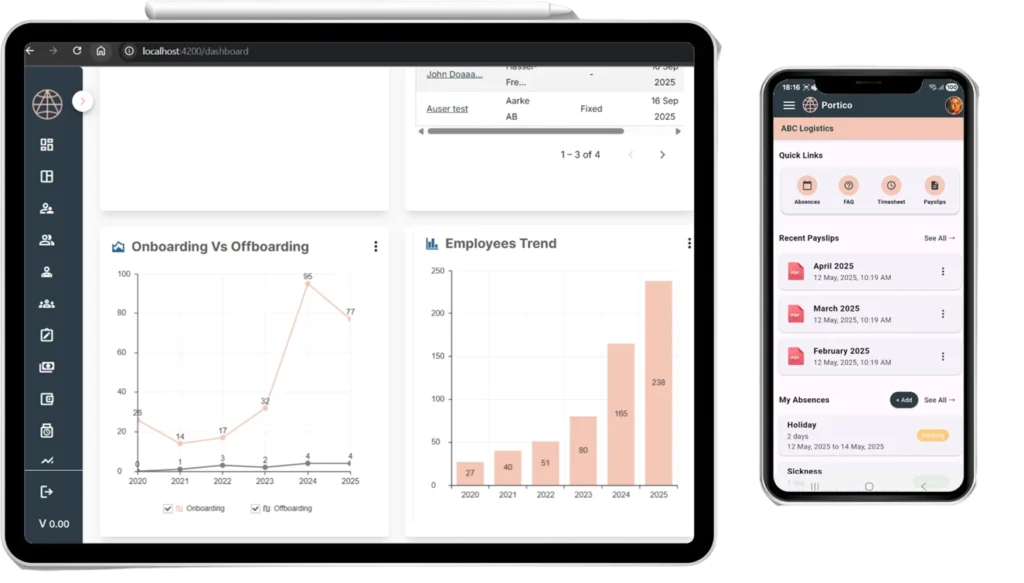
We don’t hide fees or sneak price increases. We run Saint Lucian payroll in-house and file under your own registrations, or employ on your behalf where you have no local entity, so the same team that files your returns answers your calls. You get a named account manager, one consolidated monthly invoice covering salaries, NIC, taxes and fees, and one live Portico view of Saint Lucia beside every other country we run for you, including the rest of the Caribbean. Portico syncs with your time-tracking, leave and HR systems via API – set up by our onboarding team, not left to yours. GDPR, SOC 2 and ISO 27001 certified.

Other services
Accelerating your growth in Saint Lucia and beyond
TopSource goes far beyond payroll, acting as your end-to-end partner in global workforce management. From Employer of Record (EOR) services and seamless entity setup to localized accountancy and fractional HR support, we cover every aspect of international employment.

Meet our experts for Saint Lucia
Whether you’re entering the market or scaling operations, our specialists provide the insight and guidance you need to succeed in one of the world’s most dynamic and regulated employment landscapes. With TopSource, you’re backed by real experts, every step of the way.

Beyond a payroll serviceA globalization accelerator
Payroll platform
Global payroll simplified
Your intuitive hub for paying global teams. Simple, powerful, and designed to scale with you — no complexity, just clarity.
Audit
Eliminate barriers to growth
Avoid compliance issues across your global workforce and uncover opportunities to improve profitability. On a quarterly basis we’ll help you audit your global talent strategy to ensure it aligns with your business goals.
Intelligence
Build a data-driven talent strategy
Grow confidently and profitably with access to the latest TopSource insights & data on hiring markets, salary benchmarking & benefits.
Advisory
Expert guidance that turns complexity into clarity.
Whether you’re managing a global acquisition or entering a new market, you get clear guidance to navigate complex decisions, avoid delays, and accelerate your global expansion.



Saint Lucian payroll FAQs
Yes. A foreign company must register as an employer with the Inland Revenue Department and the National Insurance Corporation, but the Income Tax Act treats the agent responsible for paying remuneration on behalf of a non-resident employer as the representative employer, who must meet every employer obligation. The foreign company remains liable. Most non-resident employers therefore use a local payroll agent or an Employer of Record.
National Insurance is 5% from the employer and 5% from the employee on insurable earnings up to XCD 5,000 a month, so each side pays at most XCD 250 a month. Insurable earnings include overtime, commission, holiday pay and service charge, but not Christmas bonuses, annual bonuses or severance pay.
Residents have a personal allowance of XCD 25,000 a year. Chargeable income above it is taxed at 15% on the first XCD 15,000, 20% on the next XCD 15,000 and 30% on the rest, the rates in force since income year 2023. Non-resident employees do not receive the personal allowance.
NIC contributions and the monthly C3 schedule are due on or before the 7th of the following month, with a surcharge of 1.25% a month on late payments. PAYE deducted in a month and the monthly return are due within 15 days after the month ends. TD5 certificates and the annual employer return are due within one month of the year end.
The national minimum wage is XCD 6.52 an hour, or XCD 1,131 a month, under the Labour (Minimum Wage) Order 2024, in force since 1 October 2024. It is a single national rate and excludes overtime, service charge, commission and bonuses.
Under the Labour Act, employees are entitled to 14 working days of vacation leave a year for up to five years of service and 21 working days after five years. Public holidays that fall during leave do not count as leave days, and accrued leave is paid out on termination.
After six months of service, the employer pays full wages for the first two days of each period of sickness and then full wages less the NIC sickness benefit for up to three months. The National Insurance Corporation pays sickness benefit at 65% of average insurable earnings from the fourth day, for up to 26 weeks.
After probation of up to 12 weeks, an employer must give one week’s notice for under two years of service, two weeks from two years, four weeks from five years and six weeks after ten years, or pay in lieu. An employee gives one week, or two weeks after five years.
Redundancy pay applies after two years of continuous service. It is one week’s basic pay for each of the first three years, two weeks for each year from four to seven and three weeks for each year after seven, with a week’s pay capped at XCD 350 under the Labour Act.
Yes, unless they are citizens of an OECS member state or otherwise exempt. The employer applies to the Work Permit Unit of the Department of Labour, showing its efforts to recruit locally, with a non-refundable XCD 100 application fee. Permits last up to a year, are tied to one employer, and work cannot start before approval.
Looking at other markets too?
We help organizations employ and pay teams in 164 countries.