Payroll Services in Romania
Romanian employer social cost is 2.25% – among the lowest in the European Union, and the most misleading number in European payroll. The employee carries 41.5% in contributions and tax, and a quarter-time contract can take the employer’s real burden to about 100% of gross. TopSource prices Romania on what it costs, not on the headline.

TopSource rated 5/5 by our customers

What Romanian payroll actually involves
Romania is administratively one of the simplest payrolls in Europe – one employer contribution, one flat income tax, one monthly return. What makes it difficult is that much of what a foreign employer thinks they know about it is a year out of date, or comes from reading the employer rate and stopping there. These are the five things that decide whether a Romanian payroll is right.
Our Partners Globally









Calculate Your Employee Costs in Romania
Enter a gross annual salary to see the employer cost in Romania: the work insurance contribution (CAM) at 2.25%, with no ceiling – the only general employer contribution. Pension (25%), health (10%) and income tax (10%) are deducted from the employee’s gross pay, so they are not an employer cost. Part-time contracts below the minimum wage cost the employer more; see the part-time table below.
Employment Cost Calculator
*Indicative figures only and not definitive legal advice. Local regulations change frequently. Consult an expertRomania
| British Pound | Romania | |
|---|---|---|
| Base Salary (per month) | ||
| Employer Contributions | ||
| Total Cost (Annual) | ||
| Total Cost (Monthly) |
“Their expertise and understanding of the unique hiring, payment, and human resource practices in each country has been nothing short of outstanding. Our Client Success Manager, has done just that … ensured our success. Her availability and willingness to engage on a personal level has made all the difference.”

“Excellent service, especially from our account manager who has gone above and beyond to help us use the platform effectively. Our manager, significantly simplifies my workload. It is like having your own TopSource HR representative on your team.”
“TopSource has been our go-to resource for international hiring. They are responsive, thorough, respectful and knowledgeable. The Client Success team has provided us with the utmost customer service, and the more we use TopSource, the more, it gives us access to more resources and knowledge.”
Employer Costs in Romania Explained
The employer pays one contribution in Romania – the work insurance contribution, CAM, at 2.25% of gross – with no ceiling and no variation by salary, so total employer cost is gross plus 2.25% at every level. The employee carries pension at 25%, health at 10% and income tax at 10%, giving deductions of 41.5% and a net of 58.5% of gross. Of every RON 100 of total employer cost, the employee receives RON 57.21. The exception is part-time work, where a contribution floor can take the employer’s burden to about 100% of gross. Here’s the breakdown.
Romania has moved almost the entire social contribution burden onto the employee. Since the transfer took effect in January 2018 the employer pays a single contribution, the contribuția asiguratorie pentru muncă, at 2.25% of gross. There is no separate unemployment, accident, wage guarantee or health contribution on the employer side – those are financed from the CAM and the state budget. Total employer cost is gross plus 2.25%, at every salary.
The employee carries the rest: pension (CAS) at 25%, health (CASS) at 10%, and income tax at a flat 10% on what is left after those two – 6.5% of gross. Total deductions are 41.5% and net pay 58.5% of gross. Pension surcharges of 4% and 8% apply to work in particular and special conditions, such as mining or aviation, and those are employer-paid, but they do not touch ordinary commercial employment.
There is no ceiling on any of it. Pension, health, the CAM and income tax run on the full base at every salary, with no upper limit and no reduced band. The only threshold in Romanian employment is a floor rather than a cap – the part-time rule below. Of every RON 100 of employer cost the employee receives RON 57.21 and the state RON 42.79, and only RON 2.20 of that came from the employer.
That is almost exactly the wedge in Hungary, where net pay is about 58.8% of employer cost and the employer pays 13%. Romania has not made employment cheap; it has made the employer’s share almost invisible. That matters when you compare offers rather than payroll costs: a Bucharest salary has to be set knowing that 41.5% comes off it before the employee sees anything.
A large share of Romanian professional and technical work has been contracted rather than employed – through a microîntreprindere, a small company taxed on revenue rather than profit, or a PFA, a self-employed individual. The attraction was arithmetic: an employment contract costs the employee 41.5% of gross, while a micro-enterprise paid a low revenue tax and distributed profit as dividends at a low rate.
That gap narrowed sharply on 1 January 2026, from both ends. The micro-enterprise revenue threshold – EUR 1 million as recently as 2022 and EUR 500,000 in 2024 – was EUR 250,000 for 2025 and is EUR 100,000 for 2026, tested on the previous year’s revenue together with any linked enterprises, so splitting a business across two companies does not help. The 1% and 3% rates were replaced by a single 1% under Emergency Ordinance 89/2025, and dividend tax rose from 10% to 16% under Law 141/2025.
A micro-enterprise must also have at least one employee – a full-time contract, part-timers adding up to full-time hours, or a management contract paid at least the minimum wage – and since Emergency Ordinance 8/2026 a newly registered company has 90 days to hire one. A company that quietly has no employee loses the regime.
For a foreign employer the practical question is recharacterisation. The Fiscal Code sets out criteria for dependent activity, and where an arrangement meets them ANAF can treat the income as salary and assess the contributions and tax that should have been paid, with interest and penalties. An engineer working fixed hours under a foreign manager, on the company’s laptop, invoicing the same company every month through their own SRL, is not a supplier in any meaningful sense.
This rule produces the largest gap between what a foreign employer expects Romanian payroll to cost and what it does cost. Where a part-time employee’s monthly gross is below the minimum wage, pension and health contributions are still due on a floor – from July 2026, RON 4,125 a month, the minimum wage of RON 4,325 less the RON 200 non-taxable amount. The employee’s own 25% and 10% are withheld on actual pay; the difference up to the floor is paid by the employer and cannot be recovered from the worker.
The arithmetic is unforgiving because the shortfall is charged at the full 35%. A half-time employee on RON 2,162.50 generates an employer top-up of about RON 687 a month; a quarter-time employee on RON 1,081.25, about RON 1,065. With the CAM, the employer’s burden on top of gross becomes about 34% at half time and about 101% at quarter time, against a headline of 2.25%. The table below sets it out line by line.
The exceptions are narrower than employers hope. The floor does not apply to pupils and students up to 26, apprentices up to 18, people with a disability, old-age pensioners, or an employee whose several contracts together reach the minimum wage. That last one is the only exception that helps an ordinary employer, and it needs the employee’s declaration to each employer.
This may change. A bill to abolish the floor from 1 January 2027 was before the Chamber of Deputies in September 2026; its final vote was postponed over the budget cost, and the government has proposed phasing the change in. Until a law is published the floor applies, and any workforce built on part-time shifts – support rotas, seasonal retail, a flexible pool – needs pricing against it rather than against 2.25%.
Meal vouchers – tichete de masă – are close to universal in Romanian employment and still worth having, but they are no longer a clean exemption. The maximum is RON 45 per working day under Law 201/2025, held at that level until at least March 2027. Since January 2024 they attract income tax at 10% and health contributions at 10%, but not pension and not the CAM. A voucher costs the employer its face value and delivers about 81% of it to the employee, against 58.5% through salary – a real advantage, and smaller than older guidance implies.
Beyond vouchers, the Fiscal Code lets a defined list of benefits be paid free of income tax within a monthly ceiling of 33% of base salary – items such as accommodation, meals and sports subscriptions – with individual limits inside that ceiling. The 33% applies to the basket as a whole, so the usable capacity is usually well below it.
Holiday vouchers – vouchere de vacanță – are optional for private employers and carry their own tax treatment. International guidance often describes them as a general obligation; a private employer has no duty to provide them.
The honest summary is that Romania’s benefit-side efficiency is real but modest. The voucher and the 33% basket might move a few points of a package from a 41.5% deduction to a much lighter one – worth doing, and not worth rebuilding a pay policy around.
Annual leave is a minimum of 20 working days, and collective agreements and contracts often give more. There are 16 distinct public holidays in 2026 rather than the usual 17, because Pentecost Monday and Children’s Day both fall on 1 June. Notice on dismissal is at least 20 working days. There is no statutory severance for ordinary dismissal or redundancy – only what a collective agreement or the contract provides, which for many foreign employers means nothing at all.
Sick pay has changed twice since August 2025. For ordinary illness the flat 75% is gone: since 1 August 2025 the indemnity is 55% for a certificate of up to 7 days, 65% for 8 to 14 days and 75% from 15 days, under Law 141/2025. The employer pays days two to six and the health fund pays from day seven. And for certificates issued from 1 February 2026 to 31 December 2027 the first day is unpaid under Emergency Ordinance 91/2025 – once per illness episode since Law 64/2026, and not at all, since 1 June 2026, for maternity, maternal risk, oncology, hospitalisation and national health programmes.
Child-raising leave is generous and has also changed. The indemnity is capped at RON 8,500 gross, and since 1 August 2025 health contributions of 10% are withheld from it, which takes the net maximum to RON 7,650.
Two administrative points close this out, and both are enforcement priorities. Every new employee must be registered in REGES-Online before their first working day; the system replaced REVISAL from the start of 2026 under Government Decision 295/2025, and although a court annulled that decision at first instance in May 2026, the ruling is not final and the system remains in use. And under article 164 of the Labour Code, as amended in 2024, an employee can be paid the minimum wage for at most 24 months from hiring, after which a higher base salary is mandatory – a rule almost never mentioned in English-language material.
Romania contribution rates and thresholds, 2026
| Item | Employee | Employer | Detail, and the instrument |
|---|---|---|---|
| CAM – work insurance contribution | — | 2.25% | The only general employer contribution. Fiscal Code (Law 227/2015) |
| Total employer cost | — | Gross × 102.25% | At every salary level |
| CAS – pension | 25% | — | Employee. No ceiling |
| CAS – particular / special conditions | — | +4% / +8% | Employer, only where the work holds that classification |
| CASS – health | 10% | — | Employee. No ceiling on employment income |
| Income tax | 10% | — | Flat, on gross less CAS and CASS – 6.5% of gross |
| Total employee deduction | 41.5% | — | Net pay is 58.5% of gross |
| Net pay as a share of employer cost | 57.21% | — | Constant at every salary. The state’s share is 42.79% |
| Ceiling on employment income | None | None | The only threshold is a floor – the part-time rule |
| Pillar II private pension | 4.75% | — | Carved out of the 25% CAS, not added to it |
| Minimum wage – to 30 June 2026 | — | — | RON 4,050 a month, unchanged since 1 January 2025 |
| Minimum wage – from 1 July 2026 | — | — | RON 4,325 a month (Government Decision 146/2026), up 6.8% |
| Non-taxable amount – to 30 June | RON 300 | — | No tax or contributions on it: full-time at the minimum wage, gross up to RON 4,300 |
| Non-taxable amount – from 1 July | RON 200 | — | Gross up to RON 4,600, until 31 December 2026 (Emergency Ordinance 89/2025) |
| Part-time contribution floor | — | The shortfall | CAS and CASS due on at least RON 4,125 a month from July 2026 (RON 3,750 before); the employer pays the difference |
| Meal vouchers | — | Up to RON 45 | Per working day (Law 201/2025). 10% income tax and 10% CASS; no CAS, no CAM |
| Non-taxable benefits basket | — | 33% | Of base salary a month, with individual limits inside it |
| Dividend tax | 16% | — | Up from 10% on 1 January 2026 (Law 141/2025) |
Engagement, employment and the things that changed – 2026 positions
| Item | Position for 2026 | Instrument | Why it matters |
|---|---|---|---|
| Micro-enterprise revenue threshold | EUR 100,000 | Emergency Ordinances 156/2024 and 89/2025 | EUR 250,000 in 2025, EUR 500,000 in 2024. Tested on prior-year revenue with linked enterprises |
| Micro-enterprise tax rate | A single 1% | Emergency Ordinance 89/2025 | The 1% / 3% two-rate structure ended on 1 January 2026 |
| Dividend tax | 16% | Law 141/2025 | Was 10%. With the threshold cut, this is what narrowed the contractor route |
| IT and sector exemptions | Abolished | Emergency Ordinance 156/2024 | From January 2025 income. No sectoral payroll relief in 2026 |
| Annual leave | At least 20 working days | Labour Code | Collective agreements often give more |
| Public holidays 2026 | 16 distinct days | — | Pentecost Monday and Children’s Day both fall on 1 June |
| Notice on dismissal | At least 20 working days | Labour Code art. 75 | — |
| Statutory severance | None | — | Only what a collective agreement or the contract provides |
| Minimum wage tenure | At most 24 months | Labour Code art. 164 (Law 283/2024) | After 24 months on the minimum wage a higher base salary is mandatory |
| Sick pay, ordinary illness | 55% / 65% / 75% | Law 141/2025, from 1 August 2025 | By certificate length. Employer pays days 2–6, the health fund from day 7 |
| First day of sick leave | Unpaid | Emergency Ordinance 91/2025; Law 64/2026 | Once per illness episode, 1 February 2026 to 31 December 2027, with exceptions from 1 June 2026 |
| Child-raising indemnity | Capped at RON 8,500 gross | Law 141/2025 (CASS) | 10% CASS withheld since August 2025: RON 7,650 net |
| Employment register | REGES-Online | Government Decision 295/2025 | Register before the first working day. A May 2026 first-instance annulment is not final |
| Monthly return | Declarația 112, by the 25th | ANAF | One return for income tax and every contribution, paid the same day |
| Foreign employer without an entity | Permitted | Fiscal Code | Register with ANAF, or agree in writing that the employee declares and pays |
The part-time contribution floor, from July 2026
| Component | Full-time | Part-time 50% | Part-time 25% | Note |
|---|---|---|---|---|
| Contracted monthly gross | RON 4,325 | RON 2,162.50 | RON 1,081.25 | Full-time at the minimum wage, then half and quarter time |
| Contribution base used | RON 4,125 | RON 4,125 | RON 4,125 | Minimum wage less the RON 200 non-taxable amount, whatever the hours |
| Employee CAS 25% | RON 1,031 | RON 541 | RON 270 | Withheld from the employee: part-time on actual pay |
| Employee CASS 10% | RON 413 | RON 216 | RON 108 | Withheld from the employee |
| Shortfall against the floor | — | RON 1,963 | RON 3,044 | The floor less contracted gross |
| Employer top-up at 35% | — | RON 687 | RON 1,065 | Paid by the employer, not recoverable from the employee |
| Employer CAM 2.25% | RON 93 | RON 49 | RON 24 | Part-time on actual pay; full-time on RON 4,125 |
| Total employer cost | RON 4,418 | RON 2,898 | RON 2,171 | Gross plus top-up plus CAM |
| Cost as a multiple of gross | 1.02× | 1.34× | 2.01× | A quarter-time employee costs about twice their pay |
| Employer burden on top of gross | 2.1% | 34.0% | 100.8% | Against a headline employer rate of 2.25% |
Nothing in Romanian employment taxation is capped: pension, health, the CAM and income tax run on the full base at every salary. The only threshold is a floor – the part-time contribution base – and it raises employer cost rather than limiting it. The part-time table is a TopSource calculation from the July 2026 figures: the floor is the RON 4,325 minimum wage less the RON 200 non-taxable amount; the full-time column benefits from that RON 200, which carries no tax or contributions; income tax is left out because it does not affect employer cost; and it assumes none of the exceptions applies. From January to June 2026 the floor was RON 3,750.
Rates and thresholds are for the 2026 calendar year and were verified on 29 September 2026. Two minimum wages apply in 2026 – RON 4,050 to 30 June and RON 4,325 from 1 July – and the non-taxable amount fell from RON 300 to RON 200 on the same date. A bill to abolish the part-time contribution floor from January 2027 was before Parliament at that date. Romania had not yet transposed the EU Pay Transparency Directive, whose deadline passed in June 2026. This page is general information, not tax or legal advice.
How our Romania payroll service works
Why TopSource for Romanian Payroll
TopSource for payroll, Employer of Record or any other of our services represents a simpler, more reliable and transparent option.
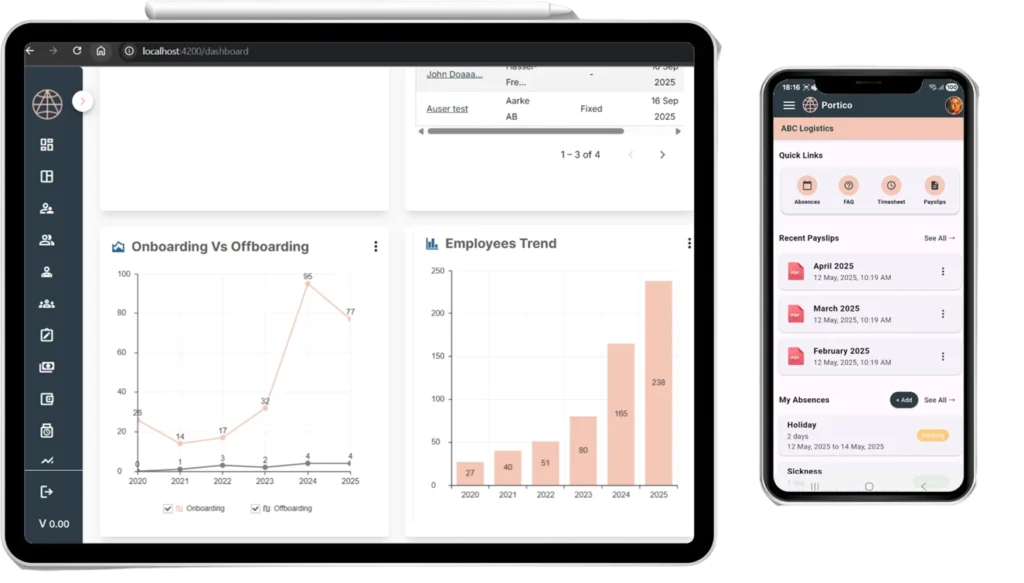
We don’t hide fees or sneak price increases. We run Romanian payroll in-house, price part-time roles against the contribution floor rather than the headline rate, and will tell you honestly whether you need an entity here – in Romania the answer is often no. You get a named account manager, one consolidated monthly invoice covering salaries, contributions, taxes and fees, and one live Portico view of Romania beside every other country we run for you. Portico syncs with your time-tracking, leave and HR systems via API – set up by our onboarding team, not left to yours. GDPR, SOC 2 and ISO 27001 certified.

Other services
Accelerating your growth in Romania and beyond
TopSource goes far beyond payroll, acting as your end-to-end partner in global workforce management. From Employer of Record (EOR) services and seamless entity setup to localized accountancy and fractional HR support, we cover every aspect of international employment.

Meet our experts for Romania
Whether you’re entering the market or scaling operations, our specialists provide the insight and guidance you need to succeed in one of the world’s most dynamic and regulated employment landscapes. With TopSource, you’re backed by real experts, every step of the way.

Beyond a payroll serviceA globalization accelerator
Payroll platform
Global payroll simplified
Your intuitive hub for paying global teams. Simple, powerful, and designed to scale with you — no complexity, just clarity.
Audit
Eliminate barriers to growth
Avoid compliance issues across your global workforce and uncover opportunities to improve profitability. On a quarterly basis we’ll help you audit your global talent strategy to ensure it aligns with your business goals.
Intelligence
Build a data-driven talent strategy
Grow confidently and profitably with access to the latest TopSource insights & data on hiring markets, salary benchmarking & benefits.
Advisory
Expert guidance that turns complexity into clarity.
Whether you’re managing a global acquisition or entering a new market, you get clear guidance to navigate complex decisions, avoid delays, and accelerate your global expansion.


Romanian payroll FAQs
Gross salary plus 2.25%, for full-time employment at any salary. Romania moved almost all social contributions to the employee in 2018, leaving the employer a single work insurance contribution, CAM, at 2.25% of gross with no ceiling – among the lowest employer contributions in the European Union. That is the employer’s share, not the total burden: the employee pays pension at 25%, health at 10% and income tax at 10%, so of every RON 100 of employer cost the employee receives RON 57.21. Part-time work is the exception: below the minimum wage a contribution floor applies, and a quarter-time employee costs the employer about twice their gross pay.
Pension (CAS) at 25% and health (CASS) at 10%, both paid by the employee, plus income tax at a flat 10% on gross after those two – total employee deductions of 41.5% and a net of 58.5% of gross. The employer pays only the work insurance contribution (CAM) at 2.25%. None of these is capped. Pension surcharges of 4% and 8% apply to work in particular and special conditions and are employer-paid, but only where the work holds that classification. Of the 25% pension contribution, 4.75% goes to the employee’s Pillar II private fund.
Because of a contribution floor with no real equivalent in most of Europe. Where a part-time employee earns less than the minimum wage, pension and health contributions are still due on a floor – from July 2026, RON 4,125 a month, the minimum wage less the RON 200 non-taxable amount – and the employer pays the difference out of its own funds. A half-time employee on RON 2,162.50 costs about RON 687 a month in top-up and a quarter-time employee about RON 1,065, taking the employer’s burden from 2.25% to about 34% and 101% of gross. A few narrow exceptions apply, and a bill to abolish the floor from January 2027 was before Parliament in September 2026.
It is a much less attractive route than it was, and it was never risk-free. From 1 January 2026 the micro-enterprise revenue threshold is EUR 100,000 – it was EUR 1 million in 2022 – the 1% and 3% rates became a single 1%, and dividend tax rose from 10% to 16%. The threshold is tested on prior-year revenue together with linked enterprises, and the company needs at least one employee. Separately, ANAF can recharacterise the arrangement as employment under the Fiscal Code’s dependent-activity criteria and assess the contributions and tax that should have been paid, with interest and penalties. Someone working fixed hours, under your direction, on your equipment, for you alone, is not a supplier.
There are two figures. The national minimum wage was RON 4,050 a month until 30 June 2026 – unchanged since January 2025 – and rose to RON 4,325 from 1 July 2026 under Government Decision 146/2026. A cost model using one annual figure is wrong for half the year. The non-taxable amount for full-time employees at the minimum moved the other way on the same day, from RON 300 to RON 200 a month, with the qualifying gross ceiling rising from RON 4,300 to RON 4,600; it runs to 31 December 2026. A separate, higher minimum applies in construction.
No. The income tax exemption for IT employees ended from January 2025 income under Emergency Ordinance 156/2024, together with the reliefs for construction and agri-food workers. There is no sectoral payroll relief in Romania in 2026. It is worth stating plainly because the IT exemption ran for more than twenty years, was the best-known feature of Romanian employment tax internationally, and much English-language guidance still describes it as current. An earlier change in November 2023 had already limited it to the first RON 10,000 of monthly income, which is sometimes confused with the abolition.
Not fully, and they have not been since January 2024. Meal vouchers are capped at RON 45 per working day under Law 201/2025, a level held until at least March 2027, and they attract income tax at 10% and health contributions at 10% – but not pension contributions and not the employer’s CAM. That still makes them more efficient than salary, which carries a 41.5% employee deduction: about 81% of a voucher reaches the employee, against 58.5% of salary. Alongside them, a basket of non-taxable benefits can be paid within a monthly ceiling of 33% of base salary, with individual limits inside it.
It changed twice between August 2025 and February 2026. For ordinary illness the old flat 75% is gone: since 1 August 2025 the indemnity is 55% for a certificate of up to 7 days, 65% for 8 to 14 days and 75% from 15 days, under Law 141/2025. The employer pays days two to six and the national health fund pays from day seven. And for certificates issued from 1 February 2026 to 31 December 2027, the first day is unpaid under Emergency Ordinance 91/2025 – once per illness episode since Law 64/2026, and not at all, since 1 June 2026, for maternity, maternal risk, oncology, hospitalisation and national health programmes.
Yes, and Romania offers two routes. A foreign employer can register with ANAF as a payer and file the monthly Declarația 112 itself. Alternatively, employer and employee can agree in writing that the employee calculates, declares and pays their own contributions and income tax – an unusual arrangement in Europe and a genuine one here. Neither removes the obligations; both move where they sit. For more than a few people, a Romanian entity or an employer of record is usually cleaner, and the decision should turn on your permanent establishment position as much as on headcount.
Declarația 112 – the single monthly return covering income tax and every social contribution for every employee – is due by the 25th of the following month, with payment on the same date. That is the whole of the tax calendar; Romania does not split contributions across separate returns. The register side is tighter and is where employers more often fail: every new employee must be entered in REGES-Online before their first working day. REGES-Online replaced REVISAL from the start of 2026 under Government Decision 295/2025; a court annulled that decision at first instance in May 2026, but the ruling is not final and the system remains in use.
Looking at other markets too?
We help organizations employ and pay teams in 164 countries.