Payroll Services in South Africa
Fully managed South African payroll – EMP201 within seven days of month end, both EMP501 reconciliations filed in their windows, the UI-19 lodged with the UIF rather than only with SARS, COIDA kept in good standing so your Letter of Good Standing never lapses, and the bargaining council question answered before it is asked.

TopSource rated 5/5 by our customers

What South African payroll actually involves
South African payroll is two questions, and most foreign employers only ask the first. The statutory layer is small and genuinely cheap: no employer social security, no state pension contribution, no employer health levy – just unemployment insurance at 1% capped at R177.12 a month, a skills development levy at 1% with no ceiling, and a compensation fund assessment priced by industry class. That comes to about 1.1% to 2.2% of salary for a professional services employer. The second question is whether a bargaining council’s main agreement has been extended to your sector, because if it has, it is law for you whether or not you have heard of the council, and its provident fund and levies are a different order of magnitude. On top of both sits an unforgiving filing calendar: monthly declarations within seven days, two annual reconciliations, a return of earnings on a different portal, and an employee declaration that goes to the UIF rather than to SARS.
Our Partners Globally









Calculate Your Employee Costs in South Africa
Enter a gross annual salary to see statutory employer cost in South Africa for 2026/27: unemployment insurance at 1% capped at R2,125.44 a year, the skills development levy at 1% with no ceiling, and COIDA at the 0.18% rate for professional services on earnings up to R668,000. Other industries pay a higher COIDA rate, up to 3.34%. Bargaining council provident funds and levies, where a council applies, are not included.
Employment Cost Calculator
*Indicative figures only and not definitive legal advice. Local regulations change frequently. Consult an expertSouth Africa
| British Pound | South Africa | |
|---|---|---|
| Base Salary (per month) | ||
| Employer Contributions | ||
| Total Cost (Annual) | ||
| Total Cost (Monthly) |
“Their expertise and understanding of the unique hiring, payment, and human resource practices in each country has been nothing short of outstanding. Our Client Success Manager, has done just that … ensured our success. Her availability and willingness to engage on a personal level has made all the difference.”

“Excellent service, especially from our account manager who has gone above and beyond to help us use the platform effectively. Our manager, significantly simplifies my workload. It is like having your own TopSource HR representative on your team.”
“TopSource has been our go-to resource for international hiring. They are responsive, thorough, respectful and knowledgeable. The Client Success team has provided us with the utmost customer service, and the more we use TopSource, the more, it gives us access to more resources and knowledge.”
Employer Costs in South Africa Explained
South African statutory employer cost is about 1.1% to 2.2% of salary for a professional services employer – among the lowest anywhere, because there is no employer social security contribution, no state pension contribution and no employer health levy. Unemployment insurance is 1% from each side but only on the first R17,712 of monthly earnings, a ceiling frozen since June 2021, so the employer’s contribution stops at R177.12 a month. The compensation fund assessment is employer-only and priced by industry class, from 0.18% for professional services to 3.34% for rock drilling, on earnings up to R668,000 a year. And the skills development levy is 1% of the entire payroll with no ceiling at all – which is why it is 88% of the employer’s statutory cost at R2.4 million of salary. All of that is true only outside a bargaining council. Here’s the breakdown.
South Africa has no employer social security contribution, no state pension contribution and no employer health levy. What it has is three modest statutory charges: unemployment insurance at 1%, the skills development levy at 1%, and the compensation fund assessment at a rate set by industry class. For a professional services employer the all-in statutory cost runs from about 2.18% of salary at R180,000 down to about 1.14% at R2.4 million.
It falls as salary rises because two of the three charges cap and one does not. Unemployment insurance is 1% from each side but only on the first R17,712 of monthly earnings – frozen since 1 June 2021 – so the employer’s contribution stops at R2,125.44 a year. The compensation fund assessment is capped at R668,000 of annual earnings per employee from 1 March 2026. The skills development levy is the exception: 1% of the entire payroll with no ceiling, exempt only where annual payroll is R500,000 or less, which most employers pass with two or three people.
The compensation fund assessment is the line that varies most. It is employer-funded in full, and the rate follows the industry class: 0.18% for finance, consulting, education and professional services, 0.81% for retail and hospitality, 2.65% for construction, transport and security, and 3.34% at the top for rock drilling and blasting. On a R600,000 salary that is the difference between 1.53% and 4.69% of total employer cost. It is assessed annually in arrears on the Return of Earnings, and the Letter of Good Standing that most commercial contracts require is only issued once the return is filed and the assessment paid.
The compensation regime also changed in 2026, and few international guides cover it. The COID Amendment Act came into force in stages from 23 January 2026, with the penalty provisions from 1 April. Administrative penalties now replace criminal prosecution and can be applied without a court, and the prescription period for claims was extended, which lengthens the tail of employer exposure.
The statutory figures above are only true for an employer outside every bargaining council, and that is a question about the employer’s actual activity. A bargaining council is formed for a sector and area by registered trade unions and employers’ organisations and concludes a main agreement that binds its own parties. The Minister of Employment and Labour can then extend that agreement to non-parties within the council’s scope by notice in the Government Gazette. From that date it is law for every employer in the sector and area.
The councils a foreign employer is most likely to fall into have deliberately wide scopes. The metal and engineering council catches light assembly, fabrication and engineering services, not just heavy industry. The motor industry council catches dealerships, parts, fitment and fuel retail. The road freight and logistics council catches warehousing and distribution, not only trucking. The building industry runs through several regional councils, so scope differs by area.
What a council requires is not a single levy but a monthly return covering several funds: an administration levy, a provident or pension fund, a sick pay fund, a holiday or leave pay fund, a dispute resolution levy and a training levy. The provident fund is the dominant number and usually cannot be replaced with the employer’s own scheme.
Four things follow for a foreign employer. Get it confirmed in writing whether your actual activity falls inside a council’s scope. Check whether the main agreement has been extended to non-parties and whether that extension is in force, since extensions lapse and are re-gazetted. Register and file from day one, because councils can assess arrears going back years. And if the sectoral terms are genuinely unaffordable, apply for an exemption – exemptions are real, but they must be applied for and they are not retrospective.
South Africa runs a tax year from 1 March to the end of February, so the current year began on 1 March 2026. PAYE is withheld monthly on seven brackets from 18% to a top rate of 45%, against a primary rebate of R17,820, which produces a tax threshold of R99,000 for an employee under 65.
Budget 2026 did something it had not done for two years. Brackets, rebates and medical scheme fees tax credits were fully adjusted for inflation at 3.4%. Bracket creep was the story of 2024/25 and 2025/26; it is not the story of the current year, and anyone writing that South Africa relies on bracket creep instead of adjusting the tables is describing the two years before this one.
Two other Budget 2026 numbers matter in payroll. The retirement fund contribution deduction cap rose from R350,000 to R430,000, the first increase in a decade, which moves the point at which employer contributions stop being deductible for the employee. And the medical scheme fees tax credit went to R376 a month for each of the first two members and R254 for each additional dependant.
The employment tax incentive is a PAYE set-off rather than a cash grant, and it is worth configuring correctly. It applies to qualifying employees aged 18 to 29 earning below R7,500 a month, at up to R1,500 a month in the first twelve qualifying months and R750 in the next twelve. SARS audits it closely, and an irregular claim is expensive.
Since 1 September 2024 every South African retirement fund has operated three components rather than one. Contributions from that date split one-third into a savings component and two-thirds into a retirement component, while everything accumulated before sits in a vested component under the old rules. A one-off seed transfer moved 10% of the vested value, capped at R30,000, into the savings component. The savings component can be accessed once per tax year; the retirement component is locked until retirement.
The honest employer answer is that payroll mechanics barely change. Employer and employee contributions continue as before, and the EMP201 is unchanged. The split happens inside the fund, not in the payroll, and the tax directive for a savings withdrawal is applied for by the fund.
What changes is administrative. A withdrawal fails if the member’s tax details do not match SARS’s records, so the quality of the payroll feed to the fund now matters. Withdrawals are taxed at the member’s marginal rate, so employees who withdraw often find an unexpected shortfall on assessment – and ask HR about it.
Separately, employer contributions to a retirement fund are a taxable fringe benefit in the employee’s hands, and the employee then deducts contributions up to 27.5% of remuneration or taxable income, capped at R430,000 a year. So an employer contribution is not a tax-free benefit, and the cap bites on senior packages.
The BCEA earnings threshold is R269,600.90 a year from 1 May 2026, up from R261,748.45. Employees above it are excluded from the working-time provisions – ordinary hours of 45 a week, overtime at time and a half, Sunday pay, night work allowances and some public holiday pay. They keep annual leave, sick leave, family responsibility leave, parental leave, notice, severance and full unfair dismissal protection.
Leave is generous and structured unusually. Annual leave is 21 consecutive days a year, which is 15 working days on a five-day week. Sick leave runs on a 36-month cycle rather than annually: the number of days the employee would ordinarily work in six weeks – 30 days on a five-day week – across each three-year cycle. Family responsibility leave is three days a year.
Parental leave changed on 3 October 2025, and much published material is out of date. The Constitutional Court declared the BCEA and Unemployment Insurance Act parental leave provisions unconstitutional for differentiating between mothers, fathers, adoptive and commissioning parents, and put an interim regime in place with immediate effect: four consecutive months where only one parent is employed, or four months and ten days shared between them where both are. Statutory leave is unpaid by the employer – the obligation is job protection – and the unemployment insurance benefit rules were not rewritten in step.
Termination is procedural rather than expensive. Notice under the BCEA is one week up to six months’ service, two weeks up to a year and four weeks after that, and severance on retrenchment is one week’s pay per completed year of service. What costs money is fairness: the Labour Relations Act requires a fair reason and a fair procedure, retrenchment requires genuine consultation under section 189, and an unfair dismissal finding at the CCMA can produce reinstatement or compensation of up to twelve months’ remuneration – twenty-four for an automatically unfair dismissal.
South African employer contribution rates, 2026/27
| Contribution | Employer | Employee | 2026/27 detail |
|---|---|---|---|
| UIF – Unemployment Insurance Fund | 1% | 1% | Monthly earnings ceiling R17,712, frozen since 1 June 2021. Maximum R177.12 a month each side |
| SDL – Skills Development Levy | 1% | — | No ceiling. Exempt only where annual payroll is R500,000 or less |
| COIDA – professional services | 0.18% | — | Finance, consulting, education. Employer only |
| COIDA – retail and hospitality | 0.81% | — | Employer only |
| COIDA – construction, transport, security | 2.65% | — | Employer only |
| COIDA – rock drilling and blasting | 3.34% | — | The highest class |
| COIDA – earnings ceiling | R668,000 a year | — | Per employee, from 1 March 2026. Minimum assessment R1,621 |
| PAYE | — | Per tax table | Seven brackets from 18% to 45%. Adjusted for inflation at 3.4% in Budget 2026 |
| Primary rebate | — | R17,820 | Tax threshold R99,000 under 65 |
| Medical scheme fees tax credit | — | R376 / R376 / R254 | A month: first two members, then each further dependant |
| Retirement fund deduction | — | 27.5%, capped at R430,000 | Cap raised from R350,000 in Budget 2026 |
| Employment Tax Incentive | PAYE set-off | — | Up to R1,500 a month in months 1–12, R750 in months 13–24. Under R7,500 a month |
| National minimum wage | R30.23 an hour | — | From 1 March 2026, up 5%. Farm and domestic workers at full parity |
| BCEA earnings threshold | R269,600.90 a year | — | From 1 May 2026 |
| Bargaining council levies | Varies | Varies | Where a council applies: provident fund, sick pay, holiday, dispute and training funds |
| Employer social security | None | — | No employer social security, state pension contribution or health levy |
The same employee at R600,000, costed four ways
| Cost element | Set by | At R600,000 a year | % of salary |
|---|---|---|---|
| UIF, employer 1% capped | Statute | R2,125 | 0.35% |
| SDL, 1% uncapped | Statute | R6,000 | 1.00% |
| COIDA, professional services 0.18% | Statute | R1,080 | 0.18% |
| Total – professional services | R9,205 | 1.53% | |
| Total – retail and hospitality | R12,985 | 2.16% | |
| Total – construction and transport | R24,025 | 4.00% | |
| Total – rock drilling and blasting | R28,165 | 4.69% | |
| Bargaining council provident fund and levies | Collective agreement, extended by the Minister | Not quantified | The dominant cost where a council applies |
Statutory employer cost by salary, professional services, 2026/27
| Annual salary | UIF | SDL | COIDA | Total and % of salary |
|---|---|---|---|---|
| R180,000 | R1,800 | R1,800 | R324 | R3,924 (2.18%) |
| R240,000 | R2,125 | R2,400 | R432 | R4,957 (2.07%) |
| R400,000 | R2,125 | R4,000 | R720 | R6,845 (1.71%) |
| R600,000 | R2,125 | R6,000 | R1,080 | R9,205 (1.53%) |
| R1,200,000 | R2,125 | R12,000 | R1,202 | R15,328 (1.28%) |
| R2,400,000 | R2,125 | R24,000 | R1,202 | R27,328 (1.14%) |
The unemployment insurance ceiling of R17,712 a month has been unchanged since 1 June 2021, so employer UIF is a flat R177.12 a month at any salary above R212,544 a year. The skills development levy applies to the whole payroll, with an exemption only where annual payroll is R500,000 or less. The compensation fund assessment is employer-funded in full, assessed annually in arrears on the Return of Earnings, and the class rates shown are the published tariffs for each industry class. The tables assume an employer outside every bargaining council; where a council’s main agreement has been extended to non-parties, its provident fund and levies sit on top and are usually the dominant cost. These are TopSource calculations from the 2026/27 rates, not published figures.
Rates, thresholds and statutory amounts shown are for the 2026/27 tax year, which runs from 1 March 2026 to 28 February 2027, and were verified on 24 September 2026. South African figures move on several dates: the tax tables, rebates, medical credits and the national minimum wage on 1 March, the BCEA earnings threshold on 1 May, and the compensation fund ceiling with the Return of Earnings cycle. The Constitutional Court’s parental leave judgment of 3 October 2025 operates as an interim regime until Parliament legislates. Where a bargaining council applies, its main agreement may set pay, hours, leave and contributions well above every statutory figure on this page. This page is general information, not tax or legal advice.
How our South African payroll service works
Why TopSource for South African Payroll
TopSource for payroll, Employer of Record or any other of our services represents a simpler, more reliable and transparent option. If you would rather not employ staff in South Africa directly, our Employer of Record in South Africa can employ them on your behalf.
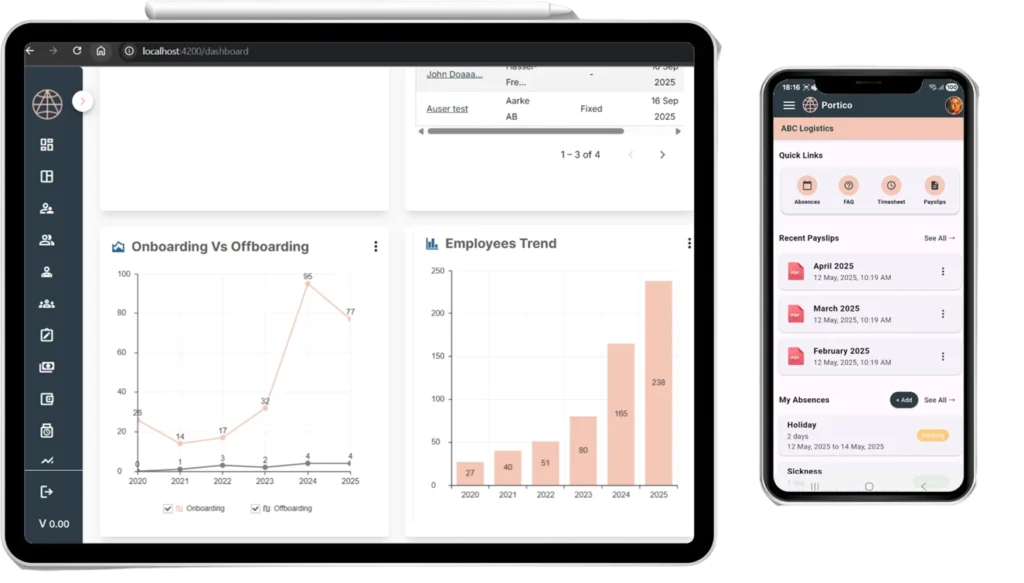
We don’t hide fees or sneak price increases. We run South African payroll in-house and register you with SARS in your own name rather than pooling you under a bureau, so the same team that files your EMP201 answers your calls. You get a named account manager, one consolidated monthly invoice covering salaries, statutory contributions, taxes and fees, and one live Portico view of South Africa beside every other country we run for you. Portico syncs with your time-tracking, leave and HR systems via API – set up by our onboarding team, not left to yours. GDPR, SOC 2 and ISO 27001 certified.

Other services
Accelerating your growth in South Africa and beyond
TopSource goes far beyond payroll, acting as your end-to-end partner in global workforce management. From Employer of Record (EOR) services and seamless entity setup to localized accountancy and fractional HR support, we cover every aspect of international employment.

Meet our experts for South Africa
Whether you’re entering the market or scaling operations, our specialists provide the insight and guidance you need to succeed in one of the world’s most dynamic and regulated employment landscapes. With TopSource, you’re backed by real experts, every step of the way.

Beyond a payroll serviceA globalization accelerator
Payroll platform
Global payroll simplified
Your intuitive hub for paying global teams. Simple, powerful, and designed to scale with you — no complexity, just clarity.
Audit
Eliminate barriers to growth
Avoid compliance issues across your global workforce and uncover opportunities to improve profitability. On a quarterly basis we’ll help you audit your global talent strategy to ensure it aligns with your business goals.
Intelligence
Build a data-driven talent strategy
Grow confidently and profitably with access to the latest TopSource insights & data on hiring markets, salary benchmarking & benefits.
Advisory
Expert guidance that turns complexity into clarity.
Whether you’re managing a global acquisition or entering a new market, you get clear guidance to navigate complex decisions, avoid delays, and accelerate your global expansion.



South African payroll FAQs
South African statutory employer cost is among the lowest in the world – about 1.1% to 2.2% of salary for a professional services employer, because there is no employer social security contribution, no state pension contribution and no employer health levy. The three charges are unemployment insurance at 1% capped at R177.12 a month, the skills development levy at 1% of the whole payroll with no ceiling, and the compensation fund assessment at an industry rate from 0.18% to 3.34%, capped at R668,000 of earnings. The caveat is that this is only true outside a bargaining council.
UIF is the Unemployment Insurance Fund contribution, charged at 1% from the employer and 1% from the employee – but only on the first R17,712 of monthly earnings, a ceiling frozen since 1 June 2021. The employer’s contribution therefore stops at R177.12 a month, or R2,125.44 a year. Two registrations are required: registering for UIF with SARS is not enough, because a separate registration with the Department of Employment and Labour is needed and the monthly UI-19 employee declaration goes to the UIF. Without it employees cannot claim.
COIDA is the compensation fund assessment for occupational injuries and diseases, paid entirely by the employer at a rate set by its industry class – 0.18% for finance, consulting, education and professional services, 0.81% for retail and hospitality, 2.65% for construction, transport and security, and 3.34% for rock drilling and blasting. It is capped at R668,000 of annual earnings per employee from 1 March 2026, with a minimum assessment of R1,621. It is assessed annually in arrears on the Return of Earnings, and the Letter of Good Standing that most contracts require is only issued once the return is filed and paid.
A bargaining council is a sectoral body of registered trade unions and employers’ organisations that concludes a main agreement for its industry – and if the Minister extends that agreement to non-parties by notice in the Government Gazette, it becomes law for every employer in that sector and area, whether or not the employer has joined anything. Scope is determined by the activity actually performed, and the councils with the widest reach – metal and engineering, motor, road freight and logistics, building – catch more than their names suggest. Councils can assess arrears going back years, so confirm the scope question in writing before the first hire.
The two-pot system has applied since 1 September 2024 and splits retirement fund contributions one-third into an accessible savings component and two-thirds into a locked retirement component, with everything accumulated before sitting in a vested component under the old rules. For payroll very little changes: contributions and the EMP201 are unchanged, the split happens inside the fund, and the tax directive for a savings withdrawal is the fund’s job. What changes is administrative – withdrawals fail if the member’s tax details do not match SARS’s records, and they are taxed at the marginal rate.
The EMP201 declaration and payment, covering PAYE, UIF and SDL together, are due within seven days of the end of each month. The employer then reconciles twice a year on the EMP501: an interim reconciliation covering March to August, filed in September and October, and an annual reconciliation for the full tax year, filed in April and May, each with an IRP5 or IT3(a) for every employee. The UI-19 employee declaration goes monthly to the UIF, and the COIDA Return of Earnings is filed annually. Late EMP501 reconciliation attracts a penalty of 1% of annual PAYE per month, up to 10%.
The national minimum wage is R30.23 an hour from 1 March 2026, up 5% from R28.79. It is an hourly floor rather than a monthly salary. Farm workers and domestic workers are now at full parity with the headline rate – older guides that still quote reduced rates for them are out of date. A worker cannot agree to less, and underpayment is recoverable with penalties on top of the arrears.
Parental leave changed on 3 October 2025, when the Constitutional Court declared the existing provisions unconstitutional for differentiating between mothers, fathers, adoptive and commissioning parents, and put an interim regime in place with immediate effect while Parliament legislates. Where only one parent is employed, that parent is entitled to four consecutive months. Where both are employed, they share four months and ten days between them as they agree. Statutory leave is unpaid by the employer – the obligation is job protection – and the unemployment insurance benefit rules were not rewritten in step.
The statutory payments are modest and the procedural risk is not. Notice under the BCEA is one week up to six months’ service, two weeks up to a year and four weeks after that, and severance on retrenchment is one week’s pay per completed year of service. What costs money is fairness: the Labour Relations Act requires a fair reason and a fair procedure, retrenchment requires genuine consultation under section 189, and an unfair dismissal finding at the CCMA can produce reinstatement or compensation of up to twelve months’ remuneration – twenty-four where the dismissal is automatically unfair.
It is possible in principle and difficult in practice. A non-resident employer with a South African permanent establishment must register and withhold PAYE; one without has no PAYE withholding obligation – but UIF and SDL do not depend on a permanent establishment, so the employer must still register for those while the employee pays their own tax as a provisional taxpayer. Employer registration also requires in practice a South African bank account and a resident public officer. A subsidiary is cleanest, and an Employer of Record is the common practical answer.
Looking at other markets too?
We help organizations employ and pay teams in 164 countries.