Payroll Services in Fiji
Fiji payroll, fully managed: PAYE withheld and filed with FRCS, FNPF contributions for every employee and the 1% training levy, with a named specialist a phone call away.

TopSource rated 5/5 by our customers

What our Fiji payroll service covers
Payroll in Fiji, from Suva to Nadi, runs on two monthly deadlines: PAYE to the Fiji Revenue and Customs Service (FRCS) and contributions to the Fiji National Provident Fund (FNPF), both due by the last day of the following month. From 1 August 2026 to 31 July 2027 the employer’s FNPF share is 8% instead of 10%.
Our Partners Globally









Calculate Your Employee Costs in Fiji
Enter a gross annual salary to see the employer’s statutory cost in Fiji: FNPF contributions on total wages, with no ceiling, and the 1% training levy. The mandatory employer FNPF rate is 8% from 1 August 2026 to 31 July 2027, a temporary cut from 10%.
Employment Cost Calculator
*Indicative figures only and not definitive legal advice. Local regulations change frequently. Consult an expertFiji
| British Pound | Fiji | |
|---|---|---|
| Base Salary (per month) | ||
| Employer Contributions | ||
| Total Cost (Annual) | ||
| Total Cost (Monthly) |
“Their expertise and understanding of the unique hiring, payment, and human resource practices in each country has been nothing short of outstanding. Our Client Success Manager, has done just that … ensured our success. Her availability and willingness to engage on a personal level has made all the difference.”

“Excellent service, especially from our account manager who has gone above and beyond to help us use the platform effectively. Our manager, significantly simplifies my workload. It is like having your own TopSource HR representative on your team.”
“TopSource has been our go-to resource for international hiring. They are responsive, thorough, respectful and knowledgeable. The Client Success team has provided us with the utmost customer service, and the more we use TopSource, the more, it gives us access to more resources and knowledge.”
Employer Costs in Fiji Explained
Until 31 July 2027, employers in Fiji pay 9% on top of gross pay: 8% to the FNPF and the 1% training levy. Employees contribute 8% to the FNPF and pay income tax through PAYE. FNPF contributions apply to total wages, with no ceiling.
Mandatory FNPF contributions are a percentage of total wages for the month. For wages paid from 1 August 2026 to 31 July 2027, the employer pays 8% and deducts 8% from the employee’s pay, 16% in total. Before that the employer share was 10%, and the cut is a temporary measure from the 2026-2027 Budget.
Employers can keep paying up to 10%: the voluntary part above 8% earns a 150% tax deduction. Employees who are Fijian citizens must be registered. Non-citizens are exempt unless they apply to join and the employer agrees.
Employers withhold PAYE from every payment using the FRCS formula, which annualises regular pay and tracks tax withheld to date. Residents pay no tax on the first FJD 30,000 of chargeable income a year, 18% from FJD 30,001 to 50,000 and 20% up to FJD 270,000, with bands of 33% to 39% above that. Non-residents pay 20% from the first dollar.
Each employee completes a tax code declaration: code P for the main job, code S for a second job, taxed at a flat 20%. If no declaration arrives within 5 working days, the employer withholds 20%. Non-cash benefits are taxed separately through quarterly fringe benefits tax at 20%.
Each month’s FNPF contribution schedule is due by the 14th of the following month, and payment by the last day of that month. Unpaid contributions attract a penalty of 10% of the outstanding balance for every month they remain unpaid. New employees are reported to the FNPF when they join.
PAYE for each month is filed and paid through the FRCS online portal by the last day of the following month, whatever the pay frequency. A month with no employees still needs a nil return, and late filing or payment attracts penalties.
For an employee on FJD 4,000 a month, the employer pays FJD 320 in FNPF and FJD 40 in training levy, for a monthly cost of FJD 4,360. The employee pays FJD 320 in FNPF and FJD 270 in PAYE, and takes home FJD 3,410.
On FJD 2,000 a month, within the FJD 30,000 a year that is free of tax, the employee pays no income tax and takes home FJD 1,840, at a cost to the employer of FJD 2,180.
The Employment Relations Act caps normal hours at 48 a week over no more than six days. The national minimum wage is FJD 5.00 an hour. After each year of service, workers get 10 working days of paid annual leave. After three months, they also get 10 days of paid sick leave, 5 days of family care leave and 3 days of bereavement leave a year.
Maternity leave is 98 consecutive days, on full pay for the first three births, and fathers who are the primary caregiver get 5 working days of paternity leave. Notice follows the pay period, from 7 days for weekly pay to one month for monthly pay, in writing. Redundancy pay is at least one week’s wages per complete year of service. A reform of the Act is before Parliament.
Fiji payroll contributions and rates, 2026
| Item | Employer | Employee | Applies to |
|---|---|---|---|
| FNPF | 8% | 8% | Total wages, no ceiling; 1 Aug 2026 to 31 Jul 2027 (employer 10% before) |
| Training levy | 1% | None | Gross payroll, administered through Fiji National University |
| PAYE, residents | Withholds | 0% to 39% | Nil on the first FJD 30,000 of chargeable income a year |
| PAYE, non-residents | Withholds | 20% up to FJD 270,000 | Then the same bands as residents |
| PAYE, second job | Withholds | 20% | Tax code S |
| FNPF payment | Last day of the following month | Contribution schedule by the 14th | |
| PAYE payment | Last day of the following month | Filed and paid together | |
| Late FNPF contributions | 10% a month | Of the outstanding balance |
Gross to net and employer cost in Fiji, monthly
| Monthly gross pay | Employee FNPF (8%) | PAYE | Net pay | Employer FNPF and levy (9%) | Total employer cost |
|---|---|---|---|---|---|
| FJD 2,000 | FJD 160.00 | FJD 0.00 | FJD 1,840.00 | FJD 180.00 | FJD 2,180.00 |
| FJD 4,000 | FJD 320.00 | FJD 270.00 | FJD 3,410.00 | FJD 360.00 | FJD 4,360.00 |
| FJD 8,000 | FJD 640.00 | FJD 1,066.67 | FJD 6,293.33 | FJD 720.00 | FJD 8,720.00 |
| FJD 25,000 | FJD 2,000.00 | FJD 4,791.67 | FJD 18,208.33 | FJD 2,250.00 | FJD 27,250.00 |
Leave, notice and severance in Fiji
| Item | Statutory minimum |
|---|---|
| Annual leave | 10 working days after each year of service |
| Sick leave | 10 working days a year after 3 months, not carried over |
| Family care leave | 5 working days a year after 3 months |
| Bereavement leave | 3 days a year after 3 months |
| Maternity leave | 98 consecutive days, full pay for the first 3 births |
| Paternity leave | 5 working days for a primary caregiver, paid after 3 months |
| Notice | 7 days for weekly pay, 14 for fortnightly, one month for monthly, in writing |
| Redundancy pay | One week’s wages per complete year of service |
| Final pay | By the end of the next working day |
The cost table assumes a resident employee with tax code P, the same pay every month and the 8% employer FNPF rate in force from 1 August 2026 to 31 July 2027. These are TopSource calculations from the verified rates.
Rates and thresholds shown were verified on 17 November 2026 against the Fiji National Provident Fund Act 2011, the FNPF notice on the 2026-2027 employer rate, the 2026-2027 Budget Supplement of the Ministry of Finance, the FRCS tax rates and Employer Guide 2026, the Employment Relations Act 2007 and the Employment Relations (National Minimum Wage) Regulations 2015. This page is general information, not tax or legal advice.
How our Fiji payroll service works
Why Choose TopSource for Global Payroll in Fiji
TopSource for payroll, Employer of Record or any other of our services represents a simpler, more reliable and transparent option. If you would rather not employ staff in Fiji directly, our Employer of Record in Fiji can employ them on your behalf.
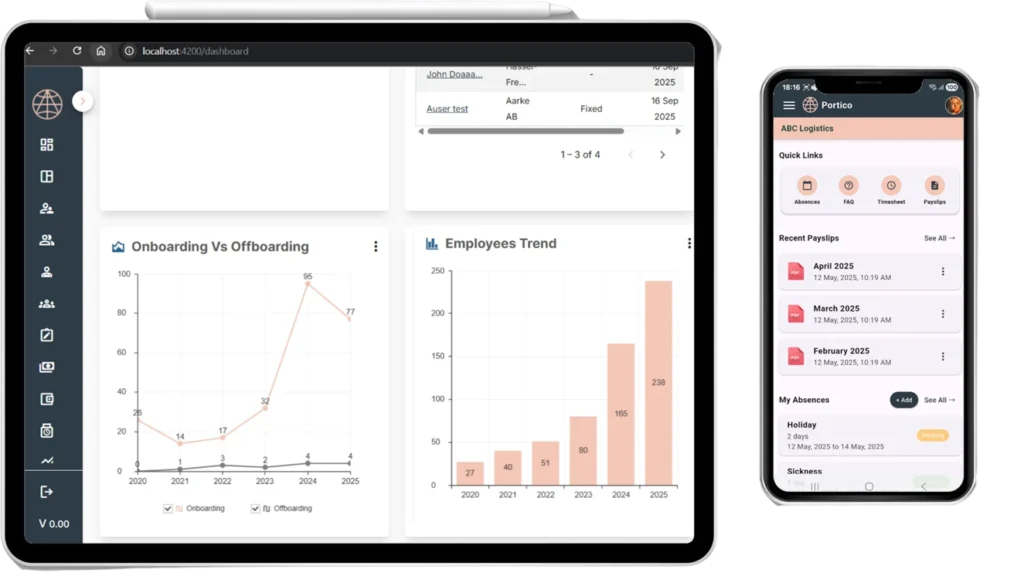
We don’t hide fees or sneak price increases. You get a named account manager, one consolidated monthly invoice covering salaries, contributions and fees, and one live Portico view of Fiji beside every other country we run for you, across the Pacific and beyond. Portico syncs with your time-tracking, leave and HR systems via API, set up by our onboarding team, not left to yours. GDPR, SOC 2 and ISO 27001 certified.

Other services
Accelerating your growth in Fiji and beyond
TopSource goes far beyond payroll, acting as your end-to-end partner in global workforce management. From Employer of Record (EOR) services and seamless entity setup to localized accountancy and fractional HR support, we cover every aspect of international employment.

Meet our experts for Fiji
Whether you’re entering the market or scaling operations, our specialists provide the insight and guidance you need to succeed in one of the world’s most dynamic and regulated employment landscapes. With TopSource, you’re backed by real experts, every step of the way.

Beyond a payroll serviceA globalization accelerator
Payroll platform
Global payroll simplified
Your intuitive hub for paying global teams. Simple, powerful, and designed to scale with you: no complexity, just clarity.
Audit
Eliminate barriers to growth
Avoid compliance issues across your global workforce and uncover opportunities to improve profitability. On a quarterly basis we’ll help you audit your global talent strategy to ensure it aligns with your business goals.
Intelligence
Build a data-driven talent strategy
Grow confidently and profitably with access to the latest TopSource insights & data on hiring markets, salary benchmarking & benefits.
Advisory
Expert guidance that turns complexity into clarity.
Whether you’re managing a global acquisition or entering a new market, you get clear guidance to navigate complex decisions, avoid delays, and accelerate your global expansion.



Fiji payroll FAQs
Look for a provider that withholds PAYE on the FRCS formula, submits the FNPF schedule by the 14th, pays FNPF and PAYE by month-end and keeps up with changes such as the temporary 8% employer FNPF rate. TopSource adds a named specialist and one consolidated invoice across every country you pay in.
Register as an employer with FRCS and the FNPF, collect each employee’s TIN and tax code declaration, and pay wages with a wage statement each pay day. Withhold PAYE and the employee’s 8% FNPF, then pay both, with the employer’s share, by the last day of the following month. Without a Fijian entity, TopSource can employ your team through our Employer of Record service.
8% of total wages from 1 August 2026 to 31 July 2027, down from 10%, with the employee also paying 8%. There is no wage ceiling. Employers that keep paying up to 10% get a 150% tax deduction on the voluntary part.
Through PAYE on every payment. Residents pay nothing on the first FJD 30,000 of chargeable income a year, 18% up to FJD 50,000 and 20% up to FJD 270,000, with higher bands up to 39%. Non-residents pay 20% from the first dollar, and second jobs are taxed at 20%.
Both are paid by the last day of the month after the month the wages relate to. The FNPF contribution schedule must be submitted by the 14th of that month. Unpaid FNPF contributions attract a penalty of 10% of the balance for each month they stay unpaid.
An employee on FJD 4,000 a month costs FJD 4,360 with 8% FNPF and the 1% training levy, and takes home FJD 3,410 after FNPF and PAYE. Tell us the role and salary and we’ll send the full cost within one business day.
Not by default. Employees who are not Fijian citizens are exempt from FNPF unless they apply to join and the employer agrees. They still pay PAYE, at non-resident rates if they are non-resident for tax purposes, and need a work permit before they start.
The national minimum wage is FJD 5.00 an hour, in force since 1 April 2025; some sectors have their own wage regulations. Normal hours are 9 a day over five days or 8 a day over six, and contracts cannot set more than 48 hours a week before overtime.
10 working days of paid annual leave after each year of service. After three months, workers also get 10 days of paid sick leave, 5 days of family care leave and 3 days of bereavement leave a year. Maternity leave is 98 days and paternity leave 5 working days.
Unless the contract says otherwise, notice follows the pay period: 7 days for weekly pay, 14 days for fortnightly pay and one month for monthly pay, given in writing. Redundancy pay is at least one week’s wages for each complete year of service.
Looking at other markets too?
We help organizations employ and pay teams in 164 countries.