Payroll Services in Denmark
Fully managed Danish payroll – ATP banded on actual paid hours rather than on headcount, Samlet Betaling paid when the invoice arrives in Digital Post, eIndkomst filed on your own deadline rather than the one you assumed, and sygedagpenge reimbursement claimed inside the five-week window.

TopSource rated 5/5 by our customers

What Danish payroll actually involves
Danish payroll is two systems that barely touch each other, and a foreign employer usually only sees one of them. The statutory system is small and unusually cheap: no percentage-based employer social security at all, just a handful of flat kroner amounts – ATP banded on paid hours, and six more schemes invoiced quarterly as Samlet Betaling, arriving in Digital Post rather than through the pay run. The contractual system is where the money is: the collective agreement sets the pay floor, the occupational pension at 11% from the employer, the Fritvalgs Lønkonto at 10% from March 2026, sick pay and much of parental pay. Denmark has no statutory minimum wage and no mechanism for extending an agreement to a company that has not signed one – but a union can lawfully take industrial action to make it sign. On top of both sits a set of operational deadlines that are unforgiving in a way the rest of the system is not: a reimbursement claim filed at six weeks instead of five is simply lost.
Our Partners Globally









Calculate Your Employee Costs in Denmark
Enter a gross annual salary to see the statutory employer cost in Denmark for 2026: ATP and the Samlet Betaling levies of about DKK 8,250 a year per full-time employee, at the rates for finance and business services, plus the 0.45% store bededag supplement and the 1% ferietillæg for salaried staff. A collective agreement adds much more: under Industriens Overenskomst, 11% employer pension and a 10% Fritvalgs Lønkonto, which are not included here. Occupational accident insurance is a private policy and is not included either.
Employment Cost Calculator
*Indicative figures only and not definitive legal advice. Local regulations change frequently. Consult an expertDenmark
| British Pound | Denmark | |
|---|---|---|
| Base Salary (per month) | ||
| Employer Contributions | ||
| Total Cost (Annual) | ||
| Total Cost (Monthly) |
“Their expertise and understanding of the unique hiring, payment, and human resource practices in each country has been nothing short of outstanding. Our Client Success Manager, has done just that … ensured our success. Her availability and willingness to engage on a personal level has made all the difference.”

“Excellent service, especially from our account manager who has gone above and beyond to help us use the platform effectively. Our manager, significantly simplifies my workload. It is like having your own TopSource HR representative on your team.”
“TopSource has been our go-to resource for international hiring. They are responsive, thorough, respectful and knowledgeable. The Client Success team has provided us with the utmost customer service, and the more we use TopSource, the more, it gives us access to more resources and knowledge.”
Employer Costs in Denmark Explained
Employer cost in Denmark is about 23% to 25% above base salary with a collective agreement and about 2% to 4% without one – and the gap between those two numbers is entirely contractual rather than statutory. Denmark has no percentage-based employer social security contribution. The statutory schemes are flat kroner amounts per full-time employee: ATP at DKK 198.00 a month from the employer at the full rate, plus AUB, Barsel.dk, the Finansieringsbidrag, AES and two small administration fees, totalling about DKK 8,250 a year for an office employer. Because the amounts are fixed, that is 2.36% of a DKK 350,000 salary and 0.41% of DKK 2,000,000. Add the statutory 0.45% store bededag supplement and the 1% ferietillæg, and an employee with no agreement costs about 2% to 4% above salary. Layer on an Industriens Overenskomst-style agreement – 11.0% employer pension and a 10.0% Fritvalgs Lønkonto – and total employer cost reaches about 23% to 25%. Compulsory accident insurance is a private policy on top, and is not what the AES levy buys. Here’s the breakdown.
Denmark has no percentage-based employer social security contribution at all. The state schemes are flat kroner amounts per full-time employee, not percentages of salary – which is why a CFO modelling Denmark at a French or Italian employer loading will be wrong by an order of magnitude on the statutory line. ATP, the statutory supplementary pension, is DKK 198.00 a month from the employer at the full rate and DKK 99.00 from the employee, banded on paid hours rather than on salary: an employee on DKK 25,000 a month and one on DKK 250,000 a month generate identical ATP.
The other schemes are invoiced together as Samlet Betaling, quarterly in arrears. For 2026, per full-time employee per quarter: AUB at DKK 705.25, Barsel.dk at DKK 550.00, the Finansieringsbidrag at DKK 82.00, the fund for posted workers at DKK 0.00, the Lønmodtagernes Feriemidler administration fee at DKK 5.00, and the FerieKonto fee at DKK 4.00 a month. AES, the occupational injury and disease levy, is annual and set by branch – DKK 284 for energy and water, DKK 457 for finance and business services, DKK 2,323 for general construction and DKK 10,892 for defence and policing. The composition moved sharply for 2026 even though the bundle is broadly flat: AUB fell 21% and Barsel.dk rose 42%.
The whole statutory package for an office employee comes to about DKK 8,250 a year. That is 2.36% of a DKK 350,000 salary, 1.03% of DKK 800,000 and 0.41% of DKK 2,000,000 – because the amounts are fixed, the percentage collapses as salary rises. Two things sit outside it. Arbejdsskadeforsikring, the occupational accident policy, is compulsory but is bought from a commercial insurer: it is not part of AES and not part of Samlet Betaling, so paying the quarterly invoice does not mean you are insured for a workplace accident. And the store bededag supplement of 0.45% of salary is a statutory addition to pay, introduced when the public holiday was abolished.
None of which is the real answer. Add a collective agreement and the employer’s loading rises by about 21 percentage points, all of it contractual rather than statutory. Denmark’s employment cost is not set by the state; it is set by the overenskomst. Whether your Danish workforce is covered by one is a question about your own company, not about Denmark.
Collective agreement coverage in Denmark is high but not universal, and there is no central register of it. The public sector is covered almost entirely, so private-sector coverage is materially lower – and it is weaker among migrant and unskilled workers, precisely the populations a foreign employer entering Denmark is likely to hire first.
Where an agreement applies, it sets nearly everything. Under the OK25 settlement, occupational pension in Industriens Overenskomst has been 13.0% in total since 1 May 2025, split 11.0% employer and 2.0% employee. That is a correction worth making explicitly: international guides routinely describe the Danish split as two-thirds employer and one-third employee, which was true at 8% and 4% of 12%. It is not true now – the employer carries about 85% of the contribution, and budgeting Denmark on an 8% employer pension understates cost by three points of salary.
The Fritvalgs Lønkonto – Særlig Opsparing in some agreements – rose from 9.0% to 10.0% on 1 March 2026 and rises again to 11.0% on 1 March 2027. It is a percentage of holiday-qualifying pay the employee can take as cash, extra pension, extra days off or care days. OK25 also extended sick pay for hourly-paid workers to up to 17 weeks and brought the weeks of full pay across maternity and parental leave to 42 – agreement obligations, not statutory ones, and a large part of why the all-in Danish cost looks nothing like the statutory figure.
Becoming bound has three routes and only two are voluntary. Join an employers’ association such as DI or Dansk Erhverv, and every agreement that association has signed binds you. Sign an accession agreement (tiltrædelsesoverenskomst) directly with a union such as 3F, HK or Dansk Metal, adopting a named agreement for your workplace. Or be compelled: Denmark has no mechanism for extending an agreement to non-signatories, but a union may lawfully take strike and sympathy action – reaching your suppliers, hauliers, cleaners and deliveries – to secure one. A company can be entirely compliant on pay, tax and contracts and still face a blockade. That is the designed enforcement mechanism of a system that has deliberately kept the state out of wage-setting.
Denmark moved to concurrent holiday (samtidighedsferie) on 1 September 2020. Employees accrue 2.08 days a month to a total of 25 days, on a holiday year running 1 September to 31 August, with a holiday-taking period extending to 31 December of the following year – sixteen months in total. Three weeks of main holiday are taken in the summer main holiday period. Any source giving a holiday year of 1 May to 30 April is describing the pre-2020 Act and should be discarded.
There are two payment models and they behave completely differently in cash terms. Salaried employees take holiday with pay – they draw normal salary during holiday, plus a ferietillæg of 1% of pay, paid either with the May and August salaries or as each holiday is taken. There is no fund and no FerieKonto payment at all while employment continues. Hourly-paid employees instead accrue feriegodtgørelse at 12.5% of holiday-qualifying pay, reported in eIndkomst and paid to FerieKonto.
The correction most foreign employers need is that concurrent holiday did not make Denmark a pay-as-you-go holiday country for salaried staff. It made the accrual concurrent; the money still moves on termination. When a salaried employee leaves, accrued but untaken holiday is settled as feriegodtgørelse of 12.5% through FerieKonto. And because the taking period runs sixteen months, an employer can be carrying well over a year of accrual for someone who defers holiday – which crystallises at once, on exit.
One legacy item belongs on any Danish balance sheet. Holiday pay accrued in the transition year to 31 August 2020 was frozen in Lønmodtagernes Feriemidler rather than paid out. An employer could pay it into the fund or keep it in the business and pay annual indexation, with the money becoming payable as each employee reaches state pension age or leaves the labour market. Employers who kept it carry a live, indexed liability that will be invoiced employee by employee for decades.
2026 is the year the Danish top-tax structure was rebuilt, and anyone working from 2025 material will get it wrong. AM-bidrag remains 8% from the first krone with no allowance. Above that, bundskat is 12.01% and the old single topskat was replaced by three tiers: mellemskat at 7.5% from DKK 641,200, topskat at a further 7.5% from DKK 777,900, and toptopskat at 5% from DKK 2,592,700. Note the naming trap – the tax called topskat in 2026 is not the one called topskat in 2025. A payroll spec or a contract clause that says topskat without a year is now ambiguous.
The personal allowance is DKK 54,100 and the employment allowance 12.75% of earnings up to a maximum of DKK 63,300. Municipal tax averages about 25% across the 98 municipalities, and church tax applies only to members. The tax ceiling on personal income is 44.57% – but that is a ceiling on income tax and does not include AM-bidrag, so the genuine top marginal rate on employment income is meaningfully higher, and rises again where toptopskat bites.
Denmark does not use employer-set tax codes. SKAT sends an electronic skattekort to you, built from the employee’s own preliminary assessment: a hovedkort for the main employment, which carries both the withholding percentage and the monthly allowance and may be held by only one employer; a bikort for secondary employment, which applies the percentage with no allowance; and a frikort for low earners, at 0% until exhausted. If no card is available you must withhold 55% of gross A-income plus AM-bidrag – an effective deduction of about 58.6%, not 55%.
The most commercially useful Danish fact for 2026 is the forskerskatteordningen, and it moved the opposite way to most expectations. The researcher and key employee scheme charges 27% tax plus 8% AM-bidrag – a combined rate of 32.84% – for up to seven years. The minimum salary requirement fell from DKK 78,000 to DKK 65,400 a month for employment starting on or after 1 January 2026; people hired in 2025 still need the old figure. That pulls a large tranche of senior hires – engineering leads and senior commercial roles, not just the C-suite – into a flat 32.84%. The requirement is an average, so a change to pay structure during the year can break it.
Danish dismissal law turns on whether the employee is a funktionær. The Funktionærloven is a mandatory statute covering clerical, shop, technical and clinical staff and anyone with managerial or supervisory duties, working more than eight hours a week under the employer’s instruction. Everyone else – typically hourly-paid production staff – has no statutory notice ladder at all, and is governed by the collective agreement and the individual contract. Classification follows the actual duties, not what the contract calls the person.
For funktionærer the ladder runs from 14 days during an agreed probation of up to three months, to one month up to six months’ service, three months to two years and nine months, four months to five years and eight months, five months to eight years and seven months, and six months beyond that. The employee gives one month regardless of service. Notice runs to the end of a month, which produces a trap worth stating plainly: a notice served on the 1st and one served on the 30th of the same month expire on the same date, so serving one day late costs a full extra month of salary – plus pension, fritvalg and holiday accrual on all of it.
Severance under §2a is a cliff edge rather than a slope: one month’s salary at twelve years of continuous service and three months at seventeen – nothing at eleven, nothing extra at sixteen. It is payable on top of notice when the employer terminates. Compensation for unfair dismissal under §2b is available to a funktionær with at least one year’s service, scaled by age and service.
Two items catch foreign employers specifically. The 120-day rule, which allows dismissal of a funktionær after 120 days of sickness in twelve months on one month’s notice, applies only if it is written into the individual contract – and notice must be served promptly once the 120th day is reached, or the shortened notice is lost. And the Employment Contracts Act rewritten in July 2023 requires written core terms within seven days for anyone averaging more than three hours a week, with compensation for defective contracts – which makes a systematically defective contract template an exposure across a whole workforce.
Danish employer contribution rates, 2026
| Contribution | Employer | Employee | Applies to |
|---|---|---|---|
| ATP – 117 hours a month and over | DKK 198.00 / month | DKK 99.00 / month | Flat amount, banded on paid hours. Not linked to salary |
| ATP – 78 to 116 hours a month | DKK 132.00 / month | DKK 66.00 / month | Two-thirds rate |
| ATP – 39 to 77 hours a month | DKK 66.00 / month | DKK 33.00 / month | One-third rate |
| ATP – under 39 hours a month | DKK 0.00 | DKK 0.00 | No contribution. The bands are cliff edges, not a gradient |
| AUB – education and apprenticeships | DKK 705.25 / quarter | — | Per full-time employee. Fell 21% for 2026 (2025: DKK 897.50) |
| Barsel.dk – parental leave equalisation | DKK 550.00 / quarter | — | Per full-time employee. Rose 42% for 2026 (2025: DKK 387.50) |
| Finansieringsbidrag | DKK 82.00 / quarter | — | Per full-time employee |
| AFU – fund for posted workers | DKK 0.00 | — | Rate set to zero for 2026 |
| AES – injury and disease levy | DKK 457 / year | — | Finance and business services. From DKK 284 (energy) to DKK 10,892 (defence) |
| Feriemidler and FerieKonto fees | DKK 5.00 / quarter + DKK 4.00 / month | — | Per employee |
| Arbejdsskadeforsikring | Market-priced | — | Compulsory private accident policy. Not part of AES or Samlet Betaling |
| AM-bidrag | — | 8% | From the first krone, with no allowance |
| A-skat | — | Per skattekort | Hovedkort, bikort or frikort from SKAT. 55% plus AM-bidrag if no card |
| Store bededag supplement | 0.45% | — | Statutory addition to salary since the holiday was abolished |
| Ferietillæg – salaried | 1% | — | Paid with the May and August salaries, or as holiday is taken |
| Feriegodtgørelse – hourly-paid and leavers | 12.5% | — | Of holiday-qualifying pay, through FerieKonto |
| Occupational pension – Industriens Overenskomst | 11.0% | 2.0% | Contractual, not statutory. Since 1 May 2025 |
| Fritvalgs Lønkonto | 10.0% | — | Contractual. From 1 March 2026; rises to 11.0% on 1 March 2027 |
The two layers, costed on one DKK 500,000 employee
| Cost element | Set by | At DKK 500,000 a year | Note |
|---|---|---|---|
| ATP – employer share | Statute | DKK 2,376 | Flat. The same for DKK 250,000 and DKK 2,500,000 |
| AUB | Statute | DKK 2,821 | Flat per full-time employee |
| Barsel.dk | Statute | DKK 2,200 | Flat per full-time employee |
| Finansieringsbidrag | Statute | DKK 328 | Flat per full-time employee |
| AES | Statute | DKK 457 | Finance and business services |
| Feriemidler and FerieKonto fees | Statute | DKK 68 | Flat |
| Statutory levies | DKK 8,250 | 1.65% of salary, and falling as salary rises | |
| Store bededag supplement | Statute | DKK 2,250 | 0.45% of salary |
| Ferietillæg | Statute | DKK 5,000 | 1%, salaried model |
| Fritvalgs Lønkonto | Collective agreement | DKK 50,000 | 10.0% from 1 March 2026. Nothing without an agreement |
| Occupational pension – employer | Collective agreement | DKK 55,000 | 11.0%. Nothing without an agreement |
| Total employer cost, with an agreement | DKK 620,500 | 24.1% above base salary | |
| The same employee, no agreement | DKK 515,500 | 3.1% above base salary. The 21-point gap is all contractual |
Employer cost by base salary, with and without an agreement, 2026
| Annual base salary | With an agreement | Above base | No agreement | Above base |
|---|---|---|---|---|
| DKK 350,000 | DKK 436,825 | 24.8% | DKK 363,325 | 3.8% |
| DKK 500,000 | DKK 620,500 | 24.1% | DKK 515,500 | 3.1% |
| DKK 800,000 | DKK 987,850 | 23.5% | DKK 819,850 | 2.5% |
| DKK 1,200,000 | DKK 1,477,650 | 23.1% | DKK 1,225,650 | 2.1% |
| DKK 2,000,000 | DKK 2,457,250 | 22.9% | DKK 2,037,250 | 1.9% |
ATP is banded on paid hours in the month, not on salary, so part-time rostering around the 39, 78 and 117-hour boundaries produces cliff edges rather than gradients. It matters beyond ATP itself, because Samlet Betaling works out the full-time-equivalent headcount for the other levies from reported ATP – so an ATP banding error mis-bills the other schemes as well. The cost tables assume a salaried office employee: statutory levies of DKK 8,250 at the finance and business services AES rate, the 0.45% store bededag supplement and the 1% ferietillæg. The “with an agreement” figures add Industriens Overenskomst rates under OK25, 11.0% employer pension and the 10.0% Fritvalgs Lønkonto, both calculated on salary; some agreements use a wider base. They exclude occupational accident insurance, which is market-priced, the 12.5% holiday settlement on termination, and any sick or parental pay actually taken. These are TopSource calculations from the 2026 rates, not published figures.
Rates, thresholds and statutory amounts shown are for the 2026 calendar year and were verified on 23 September 2026. Danish figures move on two separate calendars. The statutory levies reset each January and the composition moves even when the total does not – AUB fell 21% and Barsel.dk rose 42% for 2026. Collective agreement rates move on their own dates: the Fritvalgs Lønkonto rose to 10.0% on 1 March 2026 and rises to 11.0% on 1 March 2027. The income tax structure was rebuilt on 1 January 2026, and the forskerskatteordningen salary requirement fell on the same date. Your collective agreement may set every figure on this page above the statutory floor. This page is general information, not tax or legal advice.
How our Danish payroll service works
Why TopSource for Danish Payroll
TopSource for payroll, Employer of Record or any other of our services represents a simpler, more reliable and transparent option. If you would rather not employ staff in Denmark directly, our Employer of Record in Denmark can employ them on your behalf.
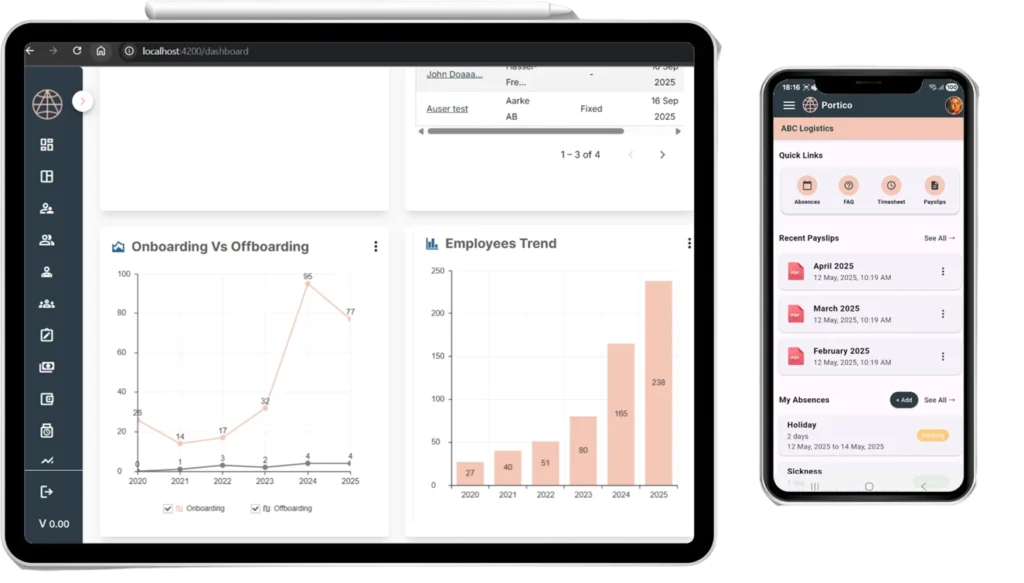
We don’t hide fees or sneak price increases. We run Danish payroll in-house and register you under your own CVR number rather than pooling you under a bureau’s, so the same team that files your eIndkomst answers your calls. You get a named account manager, one consolidated monthly invoice covering salaries, levies, taxes and fees, and one live Portico view of Denmark beside every other country we run for you. Portico syncs with your time-tracking, leave and HR systems via API – set up by our onboarding team, not left to yours. GDPR, SOC 2 and ISO 27001 certified.

Other services
Accelerating your growth in Denmark and beyond
TopSource goes far beyond payroll, acting as your end-to-end partner in global workforce management. From Employer of Record (EOR) services and seamless entity setup to localized accountancy and fractional HR support, we cover every aspect of international employment.

Meet our experts for Denmark
Whether you’re entering the market or scaling operations, our specialists provide the insight and guidance you need to succeed in one of the world’s most dynamic and regulated employment landscapes. With TopSource, you’re backed by real experts, every step of the way.

Beyond a payroll serviceA globalization accelerator
Payroll platform
Global payroll simplified
Your intuitive hub for paying global teams. Simple, powerful, and designed to scale with you — no complexity, just clarity.
Audit
Eliminate barriers to growth
Avoid compliance issues across your global workforce and uncover opportunities to improve profitability. On a quarterly basis we’ll help you audit your global talent strategy to ensure it aligns with your business goals.
Intelligence
Build a data-driven talent strategy
Grow confidently and profitably with access to the latest TopSource insights & data on hiring markets, salary benchmarking & benefits.
Advisory
Expert guidance that turns complexity into clarity.
Whether you’re managing a global acquisition or entering a new market, you get clear guidance to navigate complex decisions, avoid delays, and accelerate your global expansion.


Danish payroll FAQs
It depends almost entirely on whether a collective agreement applies, and the difference is about 21 percentage points. Denmark’s statutory employer contributions are flat kroner amounts rather than percentages – about DKK 8,250 a year per full-time office employee in 2026, which is 2.36% of a DKK 350,000 salary and 0.41% of DKK 2,000,000. With the 0.45% store bededag supplement and the 1% ferietillæg, an employee with no agreement costs about 2% to 4% above salary. Add an Industriens Overenskomst-style agreement, with 11.0% employer pension and a 10.0% Fritvalgs Lønkonto, and the total rises to about 23% to 25% above base salary.
Denmark has no statutory minimum wage – there is no Act setting a national rate. The floor comes from collective agreements: the Industriens Overenskomst minimum is DKK 143.40 an hour from 1 March 2026, and other agreements set their own. For an employee not covered by any agreement there is no legal wage floor at all, which is the part foreign employers find hardest to believe. The EU Minimum Wage Directive does not require one either: it leaves wage-setting to collective bargaining where that is the national model, and on 11 November 2025 the Court of Justice, in a case brought by Denmark (C-19/23), annulled parts of its Article 5 while upholding the rest.
The Fritvalgs Lønkonto – Særlig Opsparing in some agreements – is a percentage of holiday-qualifying pay set aside that the employee can take as cash, extra pension, extra days off or care days. Under Industriens Overenskomst it rose from 9.0% to 10.0% on 1 March 2026 and rises to 11.0% on 1 March 2027. It is a collective agreement obligation, not a statutory one, so an employer with no agreement owes nothing. On a DKK 500,000 salary, 10% is DKK 50,000 a year – almost as much as the employer pension.
Danish employees accrue 2.08 days a month to 25 days a year, on a holiday year running 1 September to 31 August, with sixteen months in which to take it. Salaried employees draw normal salary during holiday plus a ferietillæg of 1%, so there is effectively no holiday cash flow while employment continues. Hourly-paid employees instead accrue feriegodtgørelse at 12.5%, paid to FerieKonto. Concurrent holiday, introduced in 2020, made accrual concurrent but did not make the money pay-as-you-go for salaried staff: untaken holiday is settled at 12.5% through FerieKonto when the employee leaves.
The forskerskatteordningen is Denmark’s tax scheme for researchers and highly paid key employees recruited from abroad: 27% tax plus 8% AM-bidrag, a combined rate of 32.84%, for up to seven years. The minimum salary requirement fell from DKK 78,000 to DKK 65,400 a month for employment starting on or after 1 January 2026, a cut of about 16% that materially widened the scheme; employees hired in 2025 remain on the old figure. The requirement is an average, so a change to pay structure during the year can break it.
The employer carries the first 30 calendar days of sickness, and from day 31 the employee’s municipality reimburses up to the sygedagpenge maximum of DKK 5,085 a week in 2026 where the employer continues to pay salary. The claim must be made through NemRefusion within five weeks of the first day of absence – not five weeks from day 31 – and missing that window loses the reimbursement. A §56 agreement, made in advance with the employee and the municipality for someone with a chronic condition, moves reimbursement to the first day. Reimbursement is not automatic: it is a separate application against a statutory deadline.
eIndkomst is the Danish income register, and all wage reporting goes to it monthly – there is no separate annual employer return and no year-end certificate, because SKAT builds each employee’s annual statement from the monthly data. The deadline depends on your size. Small and medium employers report and pay A-skat and AM-bidrag by the 10th of the month after the pay month. Large employers – broadly those with annual A-skat above DKK 1,000,000 or AM-bidrag above DKK 250,000 – report and pay by the last day of the pay month itself, so check the category SKAT has given you in TastSelv Erhverv.
Yes, since 1 July 2024. Every Danish employer must operate an objective, reliable and accessible system recording each employee’s daily working time, keep the records for five years, and give employees access to their own data. The duty is to record working time, not only overtime or absence, so a system that logs only holiday and sickness does not comply. No particular technology is required. Self-organising employees can be exempt, but the exemption has to be agreed in writing.
It depends on whether the employee is a funktionær, and that classification follows the actual duties rather than the job title. For funktionærer the Funktionærloven sets a mandatory ladder: 14 days during an agreed probation of up to three months, one month up to six months’ service, three months to two years and nine months, four months to five years and eight months, five months to eight years and seven months, and six months thereafter. Employees give one month regardless. Notice runs to the end of a month. Employees who are not funktionærer have no statutory ladder – their notice comes from the collective agreement and is often much shorter.
Yes, and Denmark is one of the more permissive regimes in Europe on this. A foreign company can register as an employer through virk.dk, receive a CVR number for A-skat and AM-bidrag, and run Danish payroll without a subsidiary. ATP and the Samlet Betaling levies become payable once employees pass the hour thresholds, and a NemKonto must be designated before any reimbursement can be received. One point is widely misunderstood: a foreign employer with no Danish permanent establishment is generally not obliged to withhold Danish tax, but the tax is not avoided – the employee becomes responsible for paying it, which is why most employers register and withhold anyway.
Looking at other markets too?
We help organizations employ and pay teams in 164 countries.