Payroll Services in Poland
Polish employer social cost is 20.48% of pay – until the annual cap, after which it is 4.22%. TopSource tracks that cap employee by employee so it stops on the right day, runs PPK through the March 2027 re-enrolment, and checks every engagement against the reclassification power the Labour Inspectorate gained in July 2026.

TopSource rated 5/5 by our customers

What Polish payroll actually involves
Poland is a well-run payroll jurisdiction with clear rules and reliable systems. What makes it difficult for a foreign employer is that three of its most consequential features – the annual contribution cap, the contract-type question and the PPK re-enrolment cycle – happen on a date rather than every month, and none of them announces itself. These are the five things that decide whether a Polish payroll is right.
Our Partners Globally









Calculate Your Employee Costs in Poland
Enter a gross annual salary to see the full employer cost of a Polish employee: 9.76% pension and 6.50% disability insurance, each capped at PLN 282,600 of annual pay, plus 1.67% accident insurance, 2.45% for the Labour and Solidarity Funds and 0.10% for the guaranteed employee benefits fund. Because the cap is annual, the result is the average across the year. It does not include PPK, which adds 1.5% where the employee participates, or PFRON.
Employment Cost Calculator
*Indicative figures only and not definitive legal advice. Local regulations change frequently. Consult an expertPoland
| British Pound | Poland | |
|---|---|---|
| Base Salary (per month) | ||
| Employer Contributions | ||
| Total Cost (Annual) | ||
| Total Cost (Monthly) |
“Their expertise and understanding of the unique hiring, payment, and human resource practices in each country has been nothing short of outstanding. Our Client Success Manager, has done just that … ensured our success. Her availability and willingness to engage on a personal level has made all the difference.”

“Excellent service, especially from our account manager who has gone above and beyond to help us use the platform effectively. Our manager, significantly simplifies my workload. It is like having your own TopSource HR representative on your team.”
“TopSource has been our go-to resource for international hiring. They are responsive, thorough, respectful and knowledgeable. The Client Success team has provided us with the utmost customer service, and the more we use TopSource, the more, it gives us access to more resources and knowledge.”
Employer Costs in Poland Explained
Employer social contributions in Poland are 20.48% of gross at the default accident rate, ranging from 19.48% to 22.14% with the accident rate – and part of them stops. Pension and disability contributions, 16.26% of that total, cease once an employee’s cumulative earnings for the year reach PLN 282,600, leaving 4.22% for the rest of the year. An employee on PLN 10,000 a month therefore costs 20.48% across the year and one on PLN 100,000 a month costs 8.05%. PPK adds 1.5% for anyone who has not opted out. Here’s the breakdown.
Polish pension and disability contributions are capped at an annual earnings base of PLN 282,600 for 2026 – the trzydziestokrotność, thirty times the forecast average monthly wage of PLN 9,420, announced by the Minister of Family, Labour and Social Policy in Monitor Polski (M.P. 2025 poz. 1206). Once an employee’s cumulative gross for the year reaches that figure, the employer stops paying 16.26% and the employee stops paying 11.26%. Neither resumes until January. The threshold works out at exactly PLN 23,550 a month, the salary at which an employee reaches the cap at the end of December.
What is not capped matters just as much. Sickness contributions at 2.45%, accident contributions between 0.67% and 3.33%, the Labour Fund and Solidarity Fund at a combined 2.45%, the guaranteed benefits fund at 0.10% and the 9% health contribution all run on the full base for the whole year. So employer cost above the cap falls to 4.22% at a typical accident rate, not to nothing. On an employee earning PLN 100,000 a month, total employer social cost for the year is 8.05% of pay rather than 20.48%.
Here is the consequence almost no English-language guide states, and it is the most useful thing on this page for anyone budgeting a senior Polish hire. Because the cap is annual and cumulative, the employee’s net pay changes partway through the year. An employee on PLN 50,000 a month reaches the cap during June. From July their net monthly pay rises by about PLN 3,322 – roughly PLN 19,930 across the rest of the year – while the employer’s monthly cost for the same person falls from PLN 10,240 to PLN 2,110, a drop of 79%.
Two details to get right when you model it. The health contribution rises when the cap bites, because its base is gross less the employee’s social contributions and those have just fallen away – so the 9% is charged on a larger number. Income tax rises for the same reason. The net gain is real, but smaller than the headline 11.26% suggests.
Poland’s four engagement forms carry very different costs, and choosing between them has long been the central planning question for foreign employers here. An umowa o pracę – a full employment contract – carries the whole ZUS stack and the whole Labour Code: notice periods, paid leave, overtime rates, minimum wage. An umowa zlecenie, a mandate contract, carries ZUS but not the Labour Code, and no contributions at all where the contractor is a student under 26. An umowa o dzieło, a contract for a specific work, carries no ZUS. A B2B arrangement with a registered sole trader carries nothing from the engager at all.
That gap has pushed a great deal of Polish hiring, foreign and domestic, onto B2B and civil-law contracts – and on 8 July 2026 the position changed. Under the Act of 11 March 2026 amending the State Labour Inspectorate Act (Dz.U. 2026 poz. 473), a regional labour inspector can now declare by administrative decision that a civil-law or B2B arrangement is an employment relationship, where the employer has not acted on an earlier order to put it right. Until July only a labour court could do that. Now the decision comes first and the employer appeals to the labour court afterwards.
The test itself has not changed. Article 22 of the Labour Code turns on work performed under the employer’s direction, at a place and time the employer sets, and it applies whatever the contract is called. What changed is who decides first, how quickly and what it costs: the fine for using a civil-law contract where an employment contract is required doubled, to between PLN 2,000 and PLN 60,000. The inspectorate can also exchange information with ZUS and the tax administration, which makes a pattern of identical B2B contracts across a team far easier to see.
For a foreign employer the practical advice is narrow. If you have Polish people on B2B contracts who work fixed hours, use your equipment, report to your manager and cannot send a substitute, the classification is wrong and always has been – what changed is the chance of it being found. The Act gives a one-off window: an employer that voluntarily replaces such an arrangement with an employment contract by 8 July 2027 is not liable to the fine for it (article 16). The window covers that fine only.
Employer social contributions in Poland total 20.48% of gross at the default accident rate: 9.76% pension, 6.50% disability, 1.67% accident, 2.45% to the Labour Fund and Solidarity Fund combined, and 0.10% to the guaranteed employee benefits fund. The employee pays 13.71% in social contributions – 9.76% pension, 1.50% disability and 2.45% sickness – plus the 9% health contribution on pay after those contributions, about 21.5% of gross in all before income tax. Pension is the only contribution split evenly between the two sides.
The accident contribution is the only variable, and it accounts for the whole of the 19.48% to 22.14% range. A payer reporting up to nine insured persons pays a flat 1.67%, half the top rate in the schedule. From ten insured persons the rate follows the employer’s activity group and its own accident record, between 0.67% and 3.33%, and the contribution year runs from 1 April to 31 March rather than with the calendar. A foreign employer setting up in Poland should check its PKD activity code before registering, because it drives a real cost for as long as the entity exists.
Two employer costs are missing from almost every English-language guide. The first is the Solidarity Fund, hidden inside the 2.45% line most sources call the Labour Fund: it is 1.00% Labour Fund plus 1.45% Solidarity Fund, two funds reported on one line. The second is PFRON, the State Fund for the Rehabilitation of Disabled Persons, payable monthly by any employer with 25 or more full-time equivalent staff of whom fewer than 6% are registered disabled. It is charged for each missing disabled full-time equivalent, and it is not small.
Genuine exemptions also get missed in the other direction. Labour Fund, Solidarity Fund and guaranteed benefits fund contributions are not due for women from 55 or men from 60, and there are exemptions for employees returning from maternity or parental leave and for certain newly hired older or previously unemployed workers. They sit in the employer’s configuration rather than on the payslip, so nobody notices when they are missing.
Personal income tax is 12% on taxable income up to PLN 120,000 and 32% above it, with a PLN 30,000 tax-free amount applied as a PLN 300 monthly reduction – which the employer uses only where the employee has filed a PIT-2. A missing PIT-2 means PLN 3,600 a year of over-withholding, recovered only on the annual return, and it is one of the most common onboarding errors on a Polish payroll. Standard deductible employment costs are PLN 250 a month, or PLN 300 for employees commuting from another town. A 4% solidarity levy applies to income above PLN 1 million, assessed annually rather than withheld.
Poland’s zero-rate reliefs, known as PIT-0, are routinely overstated. The reliefs for people under 26, for those returning to Poland, for families with four or more children and for working pensioners exempt income from personal income tax up to PLN 85,528 a year – and none of them touches ZUS or the health contribution. An employee under 26 on an employment contract still costs the employer the full 20.48%. The only genuine contribution exemption for the under-26s is a mandate contract with a student, which is a different arrangement entirely.
PPK is Poland’s auto-enrolment pension: the employer pays 1.5% of gross and can go to 4%, the employee pays 2% and can go to 4%, and the state adds a PLN 250 welcome payment and a PLN 240 annual top-up. Employees can opt out, and many did, but the opt-out is not permanent – it lapses every four years and everyone who opted out is re-enrolled unless they opt out again. At the end of July 2026 participation stood at about 62%, with 4.4 million members.
The next re-enrolment is the date to diarise. Opt-out declarations made before 1 March 2027 lapse on that date, employers must tell the employees concerned by the end of February 2027, and contributions restart from March pay, due to the financial institution between 1 and 15 April 2027. An employer that does nothing will see its Polish payroll cost rise by 1.5% of gross for every employee who does not opt out again, and the failure mode is silence rather than an error message.
Annual leave is 20 days for employees with under ten years of seniority and 26 days from ten years, and seniority is not simply time served with you: completed education counts, up to eight years for a university degree, and all previous employment counts in full. Under the Act of 26 September 2025 (Dz.U. 2025 poz. 1423), periods of self-employment with contributions paid and of civil-law contract work now count too. It applied to the public sector from 1 January 2026 but to private employers only from 1 May 2026.
Sick pay is split. The employer pays for the first 33 days of sickness in a calendar year, or 14 days for employees aged 50 and over, generally at 80% of pay, and ZUS pays sickness benefit after that. Maternity and parental leave are ZUS-funded, and parental leave includes nine weeks for each parent that cannot be transferred. Parents who apply within 21 days of the birth can take a flat 81.5% benefit across the whole entitlement instead of the stepped default – usually the better choice, and usually not explained to them.
Notice runs from two weeks to three months by length of service with the employer. At employers with 20 or more employees, statutory severance under the collective redundancies act runs from one to three months’ pay by length of service, capped at fifteen times the minimum wage – and it is due on an individual redundancy too, not only on a collective one, a distinction international guides often get wrong. Poland has no at-will dismissal: ending an indefinite contract requires a stated, genuine reason.
Pay transparency is already law here, not pending. Since 24 December 2025, under the Act of 4 June 2025 (Dz.U. 2025 poz. 807), a candidate must be told the pay or pay range in the job advertisement, before the interview or at the latest before the contract is signed, and employers may not ask about pay in current or previous jobs. Much English-language commentary still describes this as arriving with the EU Pay Transparency Directive. It arrived in Poland first, and recruitment run from outside Poland is the most likely to be non-compliant without realising it.
Poland employer and employee contribution rates, 2026
| Contribution | Employer | Employee | Detail, and whether it caps |
|---|---|---|---|
| Emerytalna – pension | 9.76% | 9.76% | The only symmetrical contribution. Capped at PLN 282,600 for 2026 |
| Rentowa – disability | 6.50% | 1.50% | Capped at PLN 282,600 |
| Chorobowa – sickness | — | 2.45% | Employee only. Not capped |
| Wypadkowa – accident | 0.67%–3.33% | — | Not capped. Flat 1.67% for payers with up to nine insured |
| Fundusz Pracy and Fundusz Solidarnościowy | 2.45% | — | Two funds on one line: Labour Fund 1.00% and Solidarity Fund 1.45%. Not capped |
| FGŚP – guaranteed benefits | 0.10% | — | Not capped |
| Total employer ZUS | 20.48% | — | At the 1.67% accident rate. Range 19.48%–22.14% |
| Employer total above the cap | 4.22% | — | Only accident, the two funds and FGŚP continue |
| Total employee social | — | 13.71% | Of which 11.26% caps and 2.45% does not |
| Składka zdrowotna – health | — | 9.00% | Not capped and not tax-deductible. Charged on gross less social contributions |
| Annual contribution cap | — | — | PLN 282,600: thirty times the forecast average wage of PLN 9,420 (M.P. 2025 poz. 1206) |
| PPK | 1.50% | 2.00% | Each may be raised to 4%. Opt-outs made before 1 March 2027 lapse on that date |
| PIT | — | 12% / 32% | 12% up to PLN 120,000 of taxable income, 32% above |
| Tax-free amount | — | PLN 30,000 | Applied as PLN 300 a month, only where the employee has filed a PIT-2 |
| Solidarity levy | — | 4% | On income above PLN 1 million. Assessed annually, not withheld |
| Minimum wage 2026 | — | — | PLN 4,806 a month; PLN 31.40 an hour for civil-law contracts (Dz.U. 2025 poz. 1242) |
| PFRON | Variable | — | Employers with 25 or more FTE and under 6% registered disabled staff |
The four Polish engagement forms – and who decides which one you have
| Engagement form | Social contributions | Labour Code rights | What to know |
|---|---|---|---|
| Umowa o pracę – employment contract | Full ZUS: 20.48% employer, 13.71% employee | Yes – leave, notice, overtime, minimum wage | The default, and the only form safe from reclassification |
| Umowa zlecenie – mandate contract | Full ZUS; sickness cover voluntary | No, but the PLN 31.40 minimum hourly rate applies | Can be reclassified by PIP decision since 8 July 2026 |
| Umowa zlecenie with a student under 26 | None | No | A genuine exemption, and the only real under-26 contribution saving |
| Umowa o dzieło – contract for specific work | None | No | Reported to ZUS on form RUD within 7 days. Narrow test: a defined, verifiable result, not ongoing services |
| B2B – contract with a registered sole trader | None from the engager | No | Can be reclassified by PIP decision since 8 July 2026. The highest-risk form |
| Who decides | Until 8 July 2026 only a labour court. Now a regional labour inspector, by decision, once an order to correct has been ignored; the employer appeals to the labour court | ||
| The test | Article 22 of the Labour Code: work under the employer’s direction, at a place and time the employer sets, whatever the contract is called | ||
| Fine | PLN 2,000 to PLN 60,000, doubled from PLN 1,000 to 30,000 | ||
| One-off window | No fine for a past arrangement voluntarily converted into an employment contract by 8 July 2027 (article 16) | ||
| Instrument | Act of 11 March 2026, Dz.U. 2026 poz. 473, in force 8 July 2026 | ||
What a Polish employee costs across the salary range, 2026
| Monthly gross | Annual gross | Capped 16.26% | Uncapped 4.22% | Total employer | % of gross | Cap reached |
|---|---|---|---|---|---|---|
| PLN 5,000 | PLN 60,000 | PLN 9,756 | PLN 2,532 | PLN 12,288 | 20.48% | Never |
| PLN 10,000 | PLN 120,000 | PLN 19,512 | PLN 5,064 | PLN 24,576 | 20.48% | Never |
| PLN 15,000 | PLN 180,000 | PLN 29,268 | PLN 7,596 | PLN 36,864 | 20.48% | Never |
| PLN 23,550 | PLN 282,600 | PLN 45,951 | PLN 11,926 | PLN 57,876 | 20.48% | 31 December |
| PLN 30,000 | PLN 360,000 | PLN 45,951 | PLN 15,192 | PLN 61,143 | 16.98% | Month 10 |
| PLN 50,000 | PLN 600,000 | PLN 45,951 | PLN 25,320 | PLN 71,271 | 11.88% | Month 6 |
| PLN 100,000 | PLN 1,200,000 | PLN 45,951 | PLN 50,640 | PLN 96,591 | 8.05% | Month 3 |
Pension and disability are the only capped contributions. Everything else – sickness, accident, the Labour and Solidarity Funds, the guaranteed benefits fund and the 9% health contribution – runs on the full base all year, and the health contribution rises when the capped contributions stop, because its base is gross less the employee’s social contributions. The cost table assumes twelve equal monthly payments with no bonus and accident insurance at 1.67%, and excludes PPK and PFRON; figures are rounded to the nearest złoty, so components may not add exactly. These are TopSource calculations from the 2026 rates, not published figures.
Rates and thresholds are for the 2026 calendar year and were verified on 25 September 2026. The annual contribution cap is announced in Monitor Polski each autumn and the 2027 figure had not been published at that date; the minimum wage is also reset each January, and the accident contribution year runs from 1 April to 31 March. This page is general information, not tax or legal advice.
How our Poland payroll service works
Why TopSource for Polish Payroll
TopSource for payroll, Employer of Record or any other of our services represents a simpler, more reliable and transparent option. If you would rather not employ staff in Poland directly, our Employer of Record in Poland can employ them on your behalf.
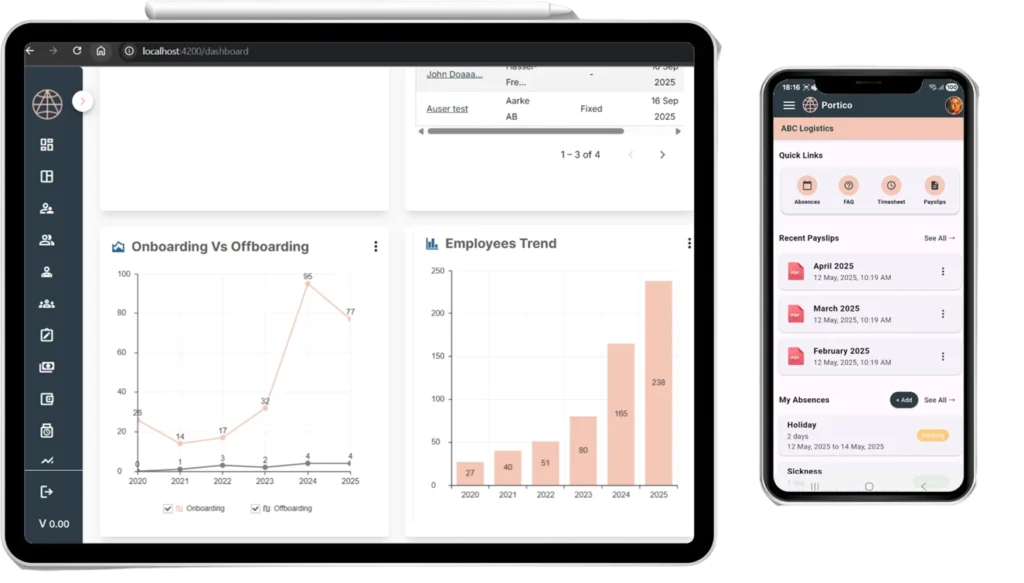
We don’t hide fees or sneak price increases. We run Polish payroll in-house and file under your own ZUS and tax registrations rather than a bureau’s, so the same team that files your declarations answers your calls – and we will tell you plainly whether you need an entity in Poland or whether direct registration with ZUS will do. You get a named account manager, one consolidated monthly invoice covering salaries, contributions, taxes and fees, and one live Portico view of Poland beside every other country we run for you. Portico syncs with your time-tracking, leave and HR systems via API – set up by our onboarding team, not left to yours. GDPR, SOC 2 and ISO 27001 certified.

Other services
Accelerating your growth in Poland and beyond
TopSource goes far beyond payroll, acting as your end-to-end partner in global workforce management. From Employer of Record (EOR) services and seamless entity setup to localized accountancy and fractional HR support, we cover every aspect of international employment.

Meet our experts for Poland
Whether you’re entering the market or scaling operations, our specialists provide the insight and guidance you need to succeed in one of the world’s most dynamic and regulated employment landscapes. With TopSource, you’re backed by real experts, every step of the way.

Beyond a payroll serviceA globalization accelerator
Payroll platform
Global payroll simplified
Your intuitive hub for paying global teams. Simple, powerful, and designed to scale with you — no complexity, just clarity.
Audit
Eliminate barriers to growth
Avoid compliance issues across your global workforce and uncover opportunities to improve profitability. On a quarterly basis we’ll help you audit your global talent strategy to ensure it aligns with your business goals.
Intelligence
Build a data-driven talent strategy
Grow confidently and profitably with access to the latest TopSource insights & data on hiring markets, salary benchmarking & benefits.
Advisory
Expert guidance that turns complexity into clarity.
Whether you’re managing a global acquisition or entering a new market, you get clear guidance to navigate complex decisions, avoid delays, and accelerate your global expansion.



Polish payroll FAQs
Employer social contributions in Poland are 20.48% of gross at the default accident rate, within a range of 19.48% to 22.14% set by the accident rate – and the cost falls sharply above the annual cap. Pension and disability contributions, 16.26% of that total, stop once the employee’s cumulative earnings for the year reach PLN 282,600, leaving only 4.22% for the rest of the year. So an employee on PLN 10,000 a month costs 20.48% in employer contributions across the year, while one on PLN 100,000 a month costs 8.05%. PPK adds 1.5% for employees who have not opted out.
The annual contribution cap – the trzydziestokrotność – is PLN 282,600 for 2026, thirty times the forecast average monthly wage of PLN 9,420. Once an employee’s cumulative gross earnings for the calendar year reach that figure, both sides stop paying pension and disability contributions: 16.26% for the employer and 11.26% for the employee. Everything else continues on the full base – sickness, accident, the Labour and Solidarity Funds, the guaranteed benefits fund and the 9% health contribution. The threshold works out at PLN 23,550 a month, the salary at which an employee reaches the cap exactly at the end of December.
Yes, for anyone earning more than PLN 23,550 a month, and it is one of the least-known features of Polish payroll. Because the contribution cap is annual and cumulative, a well-paid employee stops paying 11.26% in social contributions once their year-to-date earnings pass PLN 282,600, so their take-home pay rises for the rest of the year with no change to their salary. An employee on PLN 50,000 a month reaches the cap during June and takes home about PLN 3,322 more each month from July, roughly PLN 19,930 across the rest of the year. The rise is less than 11.26% of gross, because the health contribution and income tax both increase when the social deductions fall away.
Yes. Since 8 July 2026 a regional labour inspector can declare by administrative decision that a B2B or civil-law arrangement is an employment relationship, without going to a labour court first, where the employer has ignored an earlier order to correct it. The power comes from the Act of 11 March 2026 amending the State Labour Inspectorate Act, Dz.U. 2026 poz. 473. The test in article 22 of the Labour Code is unchanged, but the employer now appeals after the decision rather than defending before it, fines run from PLN 2,000 to PLN 60,000, and the inspectorate exchanges data with ZUS and the tax administration. An employer that voluntarily converts such an arrangement into an employment contract by 8 July 2027 escapes the fine for it.
Not necessarily. A foreign employer can register directly with ZUS as a contribution payer and run compliant payroll without a Polish company. An employer based elsewhere in the EU, the EEA or Switzerland has a second option under EU coordination rules: it can agree in writing that the employee calculates and pays their own social contributions. Both routes are genuine and both are narrow: they suit a small number of people and shift administration rather than removing it. For anything beyond a handful of staff a Polish limited company is usually the cleaner answer, and the decision should turn on your permanent establishment position as much as on headcount.
PPK is Poland’s workplace pension auto-enrolment scheme: the employer contributes 1.5% of gross with an option to go to 4%, the employee contributes 2% with the same option, and the state adds a welcome payment and an annual top-up. Employees may opt out, but not for good: the opt-out lapses every four years and everyone who opted out is re-enrolled unless they opt out again. Opt-out declarations made before 1 March 2027 lapse on that date, employers must notify the employees concerned by the end of February 2027, and contributions restart from March pay, due between 1 and 15 April 2027. Participation was about 62% at the end of July 2026.
No, and it is the most common misunderstanding about Polish payroll cost. The relief for people under 26 – like the other PIT-0 reliefs for returning migrants, families with four or more children and working pensioners – exempts income from personal income tax only, up to PLN 85,528 a year. It does not touch ZUS or the 9% health contribution. An employee under 26 on an employment contract still costs the employer the full 20.48% and still has 13.71% plus the health contribution deducted. The only genuine contribution saving for the under-26s is a mandate contract with a student, which is a different arrangement with different consequences.
PFRON is Poland’s State Fund for the Rehabilitation of Disabled Persons, and it is an employer levy that almost every English-language guide to Polish payroll leaves out. Any employer with 25 or more full-time equivalent employees of whom fewer than 6% are registered disabled pays a monthly contribution calculated on the shortfall, so it is a real and recurring cost for a growing international employer that crosses the 25 FTE line without noticing. Employers can reduce it by employing registered disabled staff or by buying from qualifying suppliers. It is declared and paid monthly, separately from ZUS.
Twenty days a year for employees with under ten years of seniority and twenty-six days from ten years – but seniority is not simply time served with you. Completed education counts, up to eight years for a university degree, and all previous employment counts in full, so a graduate with a couple of years’ experience usually starts on twenty-six days. Since the Act of 26 September 2025, periods of self-employment with contributions paid and of civil-law contract work count as well. The change applied to the public sector from 1 January 2026 and to private employers from 1 May 2026.
PLN 4,806 a month for a full-time employment contract, and PLN 31.40 an hour as the minimum rate for civil-law mandate contracts, both from 1 January 2026 under the Council of Ministers regulation published at Dz.U. 2025 poz. 1242. The hourly rate matters more than international employers expect, because it reaches umowa zlecenie arrangements that sit outside the Labour Code – one of the few statutory protections that does. The law provides for two increases in a year when forecast inflation reaches 5%; 2025 and 2026 each had a single increase because the forecast stayed below that.
Looking at other markets too?
We help organizations employ and pay teams in 164 countries.