Payroll Services in the Maldives
Fully managed Maldivian payroll – employee withholding tax filed with MIRA by the 15th, pension contributions paid on the basic salary your contracts actually define, service charge distributed on time, and every expatriate work permit fee tracked in Xpat, with a named specialist a phone call away.

TopSource rated 5/5 by our customers
What Maldivian payroll actually involves
Maldivian payroll looks light: one tax authority, no employer social security and a 7% pension contribution. The work is in the detail around it, and 2026 has changed more of that detail than most years.
Our Partners Globally









Calculate Your Employee Costs in the Maldives
Enter a gross annual basic salary to see the employer cost of a Maldivian employee: the 7% employer contribution to the Maldives Retirement Pension Scheme, with no ceiling, plus the MVR 3,000 Ramadan allowance every Maldivian employee is owed. It assumes the salary entered is the basic salary in the contract, because allowances and service charge are outside the pension base. For an expatriate, pension is voluntary and the costs are work permit fees, quota fees and insurance instead, shown in the table below.
Employment Cost Calculator
*Indicative figures only and not definitive legal advice. Local regulations change frequently. Consult an expertMaldives
| British Pound | Maldives | |
|---|---|---|
| Base Salary (per month) | ||
| Employer Contributions | ||
| Total Cost (Annual) | ||
| Total Cost (Monthly) |
“Their expertise and understanding of the unique hiring, payment, and human resource practices in each country has been nothing short of outstanding. Our Client Success Manager, has done just that … ensured our success. Her availability and willingness to engage on a personal level has made all the difference.”

“Excellent service, especially from our account manager who has gone above and beyond to help us use the platform effectively. Our manager, significantly simplifies my workload. It is like having your own TopSource HR representative on your team.”
“TopSource has been our go-to resource for international hiring. They are responsive, thorough, respectful and knowledgeable. The Client Success team has provided us with the utmost customer service, and the more we use TopSource, the more, it gives us access to more resources and knowledge.”
Employer Costs in the Maldives Explained
The statutory employer cost of a Maldivian employee is 7% of basic salary for the pension scheme plus the MVR 3,000 Ramadan allowance: about 10.1% of a MVR 8,000 monthly basic salary and about 7.4% at MVR 60,000. There is no employer social security contribution, no payroll tax and no employer health insurance contribution, because Aasandha, the national health insurance, is funded by the state. There is no statutory severance either. An expatriate is the reverse: usually no pension, but about MVR 7,000 a year in work permit fees, quota fees and insurance, plus a refundable deposit. Two things sit outside those numbers: 60 days of maternity leave at full pay, funded by the employer alone, and in tourism, the monthly service charge distribution. Here’s the breakdown.
The Maldives Retirement Pension Scheme is the only employer contribution in Maldivian payroll. Under section 14 of the Pension Act, the employer pays at least 7% and the employee 7% of pensionable wage, 14% in total, for every Maldivian employee aged 16 to 65. The employer may pay more than 7%, or the full 14%, but no more than 7% may be deducted from the employee’s salary. Nothing is due for employees over 65. Foreign employees may join voluntarily unless the employer objects, and can withdraw their balance when they leave the Maldives for good.
Pensionable wage is the basic salary stated in the employment contract, under the Regulation on Determining the Pensionable Wage in force since February 2021. Only three deductions reduce it: lateness penalties, unauthorised absence, and days not owed in a joining or leaving month. The rule that matters most is the fallback. Where the contract does not use the term basic salary, or says nothing about pension, the pensionable wage becomes the whole month’s pay plus allowances. A resort contract that describes a single consolidated salary therefore pays pension on all of it. There is no floor or ceiling in rufiyaa, and contributions are calculated in MVR even where salaries are paid in US dollars.
Contributions are paid before the 15th of the month after the month worked, with a monthly Statement of Pension Contributions filed through the Pension Office’s Koshaaru portal. Late contributions attract a surcharge of 0.5% a month, paid into the employee’s own retirement account rather than to the state, and an unfiled statement costs MVR 100 a month. Since April 2024 the Pension Office takes arrears of MVR 5,000 or more, or older than twelve months, to court. Both the employer and the employee contributions are exempt from income tax, and the employee contribution is deducted before withholding tax is calculated.
For a Maldivian employee the statutory cost is short enough to list in full: 7% of basic salary to the pension scheme and a MVR 3,000 Ramadan allowance paid before Ramadan begins. On a monthly basic salary of MVR 8,000 that is MVR 9,720 a year, or 10.13%. At MVR 60,000 a month it is MVR 53,400, or 7.42%. Because the Ramadan allowance is a flat amount, the effective rate falls as salary rises, but only slowly, since the pension has no ceiling.
What is missing matters as much as what is there. There is no employer social security contribution, no unemployment insurance and no payroll tax paid to MIRA. Aasandha covers every Maldivian citizen and is funded by the government, with nothing collected through payroll. And the Employment Act contains no statutory severance or end-of-service gratuity: on termination the employer owes notice or pay in lieu, unused annual leave and all other dues within seven days.
The minimum wage is set by the Minimum Wage Order of November 2021, in force since 1 January 2022, and it depends on the size of the employer rather than the sector. Micro enterprises are exempt. Small private enterprises pay at least MVR 21.63 an hour, about MVR 4,500 a month; medium enterprises MVR 33.65, about MVR 7,000; and larger private employers MVR 38.46, about MVR 8,000. There is no separate tourism rate: a resort pays the rate for its size. Basic salary and fixed allowances count towards it; overtime, service charge, the Ramadan allowance, bonuses and benefits in kind do not. The Order does not apply to expatriate employees, and the review due in November 2023 has not yet produced a new Order.
Two costs sit outside the annual percentages. Maternity leave is 60 days at full pay, paid by the employer on the normal pay day with no state reimbursement, plus up to 28 further days, which may be unpaid, where a doctor certifies ill health. And in tourism, service charge is collected from guests but distributed through payroll, so it adds administration, reporting and tax withholding rather than cost.
Income tax on salaries has been withheld at source since April 2020 under the Income Tax Act. The monthly bands are 0% up to MVR 60,000 of taxable pay, 5.5% from MVR 60,000 to 100,000, 8% to 150,000, 12% to 200,000 and 15% above that, with each rate applying only to the income inside its band. The annual equivalents are twelve times those figures, so a salary up to MVR 720,000 a year carries no tax at all. Expatriates are withheld on the same bands as Maldivians; the 10% non-resident withholding tax covers payments such as fees and royalties, not salaries.
Taxable pay is the month’s total remuneration, cash and non-cash, less the employee’s own pension contribution. Benefits in kind are valued at cost or market value, with specific exemptions: staff accommodation in premises set up only for employees, transport to a workplace on an uninhabited island, work uniforms, awards up to MVR 5,000 a year, other non-cash benefits up to MVR 1,000 a month, and the medical insurance the Immigration Act requires. Two changes took effect on 20 August 2026. Accommodation on an uninhabited island, or on a vessel for someone who works on it, is no longer remuneration at all. And a room with a private bathroom used by a single employee no longer qualifies for the staff accommodation exemption, however modest it is.
The employer files the MIRA 601 Employee Withholding Tax Return and pays through MIRAconnect by the 15th of the month after the salary was paid or became payable. Employees must be registered on form MIRA 118 once any of them averages more than MVR 60,000 a month, and at that point every employee averaging MVR 30,000 or more must be registered too. An employee with two employers chooses one to apply the tax-free band, on form MIRA 916; every other employer withholds a flat 8%. Where tax is not withheld, the amount paid is treated as net and the employer must gross it up and pay the tax itself.
Employers whose functional currency is not the rufiyaa – which in practice means most resorts – have filed and paid withholding tax in US dollars since October 2024. And the penalties changed on 31 August 2026, when the fourth amendment to the Tax Administration Act doubled the daily surcharge on late payment from 0.05% to 0.1% and replaced house arrest with imprisonment for failure to file.
Every expatriate needs a quota slot, employment approval and a work permit, all managed through the Xpat system run by the Ministry of Homeland Security. The quota fee is MVR 2,000 a year for each slot and the work permit fee is MVR 350 a month for each worker, which the employer pays. The separate work visa fee was discontinued in November 2020. A refundable deposit is charged per worker and depends on nationality, from about MVR 3,500 for an Indian national to MVR 18,750 for a US national on the published table, and refunds are paid to the employer’s Xpat wallet. Since the ninth amendment the Cabinet can exempt micro, small and medium enterprises from the quota fee, and qualifying businesses already receive up to 20 commercial quota slots free.
The employer must also arrange work permit medical insurance from a registered provider – cover of at least MVR 100,000 for twelve months, with the premium capped at MVR 800 – and a medical report from an approved facility within 15 days of arrival, renewed every year. The work visa is now issued only as an e-Visa, applied for within 15 days of arrival. From late September 2026 an expatriate’s salary must be paid into a bank account in the employee’s own name at a bank licensed by the Maldives Monetary Authority; in a wage dispute, salary paid any other way does not count as paid.
The regulation on expatriate employment that took effect in December 2025 adds three constraints worth planning around. It reserves a list of occupations for Maldivians over the following two to five years, cancelling existing quotas as each period ends – accountants and electricians after two years, nurses and divers after three, HR and front office managers after five. It counts three years of GST and income tax filing history when quotas are reviewed. And fines run from MVR 50,000 for a first violation to MVR 100,000 for a third. Separately, in workplaces with more than 50 employees the head of HR and 60% of senior management must be Maldivian.
Normal working time is up to 48 hours a week, with no more than six consecutive days without 24 hours off. The Act sets no daily limit, and it does not shorten private-sector hours during Ramadan; the reduced hours announced each year apply to government employees. Overtime requires agreement and is paid at 1.25 times the hourly salary on ordinary days and 1.5 times on Fridays and public holidays, and since March 2026 it is due for work beyond daily normal hours even below 48 hours in the week. At resorts and on tourist vessels, weekly rest days can be accumulated and taken later.
Paid leave is generous and entirely employer-funded. Annual leave is 30 days after a year of service and cannot be paid in lieu except on termination. Sick leave is 30 days a year, up to 15 of them without a certificate if each absence is no longer than two days. Maternity leave is 60 days at full pay; paternity leave three days; family responsibility leave ten days a year; and circumcision leave five days. Since March 2026 mothers are entitled to two paid 30-minute nursing breaks a day until the child is two. There is no statutory Hajj leave in the Employment Act. Every Maldivian employee is owed a MVR 3,000 Ramadan allowance, paid before Ramadan starts.
Wages are paid at least monthly, with a payslip showing total pay, each deduction and net pay, and overtime shown separately. They must be paid in rufiyaa unless the employer earns income in foreign currency, in which case salaries may be paid in that currency. On termination, notice on an indefinite contract is two weeks for under a year of service, one month from one to five years and two months beyond that, or pay in lieu. Redundancy carries its own notice of one, two or three months. Probation lasts up to three months, during which either side may end the contract without notice. There is no statutory severance, all final dues are payable within seven days, and an unfair dismissal claim must reach the Employment Tribunal within three months.
Maldivian employer contribution rates, 2026
| Contribution | Employer | Employee | Applies to |
|---|---|---|---|
| Retirement Pension Scheme (MRPS) | 7% minimum | 7% | Basic salary in the contract. Maldivian employees aged 16 to 65; voluntary for foreigners |
| Employee withholding tax | — | 0% to 15% | See the bands below |
| Ramadan allowance | MVR 3,000 a year | — | Every Maldivian employee |
| Employer social security | None | None | Aasandha health insurance is state-funded |
| Work permit fee | MVR 350 a month | — | Each expatriate employee |
| Quota fee | MVR 2,000 a year | — | Each slot. Up to 20 free for qualifying small businesses |
| Deposit and medical insurance | Deposit by nationality; premium up to MVR 800 | — | Each expatriate. The deposit is refundable |
| Service charge (tourism) | At least 10%, collected from guests | — | Shared equally among staff by the end of the following month |
Employee withholding tax bands, 2026
| Monthly taxable pay | Rate on this band | Tax at the top of the band |
|---|---|---|
| Up to MVR 60,000 | 0% | MVR 0 |
| MVR 60,000 to 100,000 | 5.5% | MVR 2,200 |
| MVR 100,000 to 150,000 | 8% | MVR 6,200 |
| MVR 150,000 to 200,000 | 12% | MVR 12,200 |
| Above MVR 200,000 | 15% | MVR 12,200 plus 15% of the excess |
Employer statutory cost of a Maldivian employee, 2026
| Monthly basic salary | Pension 7% a year | Ramadan allowance | Total a year | Effective rate |
|---|---|---|---|---|
| MVR 4,500 | MVR 3,780 | MVR 3,000 | MVR 6,780 | 12.56% |
| MVR 8,000 | MVR 6,720 | MVR 3,000 | MVR 9,720 | 10.13% |
| MVR 15,000 | MVR 12,600 | MVR 3,000 | MVR 15,600 | 8.67% |
| MVR 30,000 | MVR 25,200 | MVR 3,000 | MVR 28,200 | 7.83% |
| MVR 60,000 | MVR 50,400 | MVR 3,000 | MVR 53,400 | 7.42% |
Taxable pay is total remuneration less the employee’s own pension contribution; the annual bands are twelve times the monthly ones. The cost table assumes a contract that defines basic salary. Expatriate fees are those published through the Xpat system and can change without notice. These are TopSource calculations from the verified 2026 rates.
Rates, thresholds, fees and statutory amounts shown are for 2026 and were verified on 16 September 2026. Several are under review: the minimum wage revision has been pending since 2023, the Pension Act amendment of May 2026 moved the contribution deadline into regulation, the penalties in the August 2026 amendment to the Tax Administration Act are being translated, and a bill to pay tourism service charge in the currency it was collected in is before the People’s Majlis. Islamic public holidays depend on moon sighting and are confirmed each year. This page is general information, not tax or legal advice.
How our Maldivian payroll service works
Why TopSource for Maldivian Payroll
TopSource for payroll, Employer of Record or any other of our services represents a simpler, more reliable and transparent option.
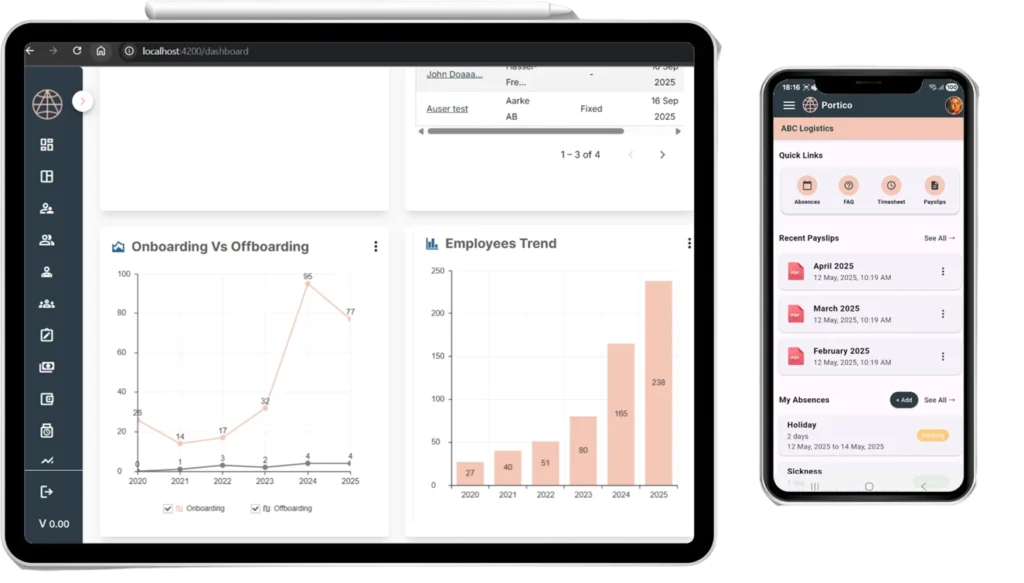
We don’t hide fees or sneak price increases. We run Maldivian payroll in-house and file under your own registration with MIRA and the Pension Office rather than a bureau’s, so the same team that files your MIRA 601 answers your calls. You get a named account manager, one consolidated monthly invoice covering salaries, pension, taxes and fees, and one live Portico view of the Maldives beside every other country we run for you. Portico syncs with your time-tracking, leave and HR systems via API – set up by our onboarding team, not left to yours. GDPR, SOC 2 and ISO 27001 certified.
Other services
Accelerating your growth in the Maldives and beyond
TopSource goes far beyond payroll, acting as your end-to-end partner in global workforce management. From Employer of Record (EOR) services and seamless entity setup to localized accountancy and fractional HR support, we cover every aspect of international employment.

Meet our experts for the Maldives
Whether you’re entering the market or scaling operations, our specialists provide the insight and guidance you need to succeed in one of the world’s most dynamic and regulated employment landscapes. With TopSource, you’re backed by real experts, every step of the way.

Beyond a payroll serviceA globalization accelerator
Payroll platform
Global payroll simplified
Your intuitive hub for paying global teams. Simple, powerful, and designed to scale with you — no complexity, just clarity.
Audit
Eliminate barriers to growth
Avoid compliance issues across your global workforce and uncover opportunities to improve profitability. On a quarterly basis we’ll help you audit your global talent strategy to ensure it aligns with your business goals.
Intelligence
Build a data-driven talent strategy
Grow confidently and profitably with access to the latest TopSource insights & data on hiring markets, salary benchmarking & benefits.
Advisory
Expert guidance that turns complexity into clarity.
Whether you’re managing a global acquisition or entering a new market, you get clear guidance to navigate complex decisions, avoid delays, and accelerate your global expansion.



Maldivian payroll FAQs
Employers contribute at least 7% of pensionable wage to the Maldives Retirement Pension Scheme, and the employee contributes 7%, for every Maldivian employee aged 16 to 65. Pensionable wage is the basic salary stated in the employment contract; if the contract does not define basic salary, it becomes the whole month’s pay plus allowances. There is no ceiling. Contributions are paid before the 15th of the following month, and late payments attract a surcharge of 0.5% a month paid into the employee’s retirement account. Pension is voluntary for foreign employees.
Employers withhold employee withholding tax every month on taxable pay, which is total remuneration less the employee’s own pension contribution. The monthly bands for 2026 are 0% up to MVR 60,000, 5.5% to MVR 100,000, 8% to MVR 150,000, 12% to MVR 200,000 and 15% above that, each applying only to the income inside the band. The MIRA 601 return and the payment are due through MIRAconnect by the 15th of the following month. An employee whose only income is from one employer does not file a personal return.
Expatriate employees are withheld on exactly the same income tax bands as Maldivians, so the first MVR 60,000 of monthly taxable pay is tax-free for them too. Pension is different: the Maldives Retirement Pension Scheme is mandatory only for Maldivian employees, and a foreign employee may join voluntarily unless the employer objects, and withdraw the balance on leaving the Maldives permanently. The employer’s statutory costs for an expatriate are work permit fees, quota fees and medical insurance instead.
The recurring statutory cost is about MVR 7,000 a year per expatriate: a work permit fee of MVR 350 a month, a quota fee of MVR 2,000 a year for the slot, and mandatory work permit medical insurance with the premium capped at MVR 800. On top of that there is a refundable deposit set by nationality, about MVR 3,500 for an Indian national to MVR 18,750 for a US national, and an annual medical report. Qualifying micro, small and medium enterprises receive up to 20 commercial quota slots free.
The Minimum Wage Order in force since 1 January 2022 sets hourly rates by employer size. Micro enterprises are exempt; small private enterprises pay at least MVR 21.63 an hour, about MVR 4,500 a month; medium enterprises MVR 33.65, about MVR 7,000; and larger private employers MVR 38.46, about MVR 8,000. There is no separate rate for tourism. Basic salary and fixed allowances count towards the minimum, while overtime, service charge and bonuses do not. The Order does not apply to expatriate employees, and a revision has been pending since 2023.
Tourism businesses must add a service charge of at least 10% to their services. Under section 52 of the Employment Act it must be shared equally among all employees who help provide the service, directly or indirectly, and each month’s collection must be paid out before the end of the following month. The employer may keep no more than 1% for administration. Distributions form part of taxable pay, records must be reported to the Labour Relations Authority and MIRA, and fines reach MVR 100,000 for not charging or not sharing it.
Salaries must generally be paid in Maldivian rufiyaa, but a business that earns income in foreign currency may pay salaries and allowances in that currency, and the September 2026 amendment to the Foreign Currency Act kept that exception. Pension contributions are still calculated on the rufiyaa value of basic salary. Employers whose functional currency is not the rufiyaa have filed and paid withholding tax in US dollars since October 2024. Expatriates’ salaries must be paid into a bank account in their own name.
Employees are entitled to 30 days of paid annual leave after one year of service, and it cannot be exchanged for pay except for unused days on termination. Paid sick leave is 30 days a year, with up to 15 days allowed without a medical certificate where each absence lasts no more than two days. Maternity leave is 60 days at full pay, paternity leave three days, family responsibility leave ten days and circumcision leave five days. All of it is paid by the employer.
Since the ninth amendment to the Employment Act took effect on 14 March 2026, notice on an indefinite contract is two weeks for under one year of service, one month from one to five years and two months beyond that, or pay in lieu. Redundancy has its own notice of one, two or three months. No notice applies during probation, which lasts up to three months. There is no statutory severance payment, but unused annual leave and all other dues must be paid within seven days, and unfair dismissal claims go to the Employment Tribunal within three months.
Withholding tax is filed on the MIRA 601 return and paid through MIRAconnect by the 15th of the month after the salary was paid. Pension contributions and the Statement of Pension Contributions are due before the 15th of the following month. In tourism, each month’s service charge must be paid out before the end of the following month. Final dues on termination are payable within seven days. Since 31 August 2026 late tax payments attract a surcharge of 0.1% a day.
Looking at other markets too?
We help organizations employ and pay teams in 164 countries.