Payroll Services in Singapore
Fully managed Singapore payroll – CPF at the 2026 rates and the S$8,000 Ordinary Wage ceiling, with Additional Wage headroom tracked per employee rather than discovered in December; the Skills Development Levy declared for foreign employees as well as locals; employment income filed to IRAS by 1 March; and IR21 tax clearance started the day a leaver resigns, not the day they go.

TopSource rated 5/5 by our customers

What Singapore payroll actually involves
Singapore payroll is the simplest in the region in one respect and the easiest to get quietly wrong in another. The simplicity is real: there is no PAYE. Employers deduct the employee’s CPF share and nothing else for tax, and employees settle directly with IRAS after year end – so there is no monthly tax remittance, no tax code, no cumulative reconciliation. What replaces it is a reporting obligation with a hard 1 March deadline, and a set of computations that are specific rather than complex. CPF applies only to citizens and Permanent Residents, at rates that step by age band and that rose again on 1 January 2026. Monthly wages are capped at $8,000 and bonuses at a separate annual figure that has to be recalculated whenever pay changes. The Skills Development Levy covers foreign employees but is not computed automatically for them. And when a foreign national or Permanent Resident resigns, the employer must stop paying them entirely and obtain tax clearance before releasing anything. None of that is difficult. All of it is invisible until it is wrong.
Our Partners Globally









Calculate Your Employee Costs in Singapore
Enter a gross annual salary to see the full employer cost of a Singapore employee – CPF at 17% for a Singapore Citizen or third-year-onward Permanent Resident aged 55 or below, on Ordinary Wages up to the $8,000 monthly ceiling, so employer CPF stops growing at $16,320 a year; plus the Skills Development Levy at 0.25%, capped at $135 a year. The figure assumes twelve equal monthly payments and no bonus – a bonus is capped separately by the Additional Wage ceiling, which the tables below explain. Employment Pass, S Pass and Work Permit holders do not attract CPF.
Employment Cost Calculator
*Indicative figures only and not definitive legal advice. Local regulations change frequently. Consult an expertSingapore
| British Pound | Singapore | |
|---|---|---|
| Base Salary (per month) | ||
| Employer Contributions | ||
| Total Cost (Annual) | ||
| Total Cost (Monthly) |
“Their expertise and understanding of the unique hiring, payment, and human resource practices in each country has been nothing short of outstanding. Our Client Success Manager, has done just that … ensured our success. Her availability and willingness to engage on a personal level has made all the difference.”

“Excellent service, especially from our account manager who has gone above and beyond to help us use the platform effectively. Our manager, significantly simplifies my workload. It is like having your own TopSource HR representative on your team.”
“TopSource has been our go-to resource for international hiring. They are responsive, thorough, respectful and knowledgeable. The Client Success team has provided us with the utmost customer service, and the more we use TopSource, the more, it gives us access to more resources and knowledge.”
Employer Costs in Singapore Explained
Employer statutory cost in Singapore is about 17.25% of salary up to the monthly ceiling and then falls sharply – to 13.7% at $120,000, 8.2% at $200,000 and 5.5% at $300,000 – because employer CPF stops rising at $8,000 a month. CPF is the whole of it: 17% for a citizen or third-year-onward Permanent Resident aged 55 or below, 16% from 55 to 60, 12.5% from 60 to 65, 9% from 65 to 70 and 7.5% above that, with the 55-to-65 bands having risen on 1 January 2026 and rising again on 1 January 2027. On top sits the Skills Development Levy at 0.25% of monthly wages, capped at $11.25 a month, so at most $135 a year. There is no employer pension beyond CPF, no payroll tax and no statutory retrenchment benefit. Two figures are worth holding on to: maximum employer CPF for any citizen employee at any salary is $17,340, because the annual CPF ceiling is $102,000; and CPF does not apply to Employment Pass, S Pass or Work Permit holders at all, so the same salary can carry a statutory cost of $17,475 or of $135 depending on who is in the seat. Here’s the breakdown.
The Central Provident Fund is the whole of Singapore’s employer statutory cost, and it applies only to Singapore Citizens and Permanent Residents. Foreign employees on an Employment Pass, S Pass or Work Permit are outside CPF entirely, and employers are prohibited from contributing for them. For a citizen or a third-year-onward Permanent Resident aged 55 or under, earning above $750 a month, the employer contributes 17% and the employee 20%, giving 37% in total. Above 55 to 60 it is 16% and 18%; above 60 to 65, 12.5% each; above 65 to 70, 9% and 7.5%; and above 70, 7.5% and 5%. Below $750 a month the employee share phases in on a graduated formula, and below $50 there is no contribution at all. Permanent Residents pay materially lower graduated rates for their first two years, with both sides able to apply jointly to move to full rates earlier.
Two bands rose on 1 January 2026, each by 1.5 percentage points in total: above 55 to 60 went from 32.5% to 34%, and above 60 to 65 from 23.5% to 25%. In each case the employer share rose 0.5 points and the employee share 1.0. A further step is already published for 1 January 2027, taking those bands to 35.5% and 26%. The whole of each increase is allocated to the employee’s Retirement Account, and the CPF Transition Offset automatically covers half of the employer increase in both years. The declared policy destination is to bring the above-55-to-60 band up to the full 37%, so more steps should be expected beyond 2027 even though only 2027 is currently published.
The ceilings are where the arithmetic gets specific. Monthly Ordinary Wages are capped at $8,000 from 1 January 2026 – the fourth and final step of a ramp that ran $6,000, $6,300, $6,800, $7,400, $8,000 since September 2023, and it is now complete. Separately, the annual CPF salary ceiling is $102,000, and it was deliberately not raised alongside the monthly figure. The Additional Wage ceiling is the difference: $102,000 less the total Ordinary Wages already subject to CPF for the year. So an employee earning $8,000 a month or more has $96,000 of Ordinary Wages subject to CPF and therefore only $6,000 of Additional Wage headroom for the entire year, while an employee on $5,000 a month has $42,000 of headroom. The practical effect is that maximum employer CPF for any citizen employee, at any salary, is 17% of $102,000 – $17,340 a year.
What attracts CPF is broader than many employers assume: basic wage, overtime, bonus, commission, and allowances including meal and transport allowances. What does not: benefits in kind and non-monetary gifts, reimbursements not exceeding actual expenditure, termination benefits including retrenchment benefit, and directors’ fees voted at a general meeting – though a director also engaged under a contract of service attracts CPF on the wages under that contract. One distinction is worth pricing deliberately: CPF is payable on salary earned during a notice period actually served, but not on salary in lieu of notice. Identical gross, different employer cost, decided purely by whether the employee works the notice. Contributions are due on the last day of the month in which wages are paid, with a grace period to the 14th of the following month, and they are paid through CPF EZPay against a CPF Submission Number.
Employer statutory cost in Singapore is about 17.25% of salary up to the monthly ceiling and then falls away sharply – to 13.7% at $120,000, 8.2% at $200,000 and 5.5% at $300,000 – because employer CPF stops rising at $8,000 a month. Add the Skills Development Levy, which is 0.25% of monthly wages with a minimum of $2 and a maximum of $11.25, so no more than $135 a year per employee, and the total maximum statutory cost of a Singapore Citizen is $17,475 a year whatever they earn. There is no employer pension beyond CPF, no statutory retrenchment benefit, and no payroll tax.
The number that reframes a Singapore hiring decision is the comparison between a citizen and a foreign national. A Singapore Citizen on $300,000 with a bonus costs an employer $17,475 in statutory contributions. An Employment Pass holder on the same package costs $135 – the Skills Development Levy and nothing else, because CPF does not apply and there is no levy on Employment Pass holders. That is a factor of about 129. It is not a loophole and it is not an argument for hiring foreign nationals: Singapore controls the same decision far more effectively through work pass qualifying salaries, the COMPASS points framework, the Dependency Ratio Ceiling and, for S Pass and Work Permit holders, monthly levies. But it does mean that a cost model built on a single blended employer percentage will be wrong for any mixed workforce, and wrong by a very large margin.
The Skills Development Levy has one operational trap worth naming. CPF EZPay computes it automatically for citizens and Permanent Residents, but the employer must manually input the amount for foreign employees – and it does cover them, including Employment Pass, S Pass and Work Permit holders. An employer with a large foreign population and a lean payroll team systematically under-declares unless somebody owns that manual step. An employer with only foreign employees does not pay through EZPay at all and pays the levy directly through the SDL payment service on GoBusiness. The levy now funds the Skills and Workforce Development Agency, established on 1 July 2026 from the merger of SkillsFuture Singapore and Workforce Singapore. Nothing in the levy itself changed, but the payee name did.
The single most common structural CPF error in Singapore is the Additional Wage ceiling true-up, and it is not a data-entry problem. Because the Additional Wage ceiling is $102,000 less the year’s Ordinary Wages subject to CPF, and because a bonus is usually paid before the year’s total Ordinary Wages are known, the ceiling used during the year is an estimate. CPF requires it to be recalculated at year end, on resignation, or on any change in salary – and the three cut in opposite directions. A mid-year pay rise pushes Ordinary Wages up, so the Additional Wage ceiling down, meaning CPF was overpaid on the bonus and a refund has to be claimed. A mid-year pay cut, or a resignation, does the reverse and leaves a shortfall to be settled with the December contribution or in the employee’s final month. And inside that sits a trap that catches even careful teams: the rate applied to any shortfall is the rate that applied when the wage was originally paid, not December’s rate. So any employee who crossed 55, 60, 65 or 70 during the year is computed wrongly by a December-rates true-up. 2026 is unusually exposed to this, because both the ceiling and the 55-to-65 rates changed on 1 January.
Singapore’s payroll tax model is genuinely different from most other jurisdictions, and understanding it correctly is the difference between a compliant operation and an accidental breach. Employers do not deduct income tax from monthly pay. The Employment Act sets out an exhaustive list of permitted salary deductions – absence from work, damage or loss of entrusted goods, accommodation, amenities and services with approval, recovery of advances and overpayments, the employee’s CPF share, co-operative society payments, and anything else with the employee’s written consent – and income tax is not on it. The only route by which an employer deducts tax from salary is where IRAS has specifically declared it an agent for the recovery of income tax in a case of arrears. Total deductions are capped at 50% of salary in any one period. Employees file their own returns by 18 April, or are placed on the No-Filing Service, and pay on assessment.
The employer’s obligation is reporting, and it is a hard deadline. The Auto-Inclusion Scheme is mandatory for employers with five or more employees in the preceding calendar year, or who have been notified by IRAS, or who have registered voluntarily – and submission is due by 1 March. Form IR8A reports remuneration for all employees including part-timers, non-residents working in Singapore, directors, board members and pensioners; Appendix 8A reports benefits in kind; Appendix 8B reports gains from share options and share ownership plans. Form IR8S, which reported excess and voluntary CPF contributions, was discontinued with effect from the 2026 year of assessment and no longer exists. Employers below the five-employee threshold may issue hard-copy forms to employees by the same date instead. The penalties are real: failure to furnish the return carries a fine up to $5,000 and, in default of payment, imprisonment up to six months, and giving incorrect information carries a penalty of up to twice the tax undercharged plus a fine up to $5,000 or imprisonment up to three years.
Then there is Form IR21, and this is where foreign employers get caught, precisely because there is no monthly withholding to build the habit. Where a non-Singapore-Citizen employee – a foreign national or a Permanent Resident – ceases employment, is posted overseas, or leaves Singapore for more than three months, two obligations bite simultaneously. The employer must file Form IR21 at least one month before the event. And it must withhold the payment of all monies due to that employee from the date it becomes aware of the impending cessation or departure. Not from the last working day. Not an estimate of the tax. All monies, from the moment of awareness – which in practice means from the day the resignation is received, not the day the employee leaves.
What goes wrong follows a predictable sequence. The resignation is processed the way a local’s would be: notice pay, accrued leave and prorated bonus released on the last working day, and the withholding obligation is breached before anyone has thought about tax. Then the IR21 is filed late, because HR treats it as leaver administration rather than as a pre-departure task with a month’s lead time. And then – the one that actually costs money – the IR21 is filed incomplete. IRAS’s own guidance addresses employers asking why they remain liable for the full tax balance after withholding, and the answer is omitted fields: the date the resignation or termination notice was given, the amount of the last salary paid, the applicable period, the payment date. Withholding alone does not discharge the employer; a complete IR21 does. Two asymmetries catch groups repeatedly: this applies to Permanent Residents as fully as to expatriates, so a leaver process scoped to expats misses them entirely; and the trigger is the resignation date, not the leaving date. The control is simply to start the IR21 the day notice is received.
Singapore has no general statutory minimum wage. The Employment Act does not regulate the amount of salary payable, and there is no prescribed minimum for migrant workers either. What exists instead is a set of conditional and sectoral floors that between them cover a substantial share of lower-paid employment. The Local Qualifying Salary is $1,800 a month gross from 1 July 2026, or $10.50 an hour for part-timers working under 35 hours a week, and it does three things: it is the minimum a local employee must be paid if the firm hires any foreign workers; it determines how many locals count toward the firm’s Work Permit and S Pass quota, with an employee at $1,800 or more counting as one, $900 to $1,799 counting as half, and below $900 counting as nothing; and it functions as wage protection for lower-paid locals. Note the coupling – it is a foreign-worker-quota rule that behaves like a minimum wage. A firm with no foreign workers is not bound by it at all; a firm with one Work Permit holder is bound by it for every local on the payroll.
The Progressive Wage Model sets occupation-specific wage ladders in cleaning, security, landscape, lift and escalator, retail, food services, waste management and now pest management, plus occupational wages for administrators and drivers across all sectors. Each has its own schedule with its own step dates, and they do not move together – retail steps on 1 September, food services and cleaning on 1 July. Pest management was announced on 15 July 2026 with a tripartite cluster being formed and no wage schedule published yet. On top of that, work pass qualifying salaries act as a floor for foreign hires: the Employment Pass requires $5,600 a month rising with age to $10,700, or $6,200 to $11,800 in financial services, plus 40 points on the COMPASS framework; the S Pass requires $3,300 rising to $4,800, or $3,800 to $5,650 in financial services. Both sets rise on 1 January 2027 for new applications.
The levies and quotas are where the real cost of a foreign workforce sits, and they are structured to make substitution unattractive. There is no levy on Employment Pass holders. S Pass holders attract a harmonised $650 a month across all sectors and tiers since 1 September 2025. Work Permit holders in services attract $300 to $800 a month depending on the firm’s dependency tier and the worker’s skill level. Above that sits the Dependency Ratio Ceiling – the share of the total workforce that may be foreign, at 35% in services, 60% in manufacturing, 75% in marine shipyard and 83.3% in construction and process – with a sub-ceiling for S Pass holders of 10% in services and 15% elsewhere. Announced levy changes for manufacturing, services, marine shipyard and process take effect in 2028, deliberately deferred to give employers time.
The Employment Act itself governs the mechanics. Salary must be paid within seven days of the end of the salary period, overtime within fourteen days. Itemised payslips are mandatory, as are written Key Employment Terms. Notice periods where the contract is silent run from one day for under 26 weeks’ service, to one week to two years, two weeks to five years, and four weeks at five years or more – and the notice must be the same for both sides, includes the day it is given, and includes public holidays and rest days. There is no statutory retrenchment benefit at all: quantum depends on the contract or collective agreement, with a tripartite advisory norm of two weeks to one month’s salary per year of service in non-unionised firms. Employers with at least ten employees must notify the Ministry of Manpower of a retrenchment exercise within five working days of telling the affected employees. Wrongful dismissal claims go to the Tripartite Alliance for Dispute Management within one month of the last day of employment and then to the Employment Claims Tribunals, capped at $20,000 or $30,000 with union assistance.
Statutory annual leave starts at seven days after three months’ service and rises by one day per additional year of service to fourteen days, for employees covered by the Employment Act. Sick leave is fourteen days of outpatient leave and up to sixty days of hospitalisation leave including the outpatient entitlement, subject to a service condition and certification. Both are modest by European standards, and most professional employers offer well above them – which means the statutory figures are rarely the operative ones in a real Singapore payroll, but they are the floor and the ones that get enforced.
Parental leave is where Singapore is genuinely generous, and where 2026 changed the arithmetic. Maternity leave is sixteen weeks of Government-Paid Maternity Leave where the child is a Singapore citizen and the mother has at least three months’ service: for a first or second child the employer pays the first eight weeks and the government reimburses the last eight, capped at $10,000 per four weeks; for a third or subsequent child the government reimburses all sixteen. Where the child is not a Singapore citizen the Employment Act gives twelve weeks, with the first eight paid by the employer where the mother has fewer than two living children and the last four unpaid. Paternity leave has been four weeks and mandatory for children born on or after 1 April 2025, reimbursed to a cap of $2,500 a week. And Shared Parental Leave, introduced at six weeks for children born from 1 April 2025, rose to ten weeks for children born on or after 1 April 2026, shared between the parents and reimbursed at the same $2,500 weekly cap.
The consequence for a payroll function is a reimbursement-tracking burden that is materially larger than it was two years ago. For a child born after 1 April 2026, an employer may be administering up to sixteen weeks of maternity leave, four weeks of paternity leave and ten weeks of shared parental leave across two employers, all paid by the employer first and reclaimed afterwards through the Government-Paid Leave portal, each with its own cap and its own claim deadline – three months after the leave ends for most schemes. Add government-paid childcare leave, where the employer pays the first three days and the government reimburses three at up to $500 a day, and twelve days of unpaid infant care leave, and the administration is the cost rather than the cash.
Two 2026 changes affect the employment relationship itself. On 1 July 2026 the minimum retirement age rose from 63 to 64 and the re-employment age from 68 to 69, under notifications made beneath the Retirement and Re-employment Act. An employer cannot dismiss an employee on grounds of age below 64, and must offer re-employment to eligible employees who reach 64 up to the age of 69 – eligibility being citizenship or permanent residence, at least two years’ service where hired at 55 or older, satisfactory performance and medical fitness. Where no suitable position exists, the employer must either transfer the obligation to another employer with the employee’s consent or make an Employment Assistance Payment. The declared policy destination is 65 and 70 by 2030. Separately, the Workplace Fairness Act 2025 and the Workplace Fairness (Dispute Resolution) Act 2025 have both been passed but are not yet in force, with commencement expected around the end of 2027 – so the obligations they create are not live and should not be described as though they were.
Singapore employer contribution rates, 2026 (all figures in Singapore dollars)
| Contribution | Employer | Employee | Applies to |
|---|---|---|---|
| CPF – aged 55 and below | 17% | 20% | Citizens and 3rd-year+ PRs, monthly wages above $750. 37% total |
| CPF – above 55 to 60 | 16% | 18% | Rose from 15.5% / 17% on 1 January 2026. 34% total |
| CPF – above 60 to 65 | 12.5% | 12.5% | Rose from 12% / 11.5% on 1 January 2026. 25% total |
| CPF – above 65 to 70 | 9% | 7.5% | Unchanged for 2026. 16.5% total |
| CPF – above 70 | 7.5% | 5% | Unchanged for 2026. 12.5% total |
| CPF – foreign employees | Nil | Nil | EP, S Pass and Work Permit holders are outside CPF. Contributing for them is prohibited |
| Ordinary Wage ceiling | $8,000 a month | — | From 1 January 2026 – the final step of the Budget 2023 ramp |
| Annual CPF salary ceiling | $102,000 | — | Not raised alongside the monthly ceiling. Caps employer CPF at $17,340 |
| Additional Wage ceiling | $102,000 less OW subject to CPF | — | Must be recalculated at year end, on resignation, or on any salary change |
| Skills Development Levy | 0.25%, min $2, max $11.25 a month | Nil | All employees including foreign nationals. Max $135 a year |
| S Pass levy / Work Permit levy | $650 a month / $300–$800 | — | No levy on Employment Pass holders. Work Permit range is the services sector, by dependency tier and skill level |
| Total employer statutory cost | ≈ 17.25% to the ceiling, ≈ 5.5% at $300,000 | — | Maximum $17,475 a year for a citizen, any salary. See the cost tables below |
What changed in 2026, and what changes on 1 January 2027
| Item | Position before | Position now | Note |
|---|---|---|---|
| Income tax withheld from salary | None | None | No PAYE. Employees settle directly with IRAS. This is the structural difference |
| Employer tax obligation | Reporting only | AIS by 1 March | Mandatory at 5+ employees. 123,000 employers filed for YA2026 |
| Form IR8S | In use | DISCONTINUED | Withdrawn with effect from YA2026. The form no longer exists |
| Departing foreign or PR employee | Withhold ALL monies | Withhold ALL monies | From the date of awareness. File IR21 one month before departure |
| CPF rates, 55 to 60 | 32.5% total | 34% total | Employer 15.5% to 16%. Further step to 35.5% on 1 January 2027 |
| CPF rates, 60 to 65 | 23.5% total | 25% total | Employer 12% to 12.5%. Further step to 26% on 1 January 2027 |
| Ordinary Wage ceiling | $7,400 | $8,000 | Ramp now complete. Annual ceiling stays at $102,000 |
| Shared Parental Leave | 6 weeks | 10 weeks | For children born on or after 1 April 2026. Reimbursed to $2,500 a week |
| Minimum retirement age | 63 | 64 | From 1 July 2026. Cannot dismiss on grounds of age below it |
| Re-employment age | 68 | 69 | From 1 July 2026. Policy destination is 65 and 70 by 2030 |
Employer statutory cost by salary, 2026
| Annual salary | Per month | Employer CPF | SDL | Total | Effective rate | Note |
|---|---|---|---|---|---|---|
| $24,000 | $2,000 | $4,080.00 | $60.00 | $4,140.00 | 17.25% | Full CPF rate applies – no ceiling effect at this level |
| $36,000 | $3,000 | $6,120.00 | $90.00 | $6,210.00 | 17.25% | SDL still below its $11.25 monthly cap |
| $60,000 | $5,000 | $10,200.00 | $135.00 | $10,335.00 | 17.23% | $42,000 of Additional Wage headroom for bonuses |
| $96,000 | $8,000 | $16,320.00 | $135.00 | $16,455.00 | 17.14% | Exactly at the Ordinary Wage ceiling. Employer CPF stops rising here |
| $120,000 | $10,000 | $16,320.00 | $135.00 | $16,455.00 | 13.71% | Only $6,000 of Additional Wage headroom for the whole year |
| $200,000 | $16,667 | $16,320.00 | $135.00 | $16,455.00 | 8.23% | Identical cash cost to the $96,000 employee |
| $300,000 | $25,000 | $16,320.00 | $135.00 | $16,455.00 | 5.49% | Still identical. There is nothing above the ceiling |
Adding a two-month bonus, and the Employment Pass comparison
| Component | At $60,000 | At $96,000 | At $300,000 | Note |
|---|---|---|---|---|
| Employer CPF on Ordinary Wages | $10,200 | $16,320 | $16,320 | 17% of OW, capped at $8,000 a month. Aged 55 or below |
| Employer CPF on a two-month bonus | $1,700 | $1,020 | $1,020 | Capped by the AW ceiling: $102,000 less OW subject to CPF |
| Skills Development Levy | $135 | $135 | $135 | 0.25% capped at $11.25 a month. Covers foreign employees too |
| Employer pension beyond CPF | $0 | $0 | $0 | There is none. CPF is the whole of it |
| Statutory retrenchment benefit | $0 | $0 | $0 | Not a statutory entitlement. Contract or collective agreement only |
| Total statutory employer cost | $12,035 | $17,475 | $17,475 | 17.19% of $70,000 total pay, 15.60% of $112,000, 4.99% of $350,000 |
| The same employee on an Employment Pass | $135 | $135 | $135 | No CPF, no levy on EP holders. SDL only – a factor of about 129 at the ceiling |
| Government-paid leave | Paid, then reclaimed | Paid, then reclaimed | Paid, then reclaimed | Maternity, paternity and shared parental leave. Administration is the cost |
CPF applies only to Singapore Citizens and Permanent Residents – Employment Pass, S Pass and Work Permit holders are outside it entirely, and employers are prohibited from contributing for them. Permanent Residents pay materially lower graduated rates for their first two years of PR status. CPF is payable on basic wage, overtime, bonus, commission and allowances, but not on benefits in kind, reimbursements at cost, retrenchment benefit, or directors’ fees voted at a general meeting. One distinction is worth pricing deliberately: CPF is payable on salary earned during a notice period actually served, but not on salary in lieu of notice. The cost tables assume a Singapore Citizen or third-year-onward Permanent Resident aged 55 or below, on the 17% employer rate, with twelve equal monthly payments; the bonus table adds a two-month bonus and expresses the effective rate over total pay including it. Because the annual CPF ceiling is $102,000, the $17,475 in that table is the maximum statutory cost of any citizen employee at any salary. The Employment Pass line assumes no levy, which is correct for the Employment Pass only – an S Pass holder would add $650 a month. These are TopSource calculations from the verified 2026 rates and ceilings, not published figures.
Rates, ceilings and thresholds shown are for the 2026 calendar year and were verified on 11 September 2026, and all figures are in Singapore dollars. CPF rates and ceilings change on 1 January; the 55-to-60 and 60-to-65 bands rose on 1 January 2026 and rise again on 1 January 2027. The Local Qualifying Salary and the retirement and re-employment ages changed on 1 July 2026. Employment Pass and S Pass qualifying salaries rise on 1 January 2027 for new applications. Progressive Wage Model rates step on their own sector-specific dates. Foreign Worker Levy changes announced for manufacturing, services, marine shipyard and process take effect in 2028. This page is general information, not tax or legal advice.
How our Singapore payroll service works
Why TopSource for Singapore Payroll
TopSource for payroll, Employer of Record or any other of our services represents a simpler, more reliable and transparent option. If you would rather not employ staff in Singapore directly, our Employer of Record in Singapore can employ them on your behalf.
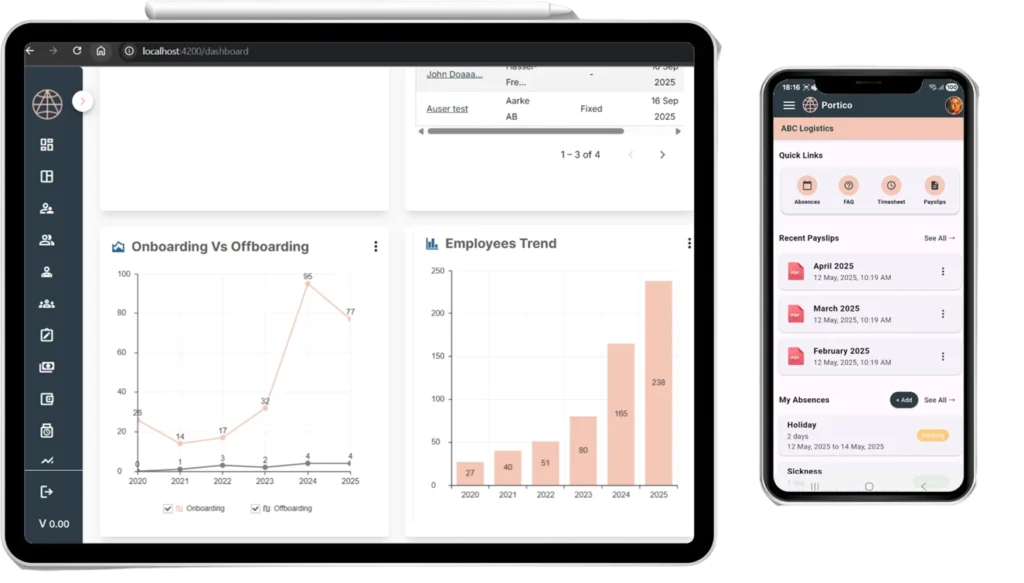
We don’t hide fees or sneak price increases. We run Singapore payroll in-house and file under your own CPF Submission Number rather than a provider’s, so the same team that submits your CPF answers your calls. You get a named account manager, one consolidated monthly invoice covering salaries, CPF, levies and fees, and one live Portico view of Singapore beside every other country we run for you. Portico syncs with your time-tracking, leave and HR systems via API – set up by our onboarding team, not left to yours. GDPR, SOC 2 and ISO 27001 certified.

Other services
Accelerating your growth in Singapore and beyond
TopSource goes far beyond payroll, acting as your end-to-end partner in global workforce management. From Employer of Record (EOR) services and seamless entity setup to localized accountancy and fractional HR support, we cover every aspect of international employment.

Meet our experts for Singapore
Whether you’re entering the market or scaling operations, our specialists provide the insight and guidance you need to succeed in one of the world’s most dynamic and regulated employment landscapes. With TopSource, you’re backed by real experts, every step of the way.

Beyond a payroll serviceA globalization accelerator
Payroll platform
Global payroll simplified
Your intuitive hub for paying global teams. Simple, powerful, and designed to scale with you — no complexity, just clarity.
Audit
Eliminate barriers to growth
Avoid compliance issues across your global workforce and uncover opportunities to improve profitability. On a quarterly basis we’ll help you audit your global talent strategy to ensure it aligns with your business goals.
Intelligence
Build a data-driven talent strategy
Grow confidently and profitably with access to the latest TopSource insights & data on hiring markets, salary benchmarking & benefits.
Advisory
Expert guidance that turns complexity into clarity.
Whether you’re managing a global acquisition or entering a new market, you get clear guidance to navigate complex decisions, avoid delays, and accelerate your global expansion.



Singapore payroll FAQs
For a Singapore Citizen or third-year-onward Permanent Resident aged 55 or below, earning more than $750 a month, the employer contributes 17% and the employee 20% – 37% in total. Above 55 to 60 it is 16% and 18%; above 60 to 65, 12.5% each; above 65 to 70, 9% and 7.5%; and above 70, 7.5% and 5%. The 55-to-60 and 60-to-65 bands each rose by 1.5 percentage points on 1 January 2026 and rise again on 1 January 2027. CPF does not apply to Employment Pass, S Pass or Work Permit holders, and employers are prohibited from contributing for them.
The Ordinary Wage ceiling is $8,000 a month from 1 January 2026, which was the fourth and final step of the ramp announced at Budget 2023 – it ran $6,000, then $6,300 from September 2023, $6,800 in 2024, $7,400 in 2025 and $8,000 in 2026. The annual CPF salary ceiling is separate and remains $102,000; it was deliberately not raised alongside the monthly figure. Together they cap employer CPF at 17% of $102,000, or $17,340 a year, for any citizen employee at any salary.
The Additional Wage ceiling is $102,000 less the total Ordinary Wages already subject to CPF for the year, and it caps CPF on bonuses and other non-monthly payments. An employee earning $8,000 a month or more has $96,000 of Ordinary Wages subject to CPF and therefore only $6,000 of Additional Wage headroom for the whole year; an employee on $5,000 a month has $42,000. Because the figure depends on the year’s total Ordinary Wages, which are not known when a bonus is usually paid, CPF requires it to be recalculated at year end, on resignation, or on any change in salary – and the rate applied to any shortfall is the rate in force when the wage was originally paid, not December’s rate.
No. Singapore has no PAYE and employers do not deduct income tax from monthly pay. Income tax is not among the deductions the Employment Act permits from salary, and employees settle directly with IRAS after year end, filing by 18 April or being placed on the No-Filing Service. The employer’s tax obligation is reporting rather than withholding: employment income data under the Auto-Inclusion Scheme by 1 March. The single exception is a departing foreign or Permanent Resident employee, where the employer must withhold all monies due and obtain tax clearance on Form IR21.
The Auto-Inclusion Scheme requires employers to submit employees’ employment income data electronically to IRAS by 1 March, and it is mandatory for any employer with five or more employees in the preceding calendar year, or who has been notified by IRAS, or who has registered voluntarily. Form IR8A reports remuneration, Appendix 8A benefits in kind and Appendix 8B gains from share plans. Form IR8S was discontinued with effect from the 2026 year of assessment. Failure to furnish the return carries a fine up to $5,000, and incorrect information carries a penalty of up to twice the tax undercharged plus a fine or imprisonment.
Form IR21 is the tax clearance return for any non-Singapore-Citizen employee – a foreign national or a Permanent Resident – who ceases employment, is posted overseas, or leaves Singapore for more than three months, and it must be filed at least one month before that happens. Alongside it, the employer must withhold the payment of all monies due to the employee from the date it becomes aware of the impending cessation or departure, not merely an estimate of the tax and not only from the last working day. IRAS holds the employer liable for the employee’s tax balance where clearance is not properly obtained, and the usual cause is an incomplete IR21 rather than a failure to withhold.
There is no general statutory minimum wage in Singapore. Instead, the Local Qualifying Salary is $1,800 a month gross from 1 July 2026, or $10.50 an hour for part-timers, and it is the minimum a local employee must be paid where the firm hires any foreign workers – it also determines how many locals count toward the firm’s work pass quota. Separately, the Progressive Wage Model sets occupation-specific wage ladders in cleaning, security, landscape, lift and escalator, retail, food services, waste management and pest management, plus occupational wages for administrators and drivers across all sectors.
The employer pays first and claims reimbursement afterwards through the Government-Paid Leave portal. Maternity leave is sixteen weeks where the child is a Singapore citizen: for a first or second child the employer funds the first eight weeks and the government reimburses the last eight, capped at $10,000 per four weeks, and for a third or subsequent child all sixteen weeks are reimbursed. Paternity leave is four weeks, mandatory for children born on or after 1 April 2025, reimbursed to $2,500 a week. Shared Parental Leave rose from six weeks to ten weeks for children born on or after 1 April 2026, at the same weekly cap. Most claims must be submitted within three months of the leave ending.
The minimum retirement age rose to 64 and the re-employment age to 69 on 1 July 2026, under notifications made beneath the Retirement and Re-employment Act. An employer cannot dismiss an employee on grounds of age below 64, and must offer re-employment to eligible employees who reach 64 up to the age of 69 – eligibility requires Singapore citizenship or permanent residence, at least two years’ service where the employee was hired at 55 or older, satisfactory performance and medical fitness. Where no suitable position exists, the employer must transfer the obligation to another employer with the employee’s consent or make an Employment Assistance Payment. The declared policy destination is 65 and 70 by 2030.
No. There is no statutory retrenchment benefit in Singapore – the amount depends entirely on the contract of service or the collective agreement. The tripartite advisory norm is between two weeks and one month’s salary per year of service in non-unionised companies, and one month per year where a collective agreement provides for it. Employees with at least two years’ service are eligible where a benefit is provided for; those with less may be given an ex-gratia payment. Employers with at least ten employees must notify the Ministry of Manpower within five working days of informing the affected employees, and CPF is not payable on retrenchment benefit because it is not given for work done.
Looking at other markets too?
We help organizations employ and pay teams in 164 countries.