Payroll Services in Hungary
Fully managed Hungarian payroll – szocho at a flat 13%, the mothers’ income tax exemptions applied to the right employees rather than missed, the family allowance converted into a contribution credit where it overflows, cafeteria delivered at 28% rather than paid as cash at 41%, and the 08 return filed by the 12th every month.

TopSource rated 5/5 by our customers

What Hungarian payroll actually involves
Hungarian payroll is the simplest employer calculation in Europe sitting on top of one of the most complicated employee calculations. The employer pays a single charge – the social contribution tax at 13% of gross, flat, with no ceiling and no step at any salary – and that is the whole of it: no pension, health or unemployment contribution and no accident insurance premium. The employee pays a flat 15% income tax and a flat 18.5% social security contribution, also without any ceiling, and then a relief system that has changed more in the last eighteen months than in the previous decade removes some or all of the income tax for a large and growing share of the workforce. Mothers of three children became fully exempt in October 2025, mothers of two began phasing in by age in January 2026, and the family allowance doubled on the same date. On top of that sits a cafeteria system that delivers benefits at 28% against a combined wedge of about 41% on cash. None of it is difficult. All of it is specific, and most of it is recent.
Our Partners Globally









Calculate Your Employee Costs in Hungary
Enter a gross annual salary to see the employer cost in Hungary for 2026: the social contribution tax (szocho) at 13%, flat, with no ceiling at any salary. It is the whole of the regular employer contribution. The employer’s one-third share of any state sick pay and the rehabilitation contribution for employers with 25 or more staff are not included, and neither is cafeteria, taxed at 28% of its value.
Employment Cost Calculator
*Indicative figures only and not definitive legal advice. Local regulations change frequently. Consult an expertHungary
| British Pound | Hungary | |
|---|---|---|
| Base Salary (per month) | ||
| Employer Contributions | ||
| Total Cost (Annual) | ||
| Total Cost (Monthly) |
“Their expertise and understanding of the unique hiring, payment, and human resource practices in each country has been nothing short of outstanding. Our Client Success Manager, has done just that … ensured our success. Her availability and willingness to engage on a personal level has made all the difference.”

“Excellent service, especially from our account manager who has gone above and beyond to help us use the platform effectively. Our manager, significantly simplifies my workload. It is like having your own TopSource HR representative on your team.”
“TopSource has been our go-to resource for international hiring. They are responsive, thorough, respectful and knowledgeable. The Client Success team has provided us with the utmost customer service, and the more we use TopSource, the more, it gives us access to more resources and knowledge.”
Employer Costs in Hungary Explained
Employer cost in Hungary is 13% of gross and it does not change at any salary level. The social contribution tax, szociális hozzájárulási adó, is flat and uncapped – there is no ceiling, no reduced rate above a threshold and no step of any kind, so an employee on the minimum wage and an executive on three million forint a month attract exactly the same percentage. There is no employer pension, health or unemployment contribution and no statutory accident insurance premium, and the 1.5% vocational training contribution was abolished on 1 January 2022, the same day szocho fell to 13%. Two smaller charges sit outside the 13% and are routinely missed: the employer pays one third of any state sickness benefit its employees receive, and employers with 25 or more staff who miss the 5% disabled-employment quota pay a rehabilitation contribution. Against Germany, Poland, Czechia or Slovakia, Hungary is the cheapest employer jurisdiction in the region. Here’s the breakdown.
The Hungarian employer pays one charge: the social contribution tax, szocho, at 13% of gross. There is no employer pension contribution, no employer health contribution, no employer unemployment contribution, no statutory accident insurance premium and no training levy, and the rate is flat with no ceiling at any salary. An employee on the minimum wage and an executive on three million forint a month attract exactly the same 13%.
One correction is worth making because foreign employers still get it wrong. The vocational training contribution, szakképzési hozzájárulás, was abolished with effect from 1 January 2022, on the same day szocho fell from 15.5% to 13% – so the combined charge went from 17% to 13%, and budgeting 13% plus 1.5% has been wrong for more than four years. What replaced the old training offset is a szocho relief for employers training apprentices under a dual training contract.
Two smaller employer charges sit outside the 13% and both are routinely missed. The sick pay contribution, táppénz-hozzájárulás, requires the employer to pay one third of the state sickness benefit received by its employees – a real cost that appears nowhere in a rate card and depends entirely on actual sickness. And the rehabilitation contribution, rehabilitációs hozzájárulás, applies to employers with an average headcount of 25 or more that do not meet the 5% disabled-employment quota, at nine times the national average gross monthly earnings for each person short of the quota. For a forty-person site with no disabled staff it is material.
So the honest headline is 13% for a typical employer, a little more once the sick pay contribution is counted, and more again for a larger employer failing the disability quota. That is lower than Germany, Poland, Czechia or Slovakia. The trade-off is entirely on the employee side, where 33.5% comes off gross with no ceiling at all.
An employee pays 15% personal income tax and 18.5% social security contribution, and neither has an upper limit. The 18.5% was created on 1 July 2020 when four separate contributions – pension at 10%, health in kind at 4%, health in cash at 3% and labour market at 1.5% – were merged into a single line. The sub-rates still exist for fund allocation, but the employer withholds and reports one figure, not four.
The absence of a ceiling is the biggest structural difference from most Western European systems and the most common modelling error a foreign employer makes. An executive on twenty million forint a month pays 18.5% on the whole of it. There is a floor, though: contributions are due on at least 30% of the minimum wage, which is 96,840 forint a month in 2026, even where actual pay is lower.
The point most often mis-sold in the Hungarian market is worth stating flatly. The income tax exemptions do not exempt anyone from the 18.5%. A mother of two with a lifetime income tax exemption still pays the full social security contribution on her whole salary – on 500,000 forint a month she nets 407,500, not 500,000.
There is one genuine interaction between the two, and foreign payroll engines usually do not carry it. Where the family allowance exceeds the employee’s income tax base – routine for a family with three children, where the monthly base relief reaches 1,320,000 forint – 15% of the unused part converts into a családi járulékkedvezmény, a credit against the employee’s social security contribution. So the relief does not simply run out when the tax reaches zero; it spills over into the contribution.
Hungary is in the middle of phasing in lifetime personal income tax exemptions for mothers, and the schedule turns on the employee’s age rather than on anything the employer controls. Mothers of four or more children have been exempt since January 2020. Mothers of three children became exempt on 1 October 2025 with no age limit. Mothers of two children are being phased in by age band: those under 40 from 1 January 2026, under 50 from January 2027, under 60 from January 2028 and all from January 2029, at which point coverage is complete.
The separate exemption for mothers under 30 has existed since 2023, and its income cap – 656,785 forint a month in 2025 – was abolished on 1 January 2026, so it is now unlimited like the others. The exemptions are lifetime and have no income ceiling, but they cover earned income only: employment wages, self-employment income and income from personally performed activity, not dividends, rent, interest or capital gains. The qualifying condition is the family allowance rather than simply having had the children. And none of it touches the 18.5% social security contribution.
Alongside them sit the other reliefs, and the family allowance doubled on 1 January 2026 after a first increase in July 2025. The monthly tax base reduction is now 133,340 forint for one child, 266,660 per child for two children and 440,000 per child for three or more – so a three-child family has 1,320,000 forint of tax base relieved every month, worth 198,000 forint of tax. The under-25s exemption runs to 715,765 forint a month, the statistical office’s average gross earnings for July 2025. The personal disability allowance is 107,600 forint a month, one third of the minimum wage, and first-married couples get 33,335 forint a month for 24 months.
Hungarian benefits sit in three tax categories and the arithmetic drives the whole reward design. A fringe benefit, béren kívüli juttatás, costs the employer 28% on the value – 15% income tax plus 13% social contribution tax. A specified benefit, egyes meghatározott juttatás, costs 33.04%, because the base is first grossed up by 1.18. And a tax-free benefit costs nothing. Against that, cash carries a combined wedge of about 41% of the employer’s total outlay once the employee’s 15% and 18.5% and the employer’s 13% are all counted.
The gap is worth real money and it is the strongest commercial argument on this page. Delivering 570,000 forint of value through the SZÉP card costs an employer 729,600 forint; delivering the same value as net cash costs 968,571 – a saving of 238,971 forint per employee per year, about 25%. For an employee under 35 who can also take the housing allowance, the combined capacity is 2,370,000 forint a year, costing 3,033,600 against a cash equivalent of 4,027,218 – a saving approaching a million forint per employee per year at no cost to the employee.
The SZÉP card for 2026 carries 450,000 forint on the main recreation sub-account plus 120,000 forint on the Aktív Magyarok sub-account for sport and active recreation, for a total of 570,000 forint at 28%. Anything above the limit falls into the 33.04% category. The housing allowance for employees under 35, in force since 1 January 2025, runs to 150,000 forint a month at 28% and can be used for rent or for repaying a housing loan; it is pro-rated in the year the employee turns 35.
Annual leave starts at 20 days and rises with age rather than with service, which is unusual and catches foreign employers out: the additional days, pótszabadság, follow an age scale running up to ten extra days, with further days for children and disability. There are eleven public holidays, plus designated working Saturdays that bridge holidays into long weekends and that a foreign scheduling system will not know about.
Sickness runs in two stages and the employer pays the first one. Betegszabadság is 15 working days a year at 70% of absence pay, paid entirely by the employer. After that the health insurance fund pays táppénz – but the employer contributes one third of it, a real employer cost outside the 13% that no rate card shows.
Notice under the Labour Code runs from 30 days and extends with service to a maximum of 90 days, and severance, végkielégítés, becomes payable at three years’ service on a scale reaching six months’ absence pay for long service. Both are calculated on távolléti díj, absence pay, rather than on base salary. There are also protected periods, including pregnancy and maternity leave, during which notice may not be given at all.
Working time is where Hungary offers flexibility that foreign employers rarely use. The munkaidőkeret, working time banking, allows hours to be averaged over a reference period rather than settled weekly, which suits seasonal and project work. It is worth configuring deliberately rather than defaulting to a fixed weekly pattern.
Hungarian contribution and relief rates, 2026
| Contribution or relief | Employer | Employee | 2026 detail |
|---|---|---|---|
| Szociális hozzájárulási adó (szocho) | 13.00% | — | Flat, with no ceiling at any salary. 13% since 1 January 2022 |
| Szakképzési hozzájárulás | Abolished | — | Repealed 1 January 2022, when szocho fell from 15.5% to 13% |
| Employer pension, health and unemployment contributions | None | — | None exists. All consolidated into szocho |
| Táppénz-hozzájárulás | One third of táppénz | — | One third of the state sickness benefit paid to the employee |
| Rehabilitációs hozzájárulás | 9× average earnings per head short | — | Employers with 25 or more staff missing the 5% disability quota |
| Társadalombiztosítási járulék (TB) | — | 18.50% | Flat, with no ceiling. Four contributions merged into one line on 1 July 2020 |
| Személyi jövedelemadó (SZJA) | — | 15.00% | Flat, before reliefs |
| Minimum contribution base | — | HUF 96,840 a month | 30% of the minimum wage. Due even where actual pay is lower |
| Minimálbér | HUF 322,800 a month | — | From 1 January 2026, up 11% |
| Garantált bérminimum | HUF 373,200 a month | — | Work requiring at least a secondary qualification. Up 7% |
| Családi kedvezmény – one child | — | HUF 133,340 of base | Per child per month. Doubled on 1 January 2026 |
| Családi kedvezmény – two children | — | HUF 266,660 of base | Per child per month |
| Családi kedvezmény – three or more | — | HUF 440,000 of base | Per child per month, so HUF 198,000 of tax a month for three children |
| Mothers’ lifetime SZJA exemption | — | 0% SZJA | Four, three and two children, and mothers under 30. Does not touch the 18.5% |
| Under-25s exemption | — | 0% SZJA to HUF 715,765 a month | Cap is the average gross earnings for July of the previous year |
| Béren kívüli juttatás (cafeteria) | 28.00% | — | 15% SZJA plus 13% szocho on the value. Paid by the employer |
| Egyes meghatározott juttatás | 33.04% | — | Base grossed up by 1.18, then 28% |
| SZÉP kártya | 28.00% | — | HUF 450,000 plus HUF 120,000 Aktív Magyarok = HUF 570,000 a year |
| Under-35 housing allowance | 28.00% | — | Up to HUF 150,000 a month for rent or housing loan repayment |
The mothers’ income tax exemptions and the phase-in schedule
| Relief | In force from | Who qualifies | Cap |
|---|---|---|---|
| Mothers of four or more children | 1 January 2020 | No age limit | None |
| Mothers of three children | 1 October 2025 | No age limit | None |
| Mothers of two children, under 40 | 1 January 2026 | First age band | None |
| Mothers of two children, under 50 | 1 January 2027 | Next age band | None |
| Mothers of two children, under 60 | 1 January 2028 | Next age band | None |
| Mothers of two children, all ages | 1 January 2029 | Coverage complete | None |
| Mothers under 30 | 1 January 2023 | Under 30 | Cap abolished from 1 January 2026 |
| Under-25s | 1 January 2022 | Under 25 | HUF 715,765 a month |
| What the exemptions cover | — | Earned income only | Not dividends, rent, interest or capital gains |
| What they do not cover | — | The 18.5% TB járulék | An exempt mother on HUF 500,000 nets HUF 407,500 |
The same employer cost, different net pay – and the cafeteria arbitrage
| Scenario, HUF 500,000 a month | SZJA | TB járulék | Net pay | Employer cost |
|---|---|---|---|---|
| No relief | HUF 75,000 | HUF 92,500 | HUF 332,500 | HUF 565,000 |
| Mother of two under 40, or of three | Nil | HUF 92,500 | HUF 407,500 | HUF 565,000 |
| Employee under 25 | Nil | HUF 92,500 | HUF 407,500 | HUF 565,000 |
| Family allowance, two children | Nil | HUF 87,502 | HUF 412,498 | HUF 565,000 |
| SZÉP card, HUF 570,000 of value a year | — | — | Employer pays HUF 729,600 | Cash equivalent HUF 968,571 |
| Under-35 housing allowance, HUF 1,800,000 a year | — | — | Employer pays HUF 2,304,000 | Cash equivalent HUF 3,058,647 |
| Both, for an employee under 35 | — | — | Employer pays HUF 3,033,600 | Saving HUF 993,618 a year |
Szocho and the employee’s TB járulék share the same base and neither has an upper ceiling; contributions are due on at least 30% of the minimum wage. The income tax reliefs reduce the personal income tax base only and have no effect on the 18.5% contribution, with one exception: where the family allowance exceeds the tax base, 15% of the unused part becomes a credit against the contribution. In the second table the two-children row relieves HUF 533,320 of base against HUF 500,000 of gross, and 15% of the HUF 33,320 left over is credited. Cafeteria figures are annual and compare the employer cost at 28% with the cost of delivering the same value as net cash. Employer szocho reliefs also exist – for labour market entrants, reduced work capacity, unskilled roles and apprentices. These are TopSource calculations from the 2026 rates, not published figures.
Rates, thresholds and statutory amounts shown are for the 2026 calendar year and were verified on 24 September 2026. Hungary reprices on 1 January and the minimum wage drags several other figures with it, including the minimum contribution base and the personal disability allowance. The mothers’ income tax exemption adds a new age band every January to 2029. The under-25s cap is reset each year from the previous July’s average earnings, and cafeteria limits are reset annually. The 2027 minimum wage is set by decree in December and is not shown. This page is general information, not tax or legal advice.
How our Hungarian payroll service works
Why TopSource for Hungarian Payroll
TopSource for payroll, Employer of Record or any other of our services represents a simpler, more reliable and transparent option.
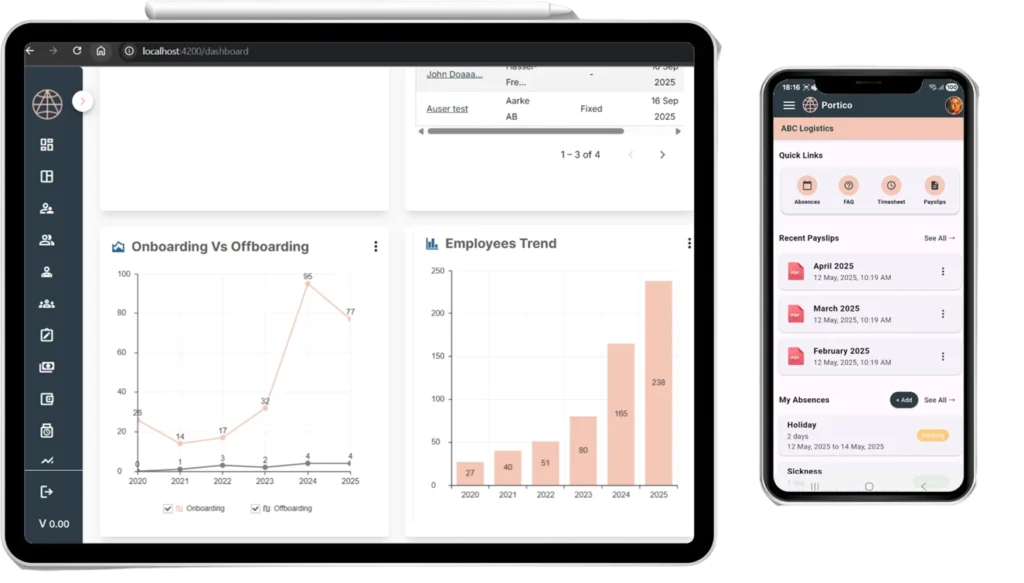
We don’t hide fees or sneak price increases. We run Hungarian payroll in-house and register you with NAV in your own name rather than pooling you under a bureau, so the same team that files your 08 return answers your calls. You get a named account manager, one consolidated monthly invoice covering salaries, contributions, taxes and fees, and one live Portico view of Hungary beside every other country we run for you. Portico syncs with your time-tracking, leave and HR systems via API – set up by our onboarding team, not left to yours. GDPR, SOC 2 and ISO 27001 certified.

Other services
Accelerating your growth in Hungary and beyond
TopSource goes far beyond payroll, acting as your end-to-end partner in global workforce management. From Employer of Record (EOR) services and seamless entity setup to localized accountancy and fractional HR support, we cover every aspect of international employment.

Meet our experts for Hungary
Whether you’re entering the market or scaling operations, our specialists provide the insight and guidance you need to succeed in one of the world’s most dynamic and regulated employment landscapes. With TopSource, you’re backed by real experts, every step of the way.

Beyond a payroll serviceA globalization accelerator
Payroll platform
Global payroll simplified
Your intuitive hub for paying global teams. Simple, powerful, and designed to scale with you — no complexity, just clarity.
Audit
Eliminate barriers to growth
Avoid compliance issues across your global workforce and uncover opportunities to improve profitability. On a quarterly basis we’ll help you audit your global talent strategy to ensure it aligns with your business goals.
Intelligence
Build a data-driven talent strategy
Grow confidently and profitably with access to the latest TopSource insights & data on hiring markets, salary benchmarking & benefits.
Advisory
Expert guidance that turns complexity into clarity.
Whether you’re managing a global acquisition or entering a new market, you get clear guidance to navigate complex decisions, avoid delays, and accelerate your global expansion.


Hungarian payroll FAQs
Employer cost in Hungary is 13% of gross and it is flat at every salary level – the social contribution tax, szociális hozzájárulási adó, has no ceiling, no step and no band. There is no employer pension, health or unemployment contribution and no statutory accident insurance premium, because all of them were consolidated into szocho. Two smaller charges sit outside it: the employer pays one third of any state sickness benefit its employees receive, and employers with 25 or more staff who do not meet the 5% disabled-employment quota pay a rehabilitation contribution.
No. The szakképzési hozzájárulás was abolished with effect from 1 January 2022, the same day the social contribution tax fell from 15.5% to 13%, so the combined charge went from 17% to 13%. Foreign employers still sometimes model 13% plus 1.5%, which has been wrong for more than four years. Thirteen per cent is the whole of the employer’s regular contribution. What replaced the old training offset is a szocho relief for employers training apprentices under a dual training contract.
Hungary is phasing in lifetime personal income tax exemptions for mothers, by number of children and then by age. Mothers of four or more children have been exempt since 2020 and mothers of three since 1 October 2025, both with no age limit. Mothers of two are being phased in by age band: under 40 from 1 January 2026, under 50 from 2027, under 60 from 2028 and all from 2029. Mothers under 30 have been exempt since 2023, with no income cap from 2026. The exemptions cover earned income only, not dividends, rent, interest or capital gains, and they do not exempt anyone from the 18.5% social security contribution.
The family allowance doubled on 1 January 2026, after a first increase in July 2025. The monthly tax base reduction is now 133,340 forint for one child, 266,660 forint per child where there are two, and 440,000 forint per child where there are three or more – so a three-child family has 1,320,000 forint of tax base relieved every month, worth 198,000 forint of tax. Where the allowance exceeds the employee’s income tax base, 15% of the unused part becomes a credit against their social security contribution, so the relief does not simply stop when the tax reaches zero.
There are two figures. The minimálbér is 322,800 forint a month from 1 January 2026, up 11%, and the garantált bérminimum – the guaranteed minimum for work requiring at least a secondary-level qualification – is 373,200 forint, up 7%. The minimum wage matters beyond its own figure because other amounts are pegged to it, including the minimum contribution base at 30% and the personal disability allowance at one third. The 2027 figures are set by government decree in December.
The 08 return, 08-as bevallás, is due to NAV by the 12th day of the month following the pay month, with payment due on the same date. It carries every employee’s personal income tax, their 18.5% social security contribution and the employer’s 13% social contribution tax. A T1041 notification is required for every start and end of employment, and the start notification must be filed before the employee begins work. At year end the employer issues an M30 certificate to each employee, and NAV uses the monthly data to pre-fill each employee’s personal return.
The SZÉP card is Hungary’s main cafeteria instrument, and for 2026 it carries an annual allowance of 570,000 forint – 450,000 on the main recreation sub-account for accommodation, catering and leisure, plus 120,000 on the Aktív Magyarok sub-account for sport and active recreation. Within the limit it is taxed as a fringe benefit at 28%, being 15% income tax and 13% social contribution tax on the value; anything above the limit is taxed at 33.04%. That makes it materially cheaper than cash, which carries a combined wedge of about 41%.
Both the employer and the state, in sequence. The employer pays betegszabadság for the first 15 working days of sickness in each calendar year, at 70% of absence pay. After that the health insurance fund pays táppénz – but the employer must contribute one third of it through the táppénz-hozzájárulás, a genuine employer cost that appears on no rate card and is one of the most frequently missed items in a Hungarian cost model.
Notice under the Labour Code starts at 30 days and extends with length of service to a statutory maximum of 90 days. Severance, végkielégítés, becomes payable at three years’ service and rises on a scale reaching six months’ pay for long service. Both are calculated on távolléti díj, absence pay, rather than on base salary, which matters for anyone with a significant variable element. There are also protected periods during which notice may not be given at all, including pregnancy and maternity leave.
Yes. A foreign company can register with NAV for a technical tax number before employment begins and run Hungarian payroll without incorporating anything in Hungary. The reason to do it properly is the consequence of not doing it: where the foreign employer does not register, the employee must declare and pay their own income tax and social security contribution on a monthly return. That is an employee-relations problem long before it becomes a compliance one. Employing people in Hungary can also create a permanent establishment for corporate tax purposes, which is a separate question.
Looking at other markets too?
We help organizations employ and pay teams in 164 countries.