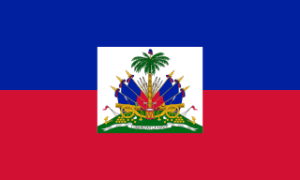
Payroll Services in Haiti
Fully managed Haitian payroll under the new Tax Code: income tax withheld on the 2026 scale, ONA and OFATMA contributions, the December boni and every payment made on time, with a named specialist a phone call away.

TopSource rated 5/5 by our customers
What Haitian payroll actually involves
Haitian payroll combines income tax withheld at source with ONA pension and OFATMA insurance contributions, a legal year-end boni and minimum wages set by sector. The Tax Code took effect on 1 October 2026 with a new income tax scale, and bonuses, allowances and overtime now carry a 15% withholding.
Our Partners Globally









Calculate Your Employee Costs in Haiti
Enter a gross annual salary to see the employer’s statutory cost for a Haitian employee in 2026: 6% to ONA, 3% OFATMA sickness and maternity insurance, 2% OFATMA work injury cover for offices and services, and the December boni of one twelfth of annual pay.
Employment Cost Calculator
*Indicative figures only and not definitive legal advice. Local regulations change frequently. Consult an expertHaiti
| British Pound | Haiti | |
|---|---|---|
| Base Salary (per month) | ||
| Employer Contributions | ||
| Total Cost (Annual) | ||
| Total Cost (Monthly) |
“Their expertise and understanding of the unique hiring, payment, and human resource practices in each country has been nothing short of outstanding. Our Client Success Manager, has done just that … ensured our success. Her availability and willingness to engage on a personal level has made all the difference.”

“Excellent service, especially from our account manager who has gone above and beyond to help us use the platform effectively. Our manager, significantly simplifies my workload. It is like having your own TopSource HR representative on your team.”
“TopSource has been our go-to resource for international hiring. They are responsive, thorough, respectful and knowledgeable. The Client Success team has provided us with the utmost customer service, and the more we use TopSource, the more, it gives us access to more resources and knowledge.”
Employer Costs in Haiti Explained
An office-based Haitian employee costs about 11% on top of gross salary in ONA and OFATMA contributions, plus the December boni of one twelfth of annual pay, about 19% in all. Income tax and the employee’s ONA and OFATMA contributions come out of gross pay, so they change net pay, not the employer’s cost. Here’s the breakdown.
Every private-sector employee is insured with the Office National d’Assurance-Vieillesse (ONA): 6% of salary is deducted from the employee and the employer pays the same amount, 12% in total. OFATMA, the office for work accident, sickness and maternity insurance, collects 3% of gross salary from the employee and 3% from the employer for sickness and maternity cover.
Work injury insurance is paid by the employer alone: 2% of payroll for commercial and service businesses, 3% in agriculture, industry and export businesses and 6% in mining.
Employers withhold income tax from salaries every month and pay it to the Direction Générale des Impôts (DGI) by the 15th of the following month. The Tax Code, adopted by decree in December 2022, took effect on 1 October 2026, the first day of the 2026–27 fiscal year. The scale adopted for it by the Ministry of Economy and Finance exempts the first HTG 360,000 of annual income, taxes the next bands at 12%, 18% and 25%, and applies 30% above HTG 2,160,000.
It replaces the scale of 29 September 2005, unchanged for twenty years, whose tax-free band ended at HTG 60,000 a year, below the annual minimum wage. Tax withheld during the year is credited against the employee’s final annual return.
From 1 October 2026, fixed expense payments, salary supplements, allowances, bonuses, year-end gifts, pay for unused leave and overtime pay carry a 15% income tax withholding on their gross amount, separate from the monthly withholding on salary. The rate was set by the amended 2025–26 budget published on 5 June 2026, and the Ministry of Economy and Finance moved its start to 1 October. Until then, 10% applied to the boni, year-end gifts and overtime.
The withholding is an advance on income tax that is credited in the employee’s final return. Employers pay it to the DGI between the 1st and the 15th of the following month, and late payment carries a 3% penalty for each month or part of a month.
Between 24 and 31 December every year, employers must pay a boni, an annual complementary salary of at least one twelfth of the salaries paid during the year, including pay in kind, housing and commission. New employees receive a share in proportion to their months of service, and a leaving employee receives the share earned. Registered non-profit and philanthropic institutions are exempt. From December 2026 the boni carries the 15% withholding.
Office staff are paid at least monthly and manual workers at least every 15 days, in legal tender. The normal working week is 48 hours, eight a day. Overtime is paid at 50% above the normal rate, as is exceptional work on Sundays and public holidays.
After a year of service, employees are entitled to at least 15 consecutive days of paid annual leave, including 13 working days, and to 15 days of paid sick leave a year with a medical certificate. Maternity leave is 12 weeks, normally six before and six after the birth; where the employee is not covered by OFATMA maternity insurance, the employer pays six weeks.
Outside the serious-misconduct grounds listed in the Labour Code, either party ending a contract after three months of service must give written notice: 15 days up to a year of service, one month up to three years, two months up to six years, three months up to ten years and four months after that. A party ending the contract immediately pays the equivalent in lieu, and unused leave is paid separately from notice.
Haitian payroll contributions and taxes, 2026
| Item | Employer | Employee | Applies to |
|---|---|---|---|
| ONA old-age insurance | 6% | 6% | Salary |
| OFATMA sickness and maternity | 3% | 3% | Gross salary |
| OFATMA work injury | 2% | — | Commercial and service businesses; 3% in agriculture, industry and export, 6% in mining |
| Income tax | — | 0% to 30% | Annual income, scale in force from 1 October 2026 |
| Withholding on bonuses, allowances and overtime | — | 15% | Gross amount, from 1 October 2026 |
| Boni | At least one twelfth of annual salary | — | Paid 24 to 31 December; registered non-profits exempt |
| Payment deadline | 15th of the next month | — | Income tax withheld from pay |
Haitian income tax scale: from 1 October 2026 and until September 2026
| Rate | Annual income from 1 October 2026 | Annual income until 30 September 2026 |
|---|---|---|
| 0% | Up to HTG 360,000 | Up to HTG 60,000 |
| 10% | — | HTG 60,001 to 240,000 |
| 12% | HTG 360,001 to 540,000 | — |
| 15% | — | HTG 240,001 to 480,000 |
| 18% | HTG 540,001 to 1,080,000 | — |
| 25% | HTG 1,080,001 to 2,160,000 | HTG 480,001 to 1,000,000 |
| 30% | Above HTG 2,160,000 | Above HTG 1,000,000 |
Daily minimum wages in Haiti from 6 May 2026
| Segment and sectors | Minimum for an eight-hour day |
|---|---|
| A: banks, insurance, telecoms, import-export, supermarkets, private schools and universities, private health, consultancies, travel agencies, 4-hibiscus hotels | HTG 1,000 |
| F: export assembly industries | HTG 1,000 |
| G: private security and fuel distribution | HTG 925 |
| B: construction, wholesale, microfinance, land transport, printing and IT services, manufacturing for the local market | HTG 900 |
| H: private vocational schools and private hospitals with more than 10 staff | HTG 900 |
| C: restaurants, agriculture, retail, NGOs, foundations and associations | HTG 760 |
| E: domestic workers | HTG 500 |
Income tax bands apply to annual income, and employers spread the withholding over the monthly payrolls of the fiscal year, which runs from 1 October to 30 September. Work injury rates depend on the employer’s sector. Minimum wages apply per eight-hour day.
Rates and amounts shown were verified on 7 October 2026 against the Ministry of Economy and Finance review of the income tax scale (July 2026), the amended 2025–26 budget published in Le Moniteur on 5 June 2026, DGI guidance, the May 2026 minimum wage order, the Labour Code, ONA and published social insurance sources. This page is general information, not tax or legal advice.
How our Haitian payroll service works
Why Choose TopSource for Global Payroll in Haiti
TopSource for payroll, Employer of Record or any other of our services represents a simpler, more reliable and transparent option.
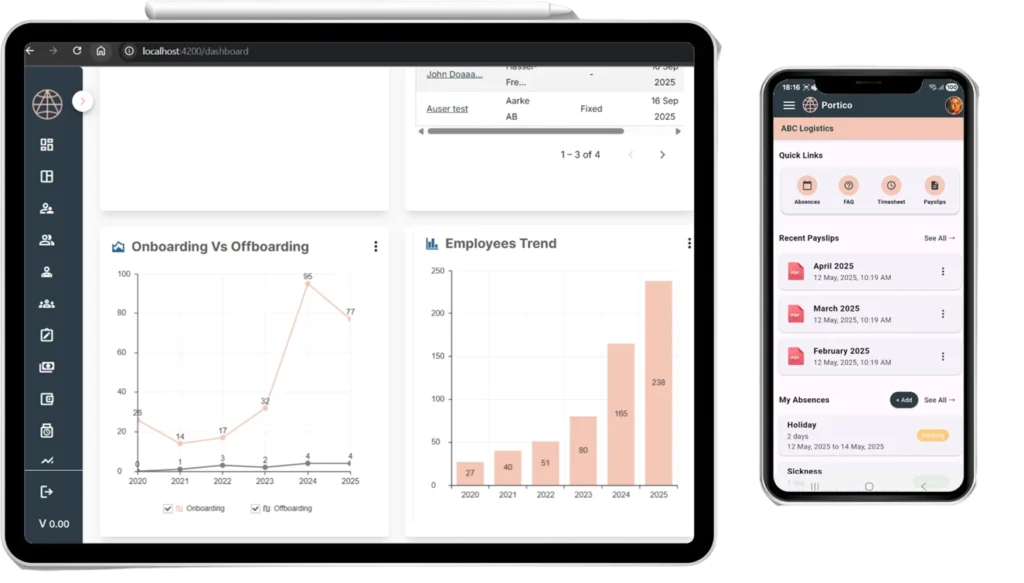
We don’t hide fees or sneak price increases. We run Haitian payroll in-house and file under your own DGI, ONA and OFATMA registrations rather than a bureau’s, so the same team that calculates your withholding answers your calls. You get a named account manager, one consolidated monthly invoice covering salaries, contributions, taxes and fees, and one live Portico view of Haiti beside every other country we run for you. Portico syncs with your time-tracking, leave and HR systems via API – set up by our onboarding team, not left to yours. GDPR, SOC 2 and ISO 27001 certified.

Other services
Accelerating your growth in Haiti and beyond
TopSource goes far beyond payroll, acting as your end-to-end partner in global workforce management. From Employer of Record (EOR) services and seamless entity setup to localized accountancy and fractional HR support, we cover every aspect of international employment.

Meet our experts for Haiti
Whether you’re entering the market or scaling operations, our specialists provide the insight and guidance you need to succeed in one of the world’s most dynamic and regulated employment landscapes. With TopSource, you’re backed by real experts, every step of the way.

Beyond a payroll serviceA globalization accelerator
Payroll platform
Global payroll simplified
Your intuitive hub for paying global teams. Simple, powerful, and designed to scale with you — no complexity, just clarity.
Audit
Eliminate barriers to growth
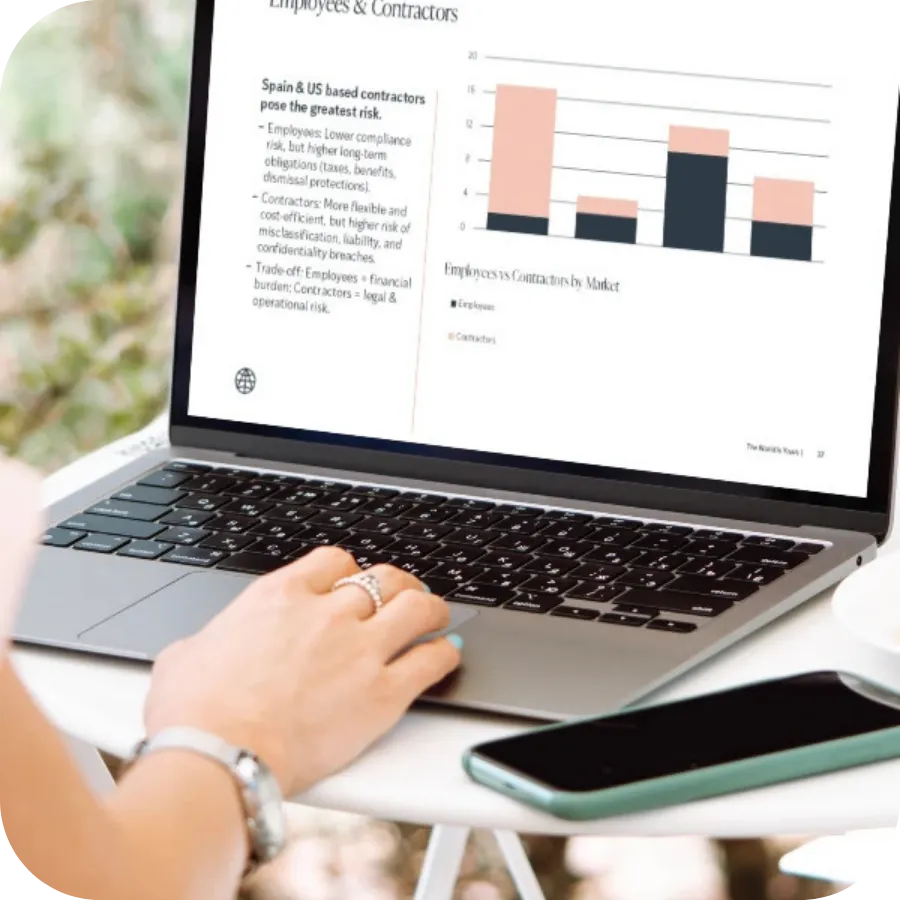
Avoid compliance issues across your global workforce and uncover opportunities to improve profitability. On a quarterly basis we’ll help you audit your global talent strategy to ensure it aligns with your business goals.
Intelligence
Build a data-driven talent strategy
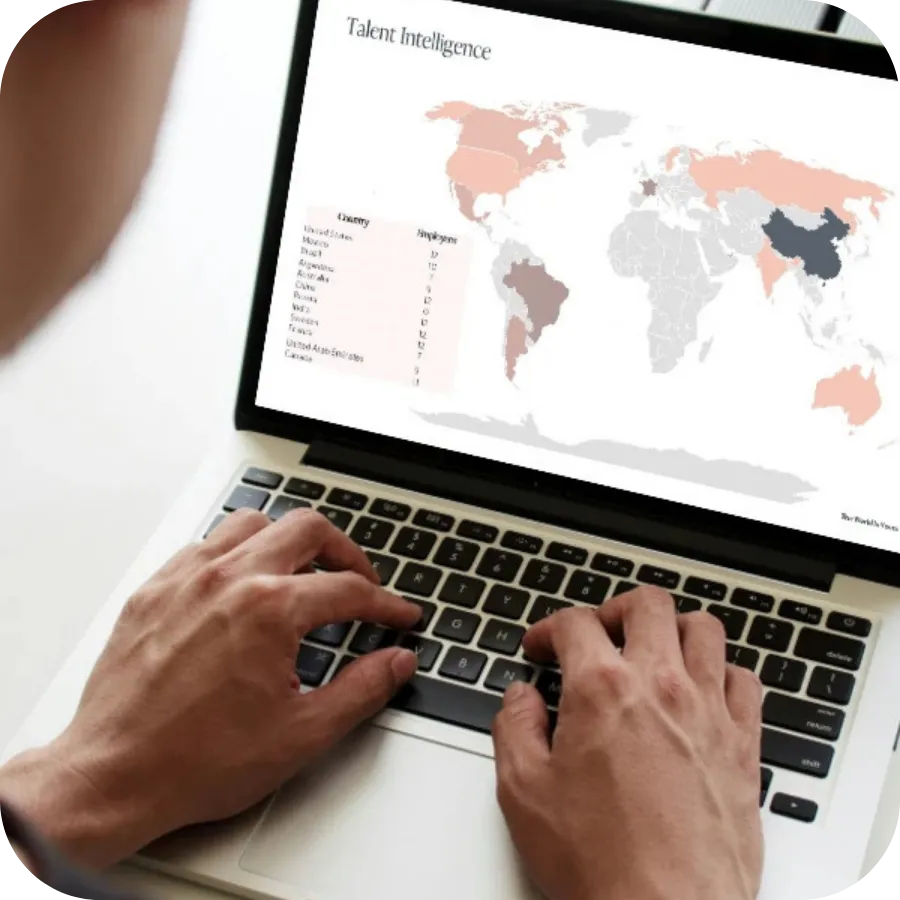
Grow confidently and profitably with access to the latest TopSource insights & data on hiring markets, salary benchmarking & benefits.
Advisory
Expert guidance that turns complexity into clarity.
Whether you’re managing a global acquisition or entering a new market, you get clear guidance to navigate complex decisions, avoid delays, and accelerate your global expansion.

Haitian payroll FAQs
The scale adopted for the Tax Code in force from 1 October 2026 exempts the first HTG 360,000 of annual income and taxes the bands above at 12%, 18%, 25% and 30%, the top rate above HTG 2,160,000. The 2005 scale it replaces taxed income above HTG 60,000.
From 1 October 2026, bonuses, allowances, fixed expense payments, year-end gifts, pay for unused leave and overtime carry a 15% withholding on their gross amount, up from 10% on the boni and overtime. It is an advance on the employee’s annual income tax.
Employers pay 6% of salary to ONA for old-age pensions, 3% to OFATMA for sickness and maternity insurance, and OFATMA work injury cover of 2% for commercial and service businesses, 3% in agriculture, industry and export and 6% in mining.
For an office-based employee, ONA and OFATMA add about 11% to gross salary, and the December boni adds one twelfth of annual pay, about 19% in all. Tell us the role and salary and we’ll send the full cost within one business day.
An annual complementary salary that employers must pay between 24 and 31 December, of at least one twelfth of the salary paid during the year. New and leaving employees receive a share in proportion to their service, and registered non-profits are exempt.
From 6 May 2026 the minimum for an eight-hour day ranges from HTG 500 for domestic workers to HTG 1,000 in segment A, which includes banks, telecoms, private schools and consultancies, and in export assembly. Restaurants, retail and NGOs pay at least HTG 760.
Income tax withheld from salaries, and the 15% withheld on bonuses and overtime, is paid to the DGI by the 15th of the following month. Late payment of the 15% withholding carries a penalty of 3% a month.
After a year of service, at least 15 consecutive days of paid annual leave, including 13 working days, plus 15 days of paid sick leave a year with a medical certificate. Maternity leave is 12 weeks.
After three months of service, 15 days up to a year, one month up to three years, two months up to six years, three months up to ten years and four months after that. A party ending the contract without notice pays the equivalent.
Registering as an employer with the DGI, ONA and OFATMA generally requires a legal presence in Haiti, such as a local company or a registered branch. Without one, the usual route is an Employer of Record. TopSource can run payroll for your Haitian entity or employ your team through our Employer of Record service.
Looking at other markets too?
We help organizations employ and pay teams in 164 countries.