Payroll Services in Japan
Fully managed Japanese payroll in yen (¥) – social insurance calculated on the correct standard monthly remuneration grade, the July annual determination filed on the payment-month basis rather than the work-month one, compulsory occasional revisions caught when a fixed allowance changes, and resident tax remitted to every employee’s own municipality on time, with a named specialist a phone call away.

TopSource rated 5/5 by our customers

What Japanese payroll actually involves
Japanese payroll is not complicated by rates. It is complicated by three structural features that exist nowhere else. Social insurance contributions are not calculated on actual pay: they run on a banded standard monthly remuneration, normally fixed once a year from the average of April, May and June and then applied for the following twelve months – so a heavy overtime quarter in spring raises cost for a full year afterwards. There are two withholding systems rather than one: national income tax withheld monthly and reconciled by the employer at year end, and resident tax withheld separately on a June-to-May cycle and remitted to each individual employee’s municipality of residence. And the compliance calendar has no single anchor – health insurance rates change with the March salary month, labour insurance on 1 April, the remuneration determination in July for a September effect, resident tax notices in May for a June start, the minimum wage between October and December, and income tax on 1 January. Get those three things right and Japan runs smoothly. Miss any of them and the error compounds for months before anyone sees it.
Our Partners Globally









Calculate Your Employee Costs in Japan
Enter a gross annual salary to see the full employer cost of a Japanese employee under 40 at a Tokyo-registered establishment – health insurance and the new child and childcare support levy at 5.04%, capped at a standard monthly remuneration of ¥1,390,000; Employees’ Pension Insurance and the child allowance contribution at 9.51%, capped at ¥650,000 a month; and labour insurance at 1.152% of actual pay, uncapped. It assumes twelve equal monthly payments, no bonus and an office workers’ accident classification. Nursing care insurance adds 0.81% from age 40, and another prefecture moves the health component by up to 0.35 points either way.
Employment Cost Calculator
*Indicative figures only and not definitive legal advice. Local regulations change frequently. Consult an expertJapan
| British Pound | Japan | |
|---|---|---|
| Base Salary (per month) | ||
| Employer Contributions | ||
| Total Cost (Annual) | ||
| Total Cost (Monthly) |
“Their expertise and understanding of the unique hiring, payment, and human resource practices in each country has been nothing short of outstanding. Our Client Success Manager, has done just that … ensured our success. Her availability and willingness to engage on a personal level has made all the difference.”

“Excellent service, especially from our account manager who has gone above and beyond to help us use the platform effectively. Our manager, significantly simplifies my workload. It is like having your own TopSource HR representative on your team.”
“TopSource has been our go-to resource for international hiring. They are responsive, thorough, respectful and knowledgeable. The Client Success team has provided us with the utmost customer service, and the more we use TopSource, the more, it gives us access to more resources and knowledge.”
Employer Costs in Japan Explained
Employer statutory cost in Japan is about 15.70% of remuneration for a Tokyo-based general-business employee under 40, rising to 16.51% from age 40 when nursing care insurance begins – broadly comparable to the United Kingdom. The largest component is Employees’ Pension Insurance at 18.3% split equally, followed by health insurance at half of the prefectural rate, which for FY2026 is 9.85% in Tokyo against a national average of 9.90% – the first reduction in 34 years. On top sit nursing care insurance, employment insurance at 8.5 per thousand for the employer, workers’ accident compensation at 3 per thousand for an office classification, the employer-only child allowance contribution at 0.36%, and a new child and childcare support levy of 0.23% that began this year. The important structural point for budgeting is that the social insurance components are charged on a capped banded figure while the labour insurance components are charged on uncapped actual wages – so the effective employer rate falls with salary, from 15.70% at ¥6 million to 9.06% at ¥20 million and 6.43% at ¥30 million. Here’s the breakdown.
Employer social insurance in Japan is about 15.70% of remuneration for a Tokyo-based general-business employee under 40, and 16.51% from age 40 when nursing care insurance begins. The components for FY2026 are health insurance at half of Tokyo’s 9.85%, the new child and childcare support levy at half of 0.23%, nursing care insurance at half of 1.62% where it applies, Employees’ Pension Insurance at half of 18.3%, the child allowance contribution at 0.36% employer-only, employment insurance at 8.5 per thousand for general business, workers’ accident compensation at 3 per thousand for the default office classification, and the asbestos general contribution at 0.02 per thousand. The employee carries a broadly matching 14.69% or 15.50%.
Two things make the headline percentage misleading at the top of the salary range, and both are worth modelling properly. The social insurance components are charged on the banded standard monthly remuneration and they cap – pension at ¥650,000 a month and health insurance at ¥1,390,000 – while the labour insurance components are charged on uncapped actual gross wages. So the blended employer rate falls as salary rises: 15.70% up to about ¥7.8 million of annual salary, then 13.61% at ¥10 million, 9.06% at ¥20 million and 6.43% at ¥30 million. Maximum employer pension contribution is ¥713,700 a year however much the employee earns. The 2025 pension reform raises that ceiling in stages from September 2027, so this particular advantage narrows.
Health insurance is prefectural and it is set by where the insured establishment is registered, not where the employee lives. FY2026 rates run from 9.21% in Niigata to 10.55% in Saga, with Tokyo at 9.85%, Aichi 9.93%, Fukuoka 10.11%, Osaka 10.13% and Hokkaido 10.28%. On a ¥6 million salary that spread is worth about ¥40,000 a year of employer cost between the cheapest and most expensive prefecture. A company headquartered in Tokyo with a branch registered as a separate establishment in Kyushu therefore runs two different health insurance rates in the same pay run, which surprises people. Forty prefectures cut their rate for FY2026 and the other seven held it, and the national average fell to 9.90% – the first reduction in 34 years.
Workers’ accident compensation is employer-only, has no employee deduction ever, and is rated by industry across 54 classifications from 2.5 to 88 per thousand. Most white-collar employers sit in the default all-other-businesses classification at 3 per thousand, or financial services, insurance and real estate at 2.5. Construction is 9.5, food manufacturing 5.5, forestry 52 and mining 88. Unlike the monthly social insurance cycle, labour insurance operates on an annual declare-and-reconcile basis: the annual settlement runs from 1 June to 10 July and declares the prior year’s final premium alongside the current year’s estimate, with a three-instalment option where the estimated premium reaches ¥400,000.
This is the mechanic that makes Japanese payroll different, and getting it wrong is expensive because it compounds over twelve months. Contributions are calculated on a graded figure – the standard monthly remuneration (標準報酬月額) – rather than on actual pay. The health insurance table has 50 grades running from ¥58,000 to ¥1,390,000; the pension table has 32, from ¥88,000 to ¥650,000. Because the health table is much longer at the top, an employee on ¥900,000 a month sits mid-table for health insurance but is pinned at the pension ceiling – so a rise from ¥700,000 to ¥900,000 increases health and nursing care contributions and changes pension not at all.
Three events set the grade. On joining, it is determined from contractually agreed remuneration, filed within five days of hire; someone joining between January and May holds that determination until August of the same year, while a June-to-December joiner holds it until August of the following year and skips that year’s regular determination entirely. Then the annual regular determination, filed by 10 July on the calculation form (算定基礎届), averages April, May and June and applies from September through the following August. And then occasional revision, filed on the change form (月額変更届), which is compulsory rather than optional whenever three conditions are all met: a change in fixed wages, a resulting shift of two or more grades, and three consecutive months each with 17 or more payment-basis days. It takes effect from the fourth month after the fixed-wage change – a change in April applies from July.
Four details in that paragraph cause most of the errors. First, the April-to-June months are months of actual payment, not months of work: for the very common arrangement of paying the previous month’s salary on the 25th, the window is really March to May work, and misreading it shifts every employee’s grade at once. Second, a month only counts toward the average if it has 17 or more payment-basis days – 11 for short-time workers at expanded-coverage establishments – with fallback rules where fewer months qualify. Third, the two-grade test for occasional revision is on the grade table, not on the percentage increase, so a modest rise that happens to straddle a boundary triggers a compulsory filing while a larger rise inside a band does not; it cannot be eyeballed. Fourth, and the one that catches people most often: the trigger is a change in fixed wages, which includes introducing or increasing a fixed commuting or housing allowance. Because commuting allowance is income-tax-exempt up to ¥150,000 a month, there is no tax signal to prompt anyone, and the missed occasional revision surfaces later as retrospectively collected premiums.
What counts as remuneration is broader than most foreign employers expect. It includes base salary, overtime, commuting allowance, housing allowance, position and family allowances, and benefits in kind valued using the prefectural in-kind valuation table rather than at the employer’s cost. It excludes condolence and congratulation payments, business travel expenses, retirement allowance, dismissal notice pay and insurance benefits. The dividing line for bonuses is the four-times-a-year rule: a payment made four or more times a year is remuneration and folds into the monthly grade, while three or fewer times makes it a bonus with its own separate treatment. That means moving from two bonuses a year to quarterly bonuses re-characterises the whole amount and can materially change total contributions without changing the amount paid – compensation redesign in Japan has a social insurance consequence that has nothing to do with the total.
Bonuses then have two different cap mechanics operating in the same payment. The standard bonus amount is the actual bonus rounded down to the nearest ¥1,000. For pension and the child allowance contribution the cap is ¥1,500,000 per payment, with multiple bonuses in the same month aggregated first. For health insurance, nursing care and the new support levy the cap is ¥5,730,000 cumulative across the fiscal year – and the fiscal year runs April to March, not the calendar year used for income tax, so a system configured on a calendar year gets the annual cumulative cap wrong. A ¥3 million summer bonus is therefore capped at ¥1.5 million for pension but counted in full for health insurance.
National income tax is withheld monthly from the withholding tax tables, with which column applies determined by whether the employee has filed a dependent deduction declaration. The employer then performs the year-end adjustment (年末調整) at the final salary payment of the year, normally December – recalculating each employee’s actual annual liability and settling the difference against the tax withheld. Because the employer carries out that reconciliation, most Japanese employees never file a tax return at all. This is a genuine transfer of the assessment function to the employer and it is unlike almost every other jurisdiction. Employees earning over ¥20 million and those on the non-declaration column are excluded and must file personally. The withholding statement must be issued to the employee and the required copies submitted by 31 January, which is the same deadline as the resident tax wage payment report.
Tax reform has moved the numbers twice in two years, and most commentary is still describing the first move. The 2025 reform raised the employment income deduction floor from ¥550,000 to ¥650,000 and restructured the basic deduction, taking the salary at which national income tax first becomes payable from ¥1,030,000 to ¥1,600,000 – the widely discussed end of the one-point-oh-three-million-yen wall. The 2026 reform, enacted on 31 March 2026, then raised it again: the basic deduction to ¥620,000 plus a special addition of up to ¥420,000, and the employment income deduction floor to ¥690,000 plus a special ¥50,000. That puts the tax-free salary at ¥1,780,000 for the 2026 and 2027 tax years.
The special additions are temporary. They cover 2026 and 2027; the ruling coalition has said it intends to hold the threshold at ¥1.78 million, but the mechanism from 2028 has not been legislated. And there is a separate threshold that gets conflated with it constantly: the income limit for someone to be claimed as a dependant, which rose from ¥580,000 to ¥620,000 of total income – ¥1,360,000 for someone with salary income only. Two different numbers, ¥1.78 million for the employee’s own tax and ¥1.36 million for dependant status, are the most common source of confusion in Japanese payroll conversation this year.
Both reforms reached employees through the year end rather than the monthly tables, which explains an unusual pair of Decembers. The 2025 changes took legal effect for the 2025 tax year but the monthly withholding tables only changed from January 2026, so the whole benefit arrived as unusually large refunds in the December 2025 year-end adjustment. The 2026 changes take effect on 1 December 2026 and are applied through the December 2026 year-end adjustment, with the monthly tables following in January 2027 – so December 2026 produces large refunds again, and employees and cash planning should both expect it. From 2026 the monthly withholding mechanics also recognise specified relatives, which feeds the monthly calculation rather than only the year end. Looking ahead, the special reconstruction surtax falls from 2.1% to 1.1% on 1 January 2027 and a new 1% defence surtax begins alongside it – the combined rate is unchanged, but it means new withholding tables, new payment slips and new year-end handling for 2027.
Resident tax is a second, entirely separate withholding system, and administratively it is the heaviest thing in a Japanese pay run. The rate is broadly 10% – 4% prefectural plus 6% municipal – with a flat per-capita levy of ¥4,000 plus ¥1,000 of forest environment tax, so ¥5,000 in practice. An employer that withholds national income tax is a statutory special collection agent (特別徴収) and must also withhold resident tax. It is not optional and not at the employee’s election.
Two features make it awkward. The municipality entitled to tax an employee is the one where they were resident on 1 January, regardless of where they live or work later in the year. And the basis is the prior calendar year’s income, so the resident tax collected from June 2026 to May 2027 is assessed on 2025 income – a full year’s lag built into the system. The annual cycle runs: file a wage payment report for each employee with their municipality by 31 January; receive a determination notice from each municipality by 31 May showing the annual amount and twelve monthly instalments; deduct monthly from June through the following May; and remit to each municipality by the 10th of the following month.
The employer does not compute resident tax – the municipality does, and tells the employer the exact yen amount per employee per month. But the employer must file a report to, receive a notice from, and make a separate monthly bank remittance to every municipality in which any employee lives. That is where the burden sits. There is a semi-annual remittance option for employers with consistently fewer than ten employees, on application and approval, which consolidates the remittance into two payments while monthly deduction from salary continues as normal. One quirk to brief employees on every year: the annual amount is divided by twelve with the remainder loaded into June, so the June instalment is always larger than the other eleven and the June payslip shows a step change that has to be explained.
Leavers are where this becomes a dispute. Where an employee leaves between 1 June and 31 December, lump-sum collection of the remaining balance is optional and happens only if the employee asks – otherwise the balance reverts to the employee to pay personally. But where an employee leaves between 1 January and 30 April, lump-sum collection is mandatory on the employer: the entire unpaid balance for the year must be withheld from final wages or retirement allowance without any request from the employee, and remitted by 31 May. So somebody resigning in February has up to four months of resident tax compulsorily deducted from a single final payslip, which on a mid-senior salary is a large and unexpected reduction in final take-home. If the final pay is insufficient to cover it the employer is left short and must resolve it with the municipality. Japanese employers brief leavers on this routinely; foreign employers routinely do not, and it becomes a problem at the worst possible moment. Practice varies for May leavers and is worth checking with the specific municipality. And because of the 1 January assessment date, someone leaving Japan in March 2026 remains liable for the full year’s resident tax assessed on 2025 income, and must appoint a tax agent where a balance remains.
The statutory working week is 40 hours and the day is eight. Any overtime or holiday work at all requires an Article 36 agreement (36協定) concluded with the employee representative and filed with the Labour Standards Inspection Office before the work happens. Overtime is capped at 45 hours a month and 360 a year, with a special clause permitting up to 100 hours in a single month, 720 a year, and an average of 80 hours over any two to six months – and breaching the cap is a criminal offence carrying up to six months’ imprisonment or a fine of up to ¥300,000, with serious offenders publicly named. Premium rates are 25% for overtime, 35% for statutory holiday work and 25% for late-night hours, with 50% for hours beyond 60 in a month now applying to small and medium employers as well since April 2023. Employers must record working hours objectively rather than by self-declaration.
Annual paid leave starts at 10 days after six months of continuous service with 80% attendance and rises by service year – note that the table includes an 18-day step at five years and six months before reaching 20 days at six years and six months, which many summaries collapse. Unused leave carries forward two years. Since April 2019 the employer has an active obligation to ensure that at least five days are actually taken each year, and failure carries a fine of up to ¥300,000 per employee. Hourly leave is available but does not count toward the mandatory five days, which is a trap for employers who have introduced it as a flexibility measure.
Family leave saw substantial reform in 2025 and the employer economics are better than most people assume. Childcare leave benefit runs at 67% then 50% through employment insurance, and a post-birth leave support benefit adds 13% where both parents take leave – taking it to 80% of gross, which the ministry describes as approximately 100% of net. A childcare shorter-hours benefit began in April 2025. From October 2025 employers acquired obligations around flexible working for parents of children under three and further measures for children up to school age, plus a duty to ascertain and respect employee intentions. Critically for cost modelling, both employer and employee social insurance contributions are exempt during childcare leave, which makes it broadly cost-neutral to the employer.
Termination is the area where foreign employers most consistently underestimate Japan. There is no at-will employment. Dismissal requires 30 days’ notice or payment in lieu, but that is the procedural minimum, not the substantive test: dismissal must be on objectively reasonable grounds and socially acceptable, and the abuse-of-dismissal-right doctrine makes unilateral termination genuinely difficult. Fixed-term contracts convert to indefinite on employee request after five years. Retirement allowance is customary rather than statutory – there is no legal obligation to provide it – but where the work rules provide for one it becomes contractually binding, and it is taxed favourably. The practical consequence is that exits in Japan are negotiated rather than executed, and the unpaid overtime claim, with a three-year limitation period since April 2020, is the single largest financial employment exposure in the country.
Japanese employer contribution rates, FY2026 (Tokyo, general business)
| Contribution | Employer | Employee | Applies to |
|---|---|---|---|
| Health insurance – Tokyo | 4.925% | 4.925% | Tokyo 9.85% total, 50/50. Prefectural: 9.21% Niigata to 10.55% Saga. National average 9.90% |
| Child & childcare support levy | 0.115% | 0.115% | NEW: 0.23% total from the April 2026 salary month. Collected with health insurance |
| Nursing care insurance | 0.810% | 0.810% | 1.62% total, 50/50. Employees aged 40 to 64 only |
| Employees’ Pension Insurance | 9.150% | 9.150% | 18.3% total, 50/50. Fixed since September 2017. Capped at ¥650,000 a month |
| Child allowance contribution | 0.360% | Nil | Employer only. Charged on the same banded pension base, for all employees |
| Employment insurance – general business | 0.850% | 0.500% | 8.5 and 5.0 per thousand. On actual gross, uncapped. Cut again in April 2026 |
| Employment insurance – construction | 1.050% | 0.600% | 10.5 and 6.0 per thousand. Agriculture, forestry, fishery and sake brewing differ again |
| Workers’ accident compensation | 0.300% | Nil | Default office classification, 3 per thousand. Range 2.5 to 88 across 54 industries |
| Asbestos general contribution | 0.002% | Nil | 0.02 per thousand, all industries regardless of asbestos use |
| Income tax withholding | — | 5% to 45% plus 2.1% surtax | Monthly tables. Employer reconciles at year end. From 2027 the surtax is 1.1% reconstruction plus 1% defence |
| Resident tax | — | ≈10% plus ¥5,000 | 4% prefectural + 6% municipal. Employer remits to each employee’s municipality |
| Total employer statutory cost | ≈ 15.70% under 40, ≈ 16.51% at 40+ | — | Tokyo, general business. Falls above the caps – see the cost tables below |
What changed in 2026, and what changes next
| Item | FY2025 / 2025 | FY2026 / 2026 | Note |
|---|---|---|---|
| Health insurance national average | 10.00% | 9.90% | First reduction in 34 years. 40 prefectures cut, 7 held flat |
| Child & childcare support levy | Did not exist | 0.23% | NEW. From the April 2026 salary month – one month AFTER the health rate change |
| Nursing care insurance | 1.59% | 1.62% | Ages 40 to 64. Starts from the month containing the day before the 40th birthday |
| Employment insurance, general business | 14.5 per thousand | 13.5 per thousand | Second consecutive annual cut. Most commentary still quotes FY2025 |
| Employees’ pension rate | 18.3% | 18.3% | Unchanged, and fixed since September 2017 |
| Pension standard remuneration cap | ¥650,000 | ¥650,000 | Rises to ¥680,000 on 1 Sept 2027, ¥710,000 in 2028, ¥750,000 in 2029 |
| Tax-free salary threshold | ¥1,600,000 | ¥1,780,000 | 2026 reform, enacted 31 March 2026. Special additions for 2026 and 2027; applied through the December 2026 year-end adjustment |
| Dependant income limit (salary only) | ¥1,230,000 | ¥1,360,000 | A DIFFERENT threshold: ¥620,000 of total income. Conflating the two is the standard 2026 error |
| Minimum wage, national weighted average | ¥1,121 | ¥1,177 | +¥56. Tokyo ¥1,280, Kochi and Miyazaki ¥1,085. Effective 1 Oct to 2 Dec 2026 |
| Social insurance coverage threshold | 51+ employees | 51+ employees | 36+ from Oct 2027, 21+ from Oct 2029, 11+ from Oct 2032, size test gone Oct 2035 |
Employer statutory cost by salary, FY2026 (Tokyo, under 40)
| Annual salary | Per month | Health side | Pension side | Labour ins. | Total | Effective |
|---|---|---|---|---|---|---|
| ¥4,000,000 | ¥333,333 | ¥201,600 | ¥380,400 | ¥46,080 | ¥628,080 | 15.70% |
| ¥6,000,000 | ¥500,000 | ¥302,400 | ¥570,600 | ¥69,120 | ¥942,120 | 15.70% |
| ¥7,800,000 | ¥650,000 | ¥393,120 | ¥741,780 | ¥89,856 | ¥1,224,756 | 15.70% |
| ¥10,000,000 | ¥833,333 | ¥504,000 | ¥741,780 | ¥115,200 | ¥1,360,980 | 13.61% |
| ¥15,000,000 | ¥1,250,000 | ¥756,000 | ¥741,780 | ¥172,800 | ¥1,670,580 | 11.14% |
| ¥20,000,000 | ¥1,666,667 | ¥840,672 | ¥741,780 | ¥230,400 | ¥1,812,852 | 9.06% |
| ¥30,000,000 | ¥2,500,000 | ¥840,672 | ¥741,780 | ¥345,600 | ¥1,928,052 | 6.43% |
The age-40 step, and where the caps bite
| Component | At ¥6,000,000 | At ¥10,000,000 | At ¥20,000,000 | Note |
|---|---|---|---|---|
| Health insurance + support levy | ¥302,400 | ¥504,000 | ¥840,672 | 5.04% of the banded base, capped at ¥1,390,000 a month |
| Nursing care, if aged 40 to 64 | ¥48,600 | ¥81,000 | ¥135,108 | 0.81%. Adds about 0.8 points to the effective rate |
| Employees’ Pension Insurance | ¥549,000 | ¥713,700 | ¥713,700 | 9.15%, capped at ¥650,000 a month – so flat above ¥7.8m of salary |
| Child allowance contribution | ¥21,600 | ¥28,080 | ¥28,080 | 0.36%, employer only, same capped pension base |
| Employment insurance | ¥51,000 | ¥85,000 | ¥170,000 | 0.85% of actual gross, general business. Uncapped |
| Workers’ accident + asbestos | ¥18,120 | ¥30,200 | ¥60,400 | 0.302% of actual gross, office classification. Uncapped |
| Total employer, under 40 | ≈ ¥942,120 | ≈ ¥1,360,980 | ≈ ¥1,812,852 | 15.70% at ¥6m, 13.61% at ¥10m, 9.06% at ¥20m |
| Total employer, aged 40 to 64 | ≈ ¥990,720 | ≈ ¥1,441,980 | ≈ ¥1,947,960 | 16.51% at ¥6m, 14.42% at ¥10m, 9.74% at ¥20m |
Health insurance, nursing care, the new support levy, pension and the child allowance contribution are all charged on the banded standard monthly remuneration, not on actual pay, and both bases are capped – pension at ¥650,000 a month and health insurance at ¥1,390,000. Employment insurance, workers’ accident compensation and the asbestos contribution are charged on uncapped actual gross wages, which is why the two groups reconcile to different bases. Health insurance rates are prefectural and follow the prefecture in which the insured establishment is registered, not where the employee lives. The cost tables assume a Tokyo-registered establishment, general business for employment insurance, the all-other-businesses workers’ accident classification and twelve equal monthly payments with no bonus, and approximate the standard monthly remuneration by monthly salary rather than looking up the exact grade – accurate to within one grade band. The same ¥6 million employee costs about ¥19,000 a year less in Niigata and ¥21,000 more in Saga. These are TopSource calculations from the verified FY2026 rates, not published figures.
Rates and thresholds shown are for Japanese fiscal year 2026 (April 2026 to March 2027) and calendar tax year 2026, and were verified on 11 September 2026. All figures are in Japanese yen. The dates do not align: health insurance and nursing care rates change with the March salary month paid in April and are set prefecture by prefecture; the new child and childcare support levy started a month later, with the April salary month; employment insurance and workers’ accident rates change on 1 April; the standard remuneration determination is filed in July for a September effect; the minimum wage changes prefecturally between 1 October and 2 December 2026; and income tax changes on 1 January, with the 2026 reform applied through the December 2026 year-end adjustment. Figures shown are for Tokyo and the all-other-businesses workers’ accident classification; substituting another prefecture or industry changes them. This page is general information, not tax or legal advice.
How our Japanese payroll service works
Why TopSource for Japanese Payroll
TopSource for payroll, Employer of Record or any other of our services represents a simpler, more reliable and transparent option.
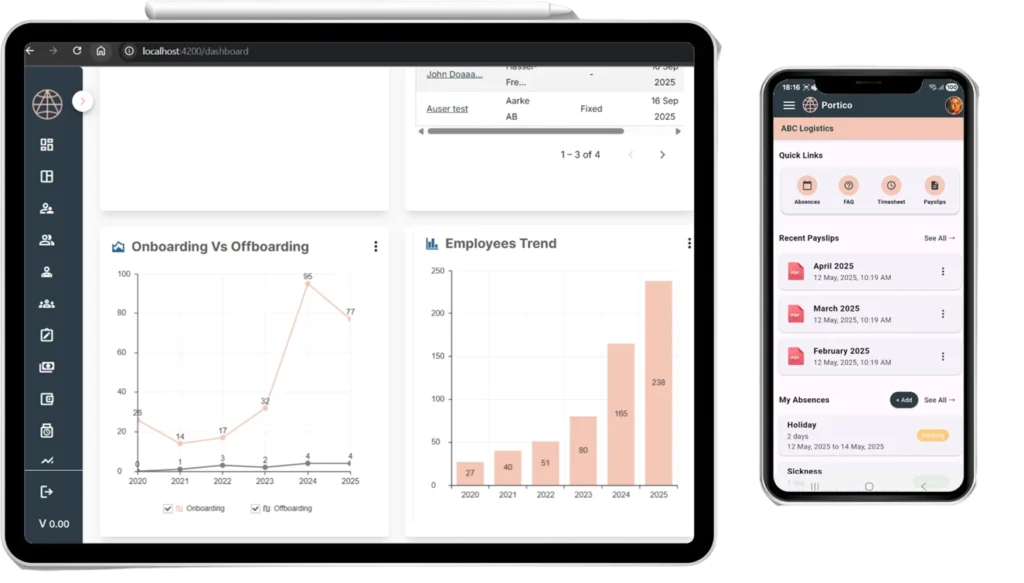
We don’t hide fees or sneak price increases. We run Japanese payroll in-house and file under your own registrations across the pension office, Hello Work, the Labour Standards Inspection Office and the tax office, rather than a provider’s, so the same team that files your annual determination answers your calls. You get a named account manager, one consolidated monthly invoice covering salaries, social insurance, taxes and fees, and one live Portico view of Japan beside every other country we run for you. Portico syncs with your time-tracking, leave and HR systems via API – set up by our onboarding team, not left to yours. GDPR, SOC 2 and ISO 27001 certified.

Other services
Accelerating your growth in Japan and beyond
TopSource goes far beyond payroll, acting as your end-to-end partner in global workforce management. From Employer of Record (EOR) services and seamless entity setup to localized accountancy and fractional HR support, we cover every aspect of international employment.

Meet our experts for Japan
Whether you’re entering the market or scaling operations, our specialists provide the insight and guidance you need to succeed in one of the world’s most dynamic and regulated employment landscapes. With TopSource, you’re backed by real experts, every step of the way.

Beyond a payroll serviceA globalization accelerator
Payroll platform
Global payroll simplified
Your intuitive hub for paying global teams. Simple, powerful, and designed to scale with you — no complexity, just clarity.
Audit
Eliminate barriers to growth
Avoid compliance issues across your global workforce and uncover opportunities to improve profitability. On a quarterly basis we’ll help you audit your global talent strategy to ensure it aligns with your business goals.
Intelligence
Build a data-driven talent strategy
Grow confidently and profitably with access to the latest TopSource insights & data on hiring markets, salary benchmarking & benefits.
Advisory
Expert guidance that turns complexity into clarity.
Whether you’re managing a global acquisition or entering a new market, you get clear guidance to navigate complex decisions, avoid delays, and accelerate your global expansion.


Japanese payroll FAQs
Employer social insurance in Japan is about 15.70% of remuneration for a Tokyo-based general-business employee under 40, rising to 16.51% from age 40 when nursing care insurance begins. For FY2026 the components are health insurance at 4.925% (half of Tokyo’s 9.85%), the new child and childcare support levy at 0.115%, nursing care at 0.810% where it applies, Employees’ Pension Insurance at 9.150%, the employer-only child allowance contribution at 0.360%, employment insurance at 0.850%, workers’ accident compensation at 0.300% for an office classification, and the asbestos general contribution at 0.002%. Because the social insurance components are capped, the effective employer rate falls to about 6.4% at ¥30 million of salary.
Standard monthly remuneration is the banded figure on which Japanese social insurance contributions are calculated, instead of actual pay. The health insurance table has 50 grades from ¥58,000 to ¥1,390,000 and the pension table has 32 from ¥88,000 to ¥650,000. It is normally fixed once a year from the average of April, May and June remuneration, filed by 10 July, and applies from September through the following August. It includes base salary, overtime, commuting allowance, housing and family allowances and benefits in kind, but excludes retirement allowance, business travel expenses and bonuses paid three or fewer times a year.
The annual regular determination is filed by 10 July each year and fixes every employee’s contribution grade from September through the following August. It averages the remuneration paid in April, May and June – and those are months of actual payment, not the months the work was performed, so for an employer that pays the previous month’s salary on the 25th the window is really March to May work. A month counts toward the average only if it has 17 or more payment-basis days, or 11 for short-time workers at expanded-coverage establishments. Employees who became insured on or after 1 June, or who left on or before 30 June, are excluded.
An occasional revision is compulsory, not optional, when three conditions are all met: a change in fixed wages, a resulting shift of two or more grades on the standard remuneration table, and three consecutive months each with 17 or more payment-basis days. It takes effect from the fourth month after the fixed-wage change, so a change in April applies from July. A change in overtime alone does not trigger it, because overtime is variable pay – but once a fixed-wage change has occurred, overtime is included in the three-month average used to test the grade shift. Raising a fixed commuting or housing allowance counts as a fixed-wage change, which is the most commonly missed trigger because it carries no income tax consequence.
Resident tax is a separate withholding obligation from national income tax, and the employer must remit it to each employee’s municipality of residence as at 1 January. It is charged at roughly 10% – 4% prefectural plus 6% municipal – plus a flat levy of about ¥5,000, and it is based on the prior calendar year’s income, so the amount collected from June 2026 to May 2027 is assessed on 2025 income. The employer files a wage payment report by 31 January, receives a determination notice from each municipality by 31 May, deducts monthly from June, and remits to each municipality by the 10th of the following month. The employer does not calculate the amount; the municipality does.
It depends on when they leave. Where an employee leaves between 1 June and 31 December, collecting the remaining balance in a lump sum is optional and happens only if the employee requests it; otherwise the balance reverts to them to pay personally. Where an employee leaves between 1 January and 30 April, lump-sum collection is mandatory on the employer – the entire unpaid balance must be withheld from final wages or retirement allowance without any request, and remitted by 31 May. Someone resigning in February can therefore have up to four months of resident tax deducted from one final payslip. Practice for May leavers varies by municipality and should be checked.
Thirty days’ notice, or payment in lieu, but that is only the procedural minimum and not the substantive test. Japan has no at-will employment: a dismissal must be on objectively reasonable grounds and socially acceptable in the circumstances, and the abuse-of-dismissal-right doctrine makes unilateral termination genuinely difficult to sustain. Fixed-term contracts convert to indefinite on the employee’s request after five years. Retirement allowance is customary rather than statutory, but where the work rules provide for one it becomes contractually binding. In practice exits in Japan are negotiated rather than executed, and the largest financial exposure is an unpaid overtime claim, which carries a three-year limitation period.
Japan’s minimum wage is set prefecturally and revised each autumn. For FY2026 the national weighted average is ¥1,177 an hour, up ¥56 from ¥1,121 – the second largest increase since the guideline system began in 1978. Tokyo is highest at ¥1,280 and Kochi and Miyazaki lowest at ¥1,085, with increases ranging from ¥54 to ¥65 across prefectures and effective dates staggered between 1 October and 2 December 2026. Overtime and holiday premiums, bonuses, commuting allowance, family allowance and attendance allowance are all excluded from the comparison, so a headline hourly rate that leans on allowances can still breach the minimum.
Annual paid leave starts at 10 days after six months of continuous service with at least 80% attendance, and rises with service to 11 days at one year and six months, 12 at two years and six months, then 14, 16, 18 and finally 20 days at six years and six months. Unused leave carries forward for two years. Since April 2019 the employer has an active obligation to ensure at least five days are actually taken each year, with a fine of up to ¥300,000 per employee for failure, and the employer must maintain an annual leave management record. Hourly leave is permitted but does not count toward the mandatory five days.
Not properly. An establishment covered by health insurance and pension must be in Japan, so a foreign company with no registered Japanese presence generally cannot enrol employees – leaving them to join the national health and pension schemes personally, without the employer’s 50% share and with lower pension accrual. Labour insurance likewise requires a workplace in Japan. A payer outside Japan with no office there generally has no withholding obligation, so the employee must file and pay personally, and with no Japanese employer to act as special collection agent they pay resident tax in four personal instalments. Meanwhile the Labour Standards Act applies in full to work performed in Japan, and an employee doing more than preparatory activities can create a permanent establishment. The realistic routes are a branch or subsidiary, or an employer of record.
Looking at other markets too?
We help organizations employ and pay teams in 164 countries.