Payroll Services in the United Arab Emirates
Fully managed UAE payroll – salaries cleared through the Wage Protection System on the first of the month as the June 2026 rules now require, end-of-service gratuity accrued monthly rather than discovered at exit, GPSSA and Abu Dhabi Pension Fund contributions filed for your Emirati staff, and your Emiratisation position tracked against live headcount, with a named specialist a phone call away.
Mainland, Dubai free zones, DIFC and ADGM – run through your own UAE entity, with your global view consolidated in Portico.

TopSource rated 5/5 by our customers

What UAE payroll actually involves
There is no income tax in the UAE and no social security for expatriate employees, which is why UAE payroll is often described as simple. It isn’t – the burden has just moved. Instead of rates, the UAE runs on a calendar and a quota. Since 1 June 2026, salaries must clear the Wage Protection System on the first day of the month with no grace period, and work permits are suspended on day five. Emiratisation carries a financial contribution of AED 120,000 a year for every unfilled position. End-of-service gratuity accrues silently every month against basic wage. And the DIFC and ADGM are separate common-law jurisdictions with their own employment statutes, their own courts and none of the above. The cost of getting UAE payroll wrong is not a percentage – it is a fine, a suspended permit, or a dispute at the exit door.
Our Partners Globally









Calculate Your Employee Costs in the UAE
Enter a gross salary to see the full monthly cost of a UAE employee – gratuity accrual, pension contributions where the employee is an Emirati or GCC national, and insurance included in your total spend per employee.
Employment Cost Calculator
*Indicative figures only and not definitive legal advice. Local regulations change frequently. Consult an expertUnited Arab Emirates
| British Pound | United Arab Emirates | |
|---|---|---|
| Base Salary (per month) | ||
| Employer Contributions | ||
| Total Cost (Annual) | ||
| Total Cost (Monthly) |
“Their expertise and understanding of the unique hiring, payment, and human resource practices in each country has been nothing short of outstanding. Our Client Success Manager, has done just that … ensured our success. Her availability and willingness to engage on a personal level has made all the difference.”

“Excellent service, especially from our account manager who has gone above and beyond to help us use the platform effectively. Our manager, significantly simplifies my workload. It is like having your own TopSource HR representative on your team.”
“TopSource has been our go-to resource for international hiring. They are responsive, thorough, respectful and knowledgeable. The Client Success team has provided us with the utmost customer service, and the more we use TopSource, the more, it gives us access to more resources and knowledge.”
Employer Costs in the UAE Explained
Statutory employer costs in the UAE depend entirely on nationality. For an expatriate employee there is no income tax, no social security and no employer contribution of any kind – the only accruing cost is end-of-service gratuity, worth 5.83% of basic wage a year for the first five years and 8.33% thereafter, plus employer-funded health insurance and a workers’ protection premium of around AED 55 a year. On a typical package that is under 4% of total remuneration. For a UAE national the employer pays 15% of contribution salary to GPSSA – effectively 12.5% while the government subsidy lasts, and 15% from September 2026 when Nafis withdraws it – on a base between AED 3,000 and AED 70,000, and no gratuity at all. Sitting above both is the cost nobody models until it arrives: the Emiratisation quota, at AED 10,000 a month for every position you have not filled. Here’s the breakdown.
The Wage Protection System is the MOHRE-monitored channel through which every mainland private-sector salary must be paid, via an agent bank or exchange house that files a monthly salary information file. On 1 June 2026, Ministerial Resolution No. 340 of 2026 replaced Ministerial Resolution No. 598 of 2022 and reset the timing entirely. Wages for the preceding Gregorian month are now due on the first day of the month. There is no grace period. The compliance threshold rose from 80% to 85%, meaning at least 85% of total wages due must be transferred by the deadline and each worker must receive at least 85% of monthly salary after lawful deductions. The exemption that gave new employees thirty days is gone – a joiner is in the WPS from their first pay cycle.
The enforcement ladder is automated and it moves quickly. Day two brings notifications and warnings. Day five suspends the issue of new work permits. Day eleven brings administrative fines and a downgrade to third category – which raises permit fees on everything you do afterwards – where the establishment has repeated the violation within six months. Day sixteen has MOHRE register labour disputes on employees’ behalf and suspend work permits. Day twenty-one opens precautionary attachment of assets, travel bans on company officials and referral to the Public Prosecution. Fines run at AED 1,000 per affected worker up to AED 20,000 per establishment.
In practice the difficulty is rarely intent. It is that a month-end payroll approved on the 28th, sent to a bank on the 29th and processed over a weekend or a public holiday no longer arrives in time – and the UAE has twelve public holidays across seven occasions in 2026, five of which move with the moon and are confirmed only weeks ahead. The exemptions are narrow: employees paid outside the UAE with employer request and employee approval, employees under a court-ordered restriction, and mission work permits of three months or less.
Emiratisation is a quota, and for most international employers it is the largest single number on the page. Private-sector companies with 50 or more employees must increase Emiratis in skilled roles by 2% a year, assessed as 1% per half-year on 30 June and 31 December, reaching a cumulative 10% of the skilled workforce by the end of 2026. A role counts as skilled only if it meets all three tests: it falls within MOHRE skill levels 1 to 5, the employee holds an attested qualification above secondary level, and the monthly salary is at least AED 4,000. The financial contribution for an unfilled position is AED 10,000 a month in 2026 – AED 120,000 a year – payable from 1 July for a first-half shortfall. Companies with 20 to 49 employees in fourteen specified sectors must employ at least two Emiratis, assessed annually, with AED 108,000 payable from January 2026 for a 2025 shortfall.
Circumventing the target is treated separately and severely: AED 100,000 for a first violation, AED 300,000 for a second and AED 500,000 thereafter, and the company must still meet the target measured on its pre-circumvention headcount. Fictitious employment also attracts AED 100,000 to AED 1,000,000 under Article 60 of the Labour Law as amended in 2024, multiplied by the number of workers.
Two 2026 changes sit alongside the quota. From 1 January 2026 MOHRE will not issue or renew an Emirati work permit showing a salary below AED 6,000 a month, and employers had until 30 June 2026 to lift existing Emirati salaries; from 1 July, non-compliant employers lose Emiratisation quota credit for those employees and face new-permit restrictions. And from September 2026 the Nafis programme stops reimbursing the 2.5% of pension contributions it currently pays on the employer’s behalf for Emiratis earning under AED 20,000, while the salary top-up is restructured from a flat AED 7,000 cap into education-banded amounts. For an employer of subsidised Emiratis this is a direct cost increase of 2.5 percentage points on contribution salary.
The arithmetic is worth stating plainly, because it usually settles the argument: an Emirati on the AED 6,000 minimum costs about AED 82,800 a year including the full 15% pension contribution. The contribution for leaving that position unfilled is AED 120,000. Compliance is cheaper than non-compliance before you count the work getting done.
There is no pension for expatriate employees in the UAE. What exists instead is end-of-service gratuity under Article 51 of Federal Decree-Law No. 33 of 2021: after one year of continuous service, 21 days of wage for each of the first five years and 30 days for each additional year, capped at two years’ wage. It is calculated on basic wage only, excluding allowances, and unpaid leave does not count toward service. Since the 2021 law there is no reduction for resignation – the entitlement is identical whether the employee resigns or is dismissed, and it is not forfeited on summary dismissal. All end-of-contract entitlements must be settled within 14 days of the contract ending.
As a monthly accrual, 21 days over a 360-day year is 5.83% of basic wage, and 30 days is 8.33%. Those are exactly the rates used by the voluntary alternative end-of-service savings scheme introduced by Cabinet Resolution No. 96 of 2023 and in force since 1 November 2023: 5.83% of basic monthly salary for employees with under five years’ service and 8.33% for five years or more, paid monthly into a MOHRE-licensed fund. Joining is the employer’s choice, but once an employee is enrolled there is no route back to statutory gratuity, and the employer must stay in for at least a year. It applies prospectively only – gratuity accrued before enrolment crystallises and remains the employer’s liability.
The DIFC works differently and it is not optional. Since 1 February 2020, DIFC employers must pay 5.83% of monthly basic wage – 8.33% after five years – into DEWS or a certified qualifying scheme, by the 21st of the following month. Gratuity survives only for service before the scheme start date. ADGM keeps classic gratuity as the default, at 21 and 30 days, with basic wage floored at 50% of annual wages, and permits a savings scheme that both the employer and the employee must opt into.
The practical failure we see most often on takeover is a gratuity liability calculated on total package rather than basic wage, or an accrual that never moved to 30 days when an employee passed five years. Both are invisible until someone leaves, and then they are a dispute.
Whether anyone contributes to a pension in the UAE depends on nationality, not on salary. Expatriates who are not GCC nationals are in no scheme: no employer contribution, no employee contribution, no return to file. UAE nationals are enrolled with the General Pension and Social Security Authority, and the rate depends on when they were first registered. Nationals registered from 31 October 2023 under Federal Decree-Law No. 57 of 2023 contribute 26% in total – 11% employee and 15% employer – on a contribution account salary of basic plus cost-of-living, social and housing allowances, between a floor of AED 3,000 and a private-sector ceiling of AED 70,000. Nationals registered before that date remain on the older 20%: 5% employee and 15% employer, on gross salary including all contractual allowances, capped at AED 50,000.
In both cases the government currently meets 2.5 percentage points of the employer’s share where contribution salary is below AED 20,000, so the employer effectively pays 12.5% – the subsidy that Nafis withdraws from September 2026. Contributions for a month are payable between the 1st and the 15th of the following month, and late payment carries 0.1% of the outstanding amount per day from the 16th. GPSSA began enforcing that penalty against employers of GCC nationals from 1 July 2025.
Two variations matter. Emiratis employed by Abu Dhabi-based entities register with the Abu Dhabi Pension Fund rather than GPSSA: 26% for members joining from 1 December 2023, on a pensionable salary capped at AED 100,000. And GCC nationals working in the UAE are covered by the GCC Insurance Protection Extension Programme, insured under their home country’s system at their home country’s rates – with the rule that the employer’s share may not exceed what a UAE employer would pay, and the employee bears any difference. Registration for nationals is due within 30 days of the start date.
Separately, and often confused with pensions: unemployment insurance under Federal Decree-Law No. 13 of 2022 has been compulsory since 1 January 2023, but it is paid by the employee, not the employer – AED 5 a month plus VAT where basic salary is AED 16,000 or less, AED 10 above. There is no employer premium and no statutory duty to deduct it, though MOHRE recovers unpaid fines of AED 400 through the WPS, so most employers brief their staff rather than leave it.
Mainland working hours are 8 a day or 48 a week, reduced by two hours a day through Ramadan for all private-sector staff regardless of religion. Overtime is paid at basic wage plus at least 25%, or plus 50% for hours between 22:00 and 04:00, with a maximum of two overtime hours a day. Working on a rest day earns a substitute day or normal pay plus 50%. Outdoor work in direct sunlight is banned between 12:30 and 15:00 from 15 June to 15 September. There is a break of not less than an hour after five consecutive hours. The DIFC and ADGM cap the week at 48 hours but mandate no overtime premium at all – a difference that surprises employers moving staff between jurisdictions.
Annual leave is 30 calendar days after a year’s service, or two days a month between six and twelve months, paid on basic salary and payable on termination however short. Sick leave is up to 90 days a year – the first 15 at full pay, the next 30 at half pay, the remaining 45 unpaid – and there is no paid sick leave during probation. Maternity leave is 60 days, 45 at full pay and 15 at half, with up to 45 further unpaid days for post-natal illness and a paid nursing hour a day for six months. Both parents get 5 working days of parental leave within six months of the birth. Bereavement leave is 5 days for a spouse and 3 for a close relative. The DIFC and ADGM both give 20 working days of annual leave and 60 working days of sick leave on a 10-day full, 20-day half, 30-day unpaid scale.
All mainland contracts are fixed-term, though the original three-year maximum was removed in 2022 and any term may now be agreed; a contract that is not renewed but continues in practice renews automatically on the same terms. Probation is a maximum of six months and cannot be repeated or extended, with 14 days’ notice from the employer, one month from an employee moving to another UAE employer, and 14 days from an employee leaving the country. Notice after probation is between 30 and 90 days. Compensation for arbitrary dismissal is capped at three months’ wage. Since the 2024 amendments MOHRE issues binding decisions on claims up to AED 50,000, and the limitation period is two years.
Employing someone without a work permit is the offence that carries the heaviest penalty: AED 100,000 to AED 1,000,000, multiplied by the number of workers. It is also the easiest to commit by accident, by letting someone start before the permit issues.
UAE employer contribution rates, 2026
| Contribution | Employer | Employee | Applies to |
|---|---|---|---|
| Income tax withholding | None | None | There is no personal income tax on employment income and no payroll withholding obligation |
| Social security – expatriates (non-GCC) | None | None | Expatriates are in no pension scheme. Gratuity applies instead |
| GPSSA – UAE nationals registered from 31 Oct 2023 | 15% (effectively 12.5% while the 2.5% subsidy applies) | 11% | On contribution account salary between AED 3,000 and AED 70,000. Federal Decree-Law No. 57 of 2023 |
| GPSSA – UAE nationals registered before 31 Oct 2023 | 15% (effectively 12.5% while the subsidy applies) | 5% | On gross salary including contractual allowances, capped at AED 50,000 |
| Abu Dhabi Pension Fund – members from 1 Dec 2023 | 15% | 11% | Emiratis employed by Abu Dhabi-based entities, including ADGM. Pensionable salary capped at AED 100,000 |
| GCC nationals | Home country rate | Home country rate | GCC Insurance Protection Extension Programme. Employer share capped at the UAE equivalent; the employee bears any excess |
| End-of-service gratuity accrual – expatriates | 5.83% of basic wage; 8.33% after 5 years | — | 21 days per year for the first 5 years, 30 days thereafter, capped at 2 years’ wage. Basic wage only |
| DIFC qualifying scheme (DEWS) | 5.83% of monthly basic wage; 8.33% after 5 years | — | Mandatory since 1 February 2020. Due by the 21st of the following month |
| Unemployment insurance (ILOE) | None | AED 5 or AED 10 per month plus VAT | Employee-paid. AED 5 where basic salary is AED 16,000 or less, AED 10 above. Compulsory since 1 January 2023 |
| Health insurance | Employer-funded | — | Mandatory in Dubai and Abu Dhabi, and in the Northern Emirates for private-sector employees since 1 January 2025. From AED 320 per year for a basic package |
| Workers’ protection insurance | AED 137.50 per skilled worker per 30-month policy | — | Replaced the AED 3,000 bank guarantee. Covers up to AED 20,000 per worker. AED 180 low-skilled, AED 250 high-risk |
| Emiratisation financial contribution | AED 10,000 per month per unfilled position | — | Not a contribution rate but the largest employer cost in UAE payroll |
Mainland, DIFC and ADGM compared, 2026
| Mainland (MOHRE) | DIFC | ADGM | |
|---|---|---|---|
| Governing law | Federal Decree-Law No. 33 of 2021, MOHRE | DIFC Law No. 2 of 2019, consolidated July 2025 | ADGM Employment Regulations 2024, in force 1 April 2025 |
| End of service | Gratuity 21 / 30 days, paid at exit. Voluntary savings scheme available | Mandatory monthly 5.83% / 8.33% into DEWS or a certified scheme, by the 21st | Gratuity 21 / 30 days, basic wage floored at 50% of annual wages. Optional savings scheme |
| Annual leave | 30 calendar days after 1 year | 20 working days | 20 working days; 5 days may carry over, expiring after 12 months |
| Sick leave | 90 days: 15 full, 30 half, 45 unpaid. None in probation | 60 working days: 10 full, 20 half, 30 unpaid | 60 working days: 10 full, 20 half, 30 unpaid. Unpaid in probation |
| Overtime premium | +25%, or +50% between 22:00 and 04:00 | None mandated | None mandated |
| Notice after probation | 30 to 90 days | 7 days under 3 months; 30 days to 5 years; 90 days at 5 years or more | 7 days under 3 months; 30 days thereafter |
| Final settlement | Within 14 days | Within 14 days, plus a daily-wage penalty for each day in arrears | Within 21 calendar days |
| Wage Protection System | Applies. From 1 June 2026, due on the 1st | Does not apply | Does not apply |
| Emiratisation quota | Applies at 50+ employees, and 20–49 in 14 sectors | MOHRE quotas do not apply | Federal Emiratisation law does not apply |
| Disputes | MOHRE conciliation, then onshore Labour Courts | DIFC Courts, English-language common law | ADGM Courts, dedicated Employment Division |
What Emiratisation costs, and what compliance saves
| Skilled workforce | Emiratis required by end 2026 | Annual contribution if none are hired | Annual cost of hiring them at the minimum |
|---|---|---|---|
| 50 skilled employees | 5 | AED 600,000 | AED 414,000 |
| 100 skilled employees | 10 | AED 1,200,000 | AED 828,000 |
| 250 skilled employees | 25 | AED 3,000,000 | AED 2,070,000 |
| 500 skilled employees | 50 | AED 6,000,000 | AED 4,140,000 |
The Emiratisation figures assume a mainland private-sector employer with 50 or more employees against the cumulative 10% target for the end of 2026, a financial contribution of AED 10,000 per month per unfilled position, and a cost of compliance calculated at the AED 6,000 monthly minimum salary for Emiratis plus the full 15% GPSSA employer contribution, with no Nafis salary support assumed. A real hire will usually cost more than the minimum and may attract Nafis support, so treat the last column as the shape of the decision rather than a quotation. Companies with 20 to 49 employees are assessed differently: those in fourteen specified sectors must employ at least two Emiratis, assessed annually, with AED 108,000 payable from January 2026 for a 2025 shortfall. Ordinary free zones such as JAFZA, DMCC and RAKEZ follow the federal Labour Law but issue their own work permits through the free zone authority; the DIFC and ADGM are different in kind, because Federal Law No. 8 of 2004 on Financial Free Zones exempts them from federal civil and commercial law.
Rates, thresholds and deadlines shown are current at 28 August 2026. UAE employment rules change by ministerial and cabinet resolution, frequently with only weeks of notice – the Wage Protection System was rewritten with effect from 1 June 2026. This page is general information, not tax or legal advice.
How our UAE payroll service works
Why TopSource for UAE Payroll
TopSource for payroll, Employer of Record or any other of our services represents a simpler, more reliable and transparent option.
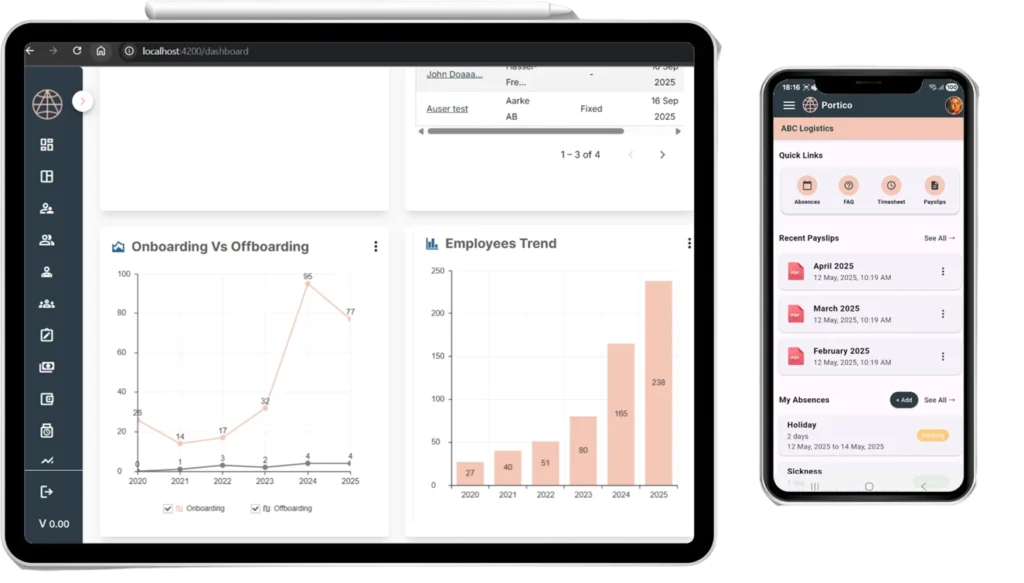
We don’t hide fees or sneak price increases. We run UAE payroll in-house, not brokered to a local agent – the same team that files your WPS salary file answers your calls, in your time zone. You get a named account manager, one consolidated monthly invoice covering salaries, contributions and fees, and one live Portico view of the UAE beside every other country we run for you. Portico syncs with your time-tracking, leave and HR systems via API – set up by our onboarding team, not left to yours. GDPR, SOC 2 and ISO 27001 certified.

Other services
Accelerating your growth in the United Arab Emirates and beyond
TopSource goes far beyond payroll, acting as your end-to-end partner in global workforce management. From Employer of Record (EOR) services and seamless entity setup to localized accountancy and fractional HR support, we cover every aspect of international employment.

Meet our experts for the United Arab Emirates
Whether you’re entering the market or scaling operations, our specialists provide the insight and guidance you need to succeed in one of the world’s most dynamic and regulated employment landscapes. With TopSource, you’re backed by real experts, every step of the way.

Beyond a payroll serviceA globalization accelerator
Payroll platform
Global payroll simplified
Your intuitive hub for paying global teams. Simple, powerful, and designed to scale with you — no complexity, just clarity.
Audit
Eliminate barriers to growth
Avoid compliance issues across your global workforce and uncover opportunities to improve profitability. On a quarterly basis we’ll help you audit your global talent strategy to ensure it aligns with your business goals.
Intelligence
Build a data-driven talent strategy
Grow confidently and profitably with access to the latest TopSource insights & data on hiring markets, salary benchmarking & benefits.
Advisory
Expert guidance that turns complexity into clarity.
Whether you’re managing a global acquisition or entering a new market, you get clear guidance to navigate complex decisions, avoid delays, and accelerate your global expansion.



UAE payroll FAQs
No. There is no personal income tax on employment income in the UAE and no payroll withholding obligation, so there is no PAYE equivalent, no monthly income tax return and no year-end certificate. Corporate tax of 9% applies to business profits above AED 375,000 for financial years beginning on or after 1 June 2023, but wages are expressly outside its scope for individuals.
Ministerial Resolution No. 340 of 2026 replaced Ministerial Resolution No. 598 of 2022 and now requires wages for the preceding month to clear the Wage Protection System on the first day of each Gregorian month, with no grace period. The compliance threshold rose from 80% to 85% and the thirty-day exemption for new employees was removed. Enforcement escalates automatically: warnings on day two, work-permit suspension on day five, fines and category downgrade on day eleven for a repeat violation within six months, and asset attachment and travel bans from day twenty-one.
End-of-service gratuity is 21 days of basic wage for each of the first five years of service and 30 days of basic wage for each year after that, capped at two years’ wage, payable after one year of continuous service. It is calculated on basic wage only, excluding allowances, and periods of unpaid leave do not count toward service. Since Federal Decree-Law No. 33 of 2021 the amount is the same whether the employee resigns or is dismissed, and all end-of-contract entitlements must be settled within 14 days.
Private-sector companies with 50 or more employees must reach 10% Emiratis in skilled roles by the end of 2026, assessed as 1% growth per half-year on 30 June and 31 December. The financial contribution for each unfilled position is AED 10,000 a month, or AED 120,000 a year, payable from 1 July 2026 for a first-half shortfall. Companies with 20 to 49 employees in fourteen specified sectors must employ at least two Emiratis, with AED 108,000 payable from January 2026 for a 2025 shortfall. Circumventing the target attracts AED 100,000 rising to AED 500,000 for repeat violations.
No. Expatriate employees who are not GCC nationals are not enrolled in any UAE pension scheme, and neither they nor their employer pays social security contributions. They receive end-of-service gratuity instead. GCC nationals are insured under their own country’s system through the GCC Insurance Protection Extension Programme, and UAE nationals are enrolled with GPSSA or, if the employer is Abu Dhabi-based, the Abu Dhabi Pension Fund.
UAE nationals registered from 31 October 2023 contribute 26% in total under Federal Decree-Law No. 57 of 2023 – 11% from the employee and 15% from the employer – on a contribution account salary between AED 3,000 and AED 70,000 in the private sector. Nationals registered before that date remain on 20%: 5% employee and 15% employer, capped at AED 50,000. The government currently pays 2.5 percentage points of the employer’s share where contribution salary is below AED 20,000, and Nafis withdraws that subsidy from September 2026.
There is no general statutory minimum wage for expatriate private-sector workers in the UAE. Article 27 of the Labour Law empowers the Cabinet to set one, but no general minimum has been issued. There is, however, a minimum for UAE nationals: since 1 January 2026 MOHRE will not issue or renew an Emirati work permit showing a salary below AED 6,000 a month, and from 1 July 2026 non-compliant employers lose Emiratisation quota credit for those employees. A separate AED 4,000 threshold forms part of the test for whether a role counts as skilled for quota purposes.
DEWS is the DIFC Employee Workplace Savings scheme, and it applies only to employers registered in the Dubai International Financial Centre. Since 1 February 2020 DIFC employers must pay 5.83% of each employee’s monthly basic wage – 8.33% after five years of service – into DEWS or a certified qualifying scheme, by the 21st of the following month, in place of end-of-service gratuity for service from that date. Mainland employers are not in DEWS; they have a voluntary alternative savings scheme at the same percentages, and ADGM keeps gratuity as its default.
Mainland employees get 30 calendar days of annual leave after one year of service, or two days a month between six and twelve months, and up to 90 days of sick leave a year – the first 15 at full pay, the next 30 at half pay and the remaining 45 unpaid, with no paid sick leave during probation. In the DIFC and ADGM the entitlements are 20 working days of annual leave and 60 working days of sick leave on a 10-day full, 20-day half, 30-day unpaid scale.
Yes, to run your own payroll. Employing onshore requires a trade licence, an establishment card, a MOHRE electronic signature card and a labour quota before any work permit can issue, plus WPS registration with an agent bank and pension registration for UAE and GCC nationals. Letting someone start before their permit issues is the most heavily penalised breach in UAE employment law, at AED 100,000 to AED 1,000,000 multiplied by the number of workers. If you do not have an entity, an Employer of Record in the UAE engages the employee through an existing licensed entity and sponsors the visa.
Looking at other markets too?
We help organizations employ and pay teams in 164 countries.