Payroll Services in Honduras
Fully managed Honduran payroll – IHSS, RAP and INFOP paid on the right ceilings, ISR withheld at the 2026 table, and the 13th and 14th month salaries calculated to the day, with a named specialist a phone call away.

TopSource rated 5/5 by our customers
What Honduran payroll actually involves
Honduran payroll pays fourteen salaries a year, funds severance in advance and runs social security through three institutions with different ceilings. The rules were rewritten in 2024, and the minimum wage for 2026 was only published in April.
Our Partners Globally









Calculate Your Employee Costs in Honduras
Enter a gross annual salary, meaning twelve monthly salaries, to see the employer cost of a Honduran employee: 8.7% IHSS up to L11,903.13 a month, the 4% Labour Reserve Fund up to L57,896.16 a month, the 1% INFOP levy, and the 13th and 14th month salaries. It does not include the 1.5% housing fund contribution on pay above L11,903.13.
Employment Cost Calculator
*Indicative figures only and not definitive legal advice. Local regulations change frequently. Consult an expertHonduras
| British Pound | Honduras | |
|---|---|---|
| Base Salary (per month) | ||
| Employer Contributions | ||
| Total Cost (Annual) | ||
| Total Cost (Monthly) |
“Their expertise and understanding of the unique hiring, payment, and human resource practices in each country has been nothing short of outstanding. Our Client Success Manager, has done just that … ensured our success. Her availability and willingness to engage on a personal level has made all the difference.”

“Excellent service, especially from our account manager who has gone above and beyond to help us use the platform effectively. Our manager, significantly simplifies my workload. It is like having your own TopSource HR representative on your team.”
“TopSource has been our go-to resource for international hiring. They are responsive, thorough, respectful and knowledgeable. The Client Success team has provided us with the utmost customer service, and the more we use TopSource, the more, it gives us access to more resources and knowledge.”
Employer Costs in Honduras Explained
A Honduran employee costs between about 22% and 30% on top of twelve monthly salaries. The 13th and 14th month salaries alone add 16.7%. Monthly contributions add the rest: 8.7% IHSS up to L11,903.13, 4% to the Labour Reserve Fund up to L57,896.16, 1% INFOP and, above the IHSS ceiling, 1.5% to the housing fund. Because the IHSS and reserve fund caps are low, the share falls as salaries rise. Severance of up to 25 months’ pay remains a liability, reduced by the reserve fund balance. Here’s the breakdown.
The Honduran Social Security Institute runs three regimes. Disability, old age and death insurance costs 3.5% from the employer and 2.5% from the employee, rates set by Decree 48-2024. Sickness and maternity insurance costs 5% from the employer and 2.5% from the employee. Both are charged on salary up to a ceiling of L11,903.13 a month, the level set for 2025 and still applied in 2026. Occupational risks insurance adds about 0.2%, paid by the employer alone.
An employer must register with the IHSS within five days of hiring its first worker, and each new worker within five days of starting. The monthly return and contributions are due within the first ten days of the following month, and late payment carries a surcharge of 5%, rising to 7.5% and 10% the longer it remains unpaid. The employer’s share can never be deducted from wages.
Sickness is shared with the IHSS. The employer pays the first three days in full; from the fourth day the IHSS pays 66% of the reference salary, up to the ceiling, and the employer tops it up to full salary. Maternity works the same way, with the IHSS paying 66% for 42 days before and 42 days after birth.
Decree 47-2024 created the Labour Reserve Fund, administered by RAP. The employer alone pays 4% of each employee’s monthly ordinary salary into an individual account, up to a ceiling of three times the highest minimum wage – L57,896.16 a month in 2026. When the employee is dismissed without cause, the balance is deducted from the severance owed; when the employee resigns, they keep the balance. Employers that already pay severance annually under an agreement are exempt. Contributions are not taxable income for the employee.
The same decree set the housing and financial inclusion fund at 1.5% from the employer and 1.5% withheld from the employee, charged only on the part of salary above the IHSS ceiling of L11,903.13, with no upper limit, and paid within 15 days of the withholding.
INFOP, the national training institute, adds a levy of 1% of wages for employers with five or more workers. It cannot be deducted from employees and is deductible for income tax.
The Framework Law on Social Protection of 2015 is often still quoted for these rates. It was struck down by the Constitutional Chamber, and the current obligations come from the 2024 decrees.
The 2026 income tax table was published by the Revenue Administration Service in January 2026, indexed by 4.98% inflation. Annual net income up to L228,324.32 is exempt; the next band to L348,154.10 is taxed at 15%, the band to L809,660.75 at 20% and income above that at 25%. Residents can deduct L40,000 a year for medical and education expenses without receipts, so a salary of up to L22,360.36 a month pays no tax.
The employer withholds the tax monthly and declares and pays it within the first ten days of the following month, and is jointly liable for any tax it fails to withhold. The 13th and 14th month salaries are each exempt up to ten average minimum wages, and severance is exempt. Salaries paid to non-residents are taxed at a final 25%.
The 2026 and 2027 minimum wages were agreed by the tripartite commission and published on 29 April 2026 in Agreement SETRASS-233-2026. For 2026 they rose 6% for employers with up to 50 workers and 7% for larger ones, backdated to 1 January, with the difference for January to April payable by 31 July 2026. The rate depends on eleven sectors and four company sizes, from L9,596.64 a month in agriculture with up to ten workers to L19,298.72 in financial services with more than 150. Maquila and free-zone companies have a separate agreement until the end of 2026.
The 13th month salary is paid in December and the 14th in June, the latter covering the year from 1 July to 30 June. Each equals a month of average ordinary salary, is pro-rated for shorter service and on termination, and forms part of salary for all legal purposes.
The day shift is up to 8 hours a day and 44 a week, paid as 48. Daytime overtime carries a 25% premium and overtime at night 50%, with no more than 12 hours of work in a day. Work on rest days and public holidays is paid double. Vacation is 10 working days after the first year, 12 after the second, 15 after the third and 20 from the fourth.
Probation can last up to 60 days. After that, notice runs from 24 hours in the first three months to one week, two weeks, one month after a year and two months after two years, or pay in lieu. Severance for dismissal without cause is 10 days’ salary for three to six months of service, 20 days for six to twelve months and one month per year after that, capped at 25 months, or 15 months for employers with up to ten workers. Employees who resign after 15 years receive 35% of it.
At least 90% of an employer’s workers must be Honduran and receive at least 85% of total salaries, and foreign workers need legal residence and a work card from the Ministry of Labour.
Honduran employer contribution rates, 2026
| Contribution | Employer | Employee | Applies to |
|---|---|---|---|
| IHSS disability, old age and death | 3.5% | 2.5% | Salary up to L11,903.13 a month |
| IHSS sickness and maternity | 5% | 2.5% | Same ceiling |
| IHSS occupational risks | 0.2% | — | Same ceiling |
| Labour Reserve Fund (RAP) | 4% | — | Salary up to L57,896.16 a month |
| Housing fund (RAP) | 1.5% | 1.5% | Salary above L11,903.13, no upper limit |
| INFOP training levy | 1% | — | Employers with five or more workers |
| 13th and 14th month salaries | One month each | — | December and June |
| Income tax (ISR) | — | 15% / 20% / 25% | Above L22,360.36 a month |
Income tax withheld at selected salaries, 2026
| Monthly salary | Annual taxable income | Tax a year | Tax a month | Effective rate |
|---|---|---|---|---|
| L22,360.36 | L228,324.32 | L0 | L0 | 0.00% |
| L30,000 | L320,000 | L13,751 | L1,146 | 3.82% |
| L50,000 | L560,000 | L60,344 | L5,029 | 10.06% |
| L80,000 | L920,000 | L137,861 | L11,488 | 14.36% |
| L150,000 | L1,760,000 | L347,861 | L28,988 | 19.33% |
Employer cost by monthly salary, 2026
| Monthly salary | Contributions a year | 13th and 14th month | Total a year | Share of twelve salaries |
|---|---|---|---|---|
| L13,654.55 | L20,935 | L27,309 | L48,244 | 29.44% |
| L19,298.72 | L25,337 | L38,597 | L63,935 | 27.61% |
| L30,000 | L33,684 | L60,000 | L93,684 | 26.02% |
| L60,000 | L56,074 | L120,000 | L176,074 | 24.45% |
| L100,000 | L68,074 | L200,000 | L268,074 | 22.34% |
Taxable income is twelve monthly salaries less the L40,000 deduction, with the 13th and 14th month within their exemption. Contributions include IHSS at 8.7% to the ceiling, the Labour Reserve Fund, INFOP and the housing fund above the IHSS ceiling. L13,654.55 and L19,298.72 are the 2026 minimum wages for financial services with up to 10 and more than 150 workers. These are TopSource calculations from the verified 2026 rates.
Rates, ceilings and statutory amounts shown are for 2026 and were verified on 16 September 2026. The income tax table is indexed every January, the IHSS board can set new ceilings, and the 2027 minimum wage increases are already agreed. This page is general information, not tax or legal advice.
How our Honduran payroll service works
Why TopSource for Honduran Payroll
TopSource for payroll, Employer of Record or any other of our services represents a simpler, more reliable and transparent option.
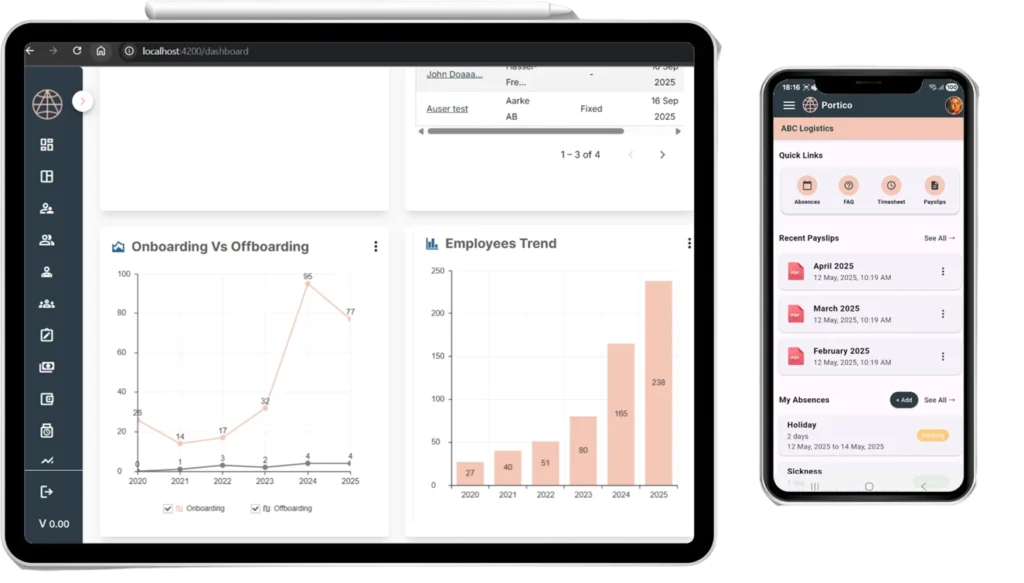
We don’t hide fees or sneak price increases. We run Honduran payroll in-house and file under your own registrations rather than a bureau’s, so the same team that files your IHSS return answers your calls. You get a named account manager, one consolidated monthly invoice covering salaries, contributions, taxes and fees, and one live Portico view of Honduras beside every other country we run for you. Portico syncs with your time-tracking, leave and HR systems via API – set up by our onboarding team, not left to yours. GDPR, SOC 2 and ISO 27001 certified.
Other services
Accelerating your growth in Honduras and beyond
TopSource goes far beyond payroll, acting as your end-to-end partner in global workforce management. From Employer of Record (EOR) services and seamless entity setup to localized accountancy and fractional HR support, we cover every aspect of international employment.

Meet our experts for Honduras
Whether you’re entering the market or scaling operations, our specialists provide the insight and guidance you need to succeed in one of the world’s most dynamic and regulated employment landscapes. With TopSource, you’re backed by real experts, every step of the way.

Beyond a payroll serviceA globalization accelerator
Payroll platform
Global payroll simplified
Your intuitive hub for paying global teams. Simple, powerful, and designed to scale with you — no complexity, just clarity.
Audit
Eliminate barriers to growth
Avoid compliance issues across your global workforce and uncover opportunities to improve profitability. On a quarterly basis we’ll help you audit your global talent strategy to ensure it aligns with your business goals.
Intelligence
Build a data-driven talent strategy
Grow confidently and profitably with access to the latest TopSource insights & data on hiring markets, salary benchmarking & benefits.
Advisory
Expert guidance that turns complexity into clarity.
Whether you’re managing a global acquisition or entering a new market, you get clear guidance to navigate complex decisions, avoid delays, and accelerate your global expansion.


Honduran payroll FAQs
Employers pay IHSS social security of 3.5% for disability, old age and death, 5% for sickness and maternity and about 0.2% for occupational risks, on salary up to L11,903.13 a month. They also pay 4% to the Labour Reserve Fund up to L57,896.16, 1.5% to the housing fund on salary above L11,903.13, and a 1% INFOP levy if they have five or more workers.
The IHSS contribution ceiling is L11,903.13 a month for both the disability, old age and death regime and the sickness and maternity regime. It was set for 2025 under Decree 48-2024 and is still applied in 2026, as the IHSS board has not fixed a new ceiling. Employees pay 2.5% to each regime on salary up to that amount.
It is a fund created by Decree 47-2024 into which the employer pays 4% of each employee’s monthly salary, up to three times the highest minimum wage – L57,896.16 a month in 2026. The balance belongs to the employee, is offset against severance on dismissal without cause, and is paid to the employee in full on resignation.
Annual net income up to L228,324.32 is exempt. Income above that is taxed at 15% up to L348,154.10, 20% up to L809,660.75 and 25% above. Residents deduct L40,000 a year for medical and education expenses without receipts, so a salary of up to L22,360.36 a month pays no tax. Employers withhold and pay the tax within the first ten days of the following month.
It depends on the sector and the size of the employer. Under Agreement SETRASS-233-2026, published in April 2026, monthly minimum wages range from L9,596.64 in agriculture with up to ten workers to L19,298.72 in financial services with more than 150. They rose 6% for employers with up to 50 workers and 7% for larger ones, backdated to 1 January.
The 13th month salary is paid in December and the 14th month salary in June. Each equals a month of average ordinary salary; the 14th covers service from 1 July to 30 June. Both are pro-rated for employees with less than a full year and on termination, and each is exempt from income tax up to ten average minimum wages.
Severance for dismissal without cause is 10 days’ salary after three to six months of service, 20 days after six to twelve months and one month’s salary per year of service after that, capped at 25 months, or 15 months for employers with up to ten workers. Employees who resign after 15 years of service receive 35%. The Labour Reserve Fund balance is deducted.
For employees covered by the IHSS, the employer pays the first three days of sickness in full. From the fourth day the IHSS pays 66% of the reference salary up to the contribution ceiling, for up to 365 days, and the employer pays the difference up to the employee’s full salary.
After a probation period of up to 60 days, notice is 24 hours for under three months of service, one week for three to six months, two weeks for six months to a year, one month for one to two years and two months after two years. It can be replaced by payment in lieu.
Yes, within limits. At least 90% of an employer’s workers must be Honduran and receive at least 85% of total salaries, although the Ministry of Labour can relax this for a period. Foreign workers need legal residence and a work card from the Ministry of Labour before they start.
Looking at other markets too?
We help organizations employ and pay teams in 164 countries.