Payroll Services in the Czech Republic
Fully managed Czech payroll – social security and health insurance at the right bases and caps, the new unified monthly employer report filed by the 20th, income tax advances and the annual reconciliation handled, with a named specialist a phone call away.

TopSource rated 5/5 by our customers

What Czech payroll actually involves
Czech payroll runs on a flat 33.8% employer contribution and a 15% income tax, which makes the cost easy to model. What changed recently is the administration: a new monthly report from 2026 and a rewritten Labour Code from June 2025.
Our Partners Globally









Calculate Your Employee Costs in the Czech Republic
Enter a gross annual salary to see the full employer cost of a Czech employee: 21.5% pension insurance, 2.1% sickness insurance and 1.2% state employment policy, each capped at CZK 2,350,416 of annual pay, plus 9% health insurance with no ceiling.
Employment Cost Calculator
*Indicative figures only and not definitive legal advice. Local regulations change frequently. Consult an expertCzech Republic
| British Pound | Czech Republic | |
|---|---|---|
| Base Salary (per month) | ||
| Employer Contributions | ||
| Total Cost (Annual) | ||
| Total Cost (Monthly) |
“Their expertise and understanding of the unique hiring, payment, and human resource practices in each country has been nothing short of outstanding. Our Client Success Manager, has done just that … ensured our success. Her availability and willingness to engage on a personal level has made all the difference.”

“Excellent service, especially from our account manager who has gone above and beyond to help us use the platform effectively. Our manager, significantly simplifies my workload. It is like having your own TopSource HR representative on your team.”
“TopSource has been our go-to resource for international hiring. They are responsive, thorough, respectful and knowledgeable. The Client Success team has provided us with the utmost customer service, and the more we use TopSource, the more, it gives us access to more resources and knowledge.”
Employer Costs in the Czech Republic Explained
A Czech employee costs 33.8% on top of gross salary for most of the pay scale: 24.8% social security and 9% health insurance, with no mandatory 13th salary and no separate payroll tax. Social security stops at CZK 2,350,416 of annual pay, so the rate falls above about CZK 195,868 a month – to 25.2% at CZK 300,000. Health insurance never caps. On top of the contributions, the employer pays the first 14 days of sickness and severance of one to three months’ earnings on redundancy. Here’s the breakdown.
The employer contributes 24.8% of gross pay to social security: 21.5% pension insurance, 2.1% sickness insurance and 1.2% state employment policy. The employee pays 7.1%, of which 6.5% is pension and 0.6% sickness insurance. Health insurance is 13.5% of gross pay, 9% from the employer and 4.5% from the employee, paid to the employee’s chosen health insurance company rather than to the state.
The two behave differently at the top. Social security is capped at a maximum annual assessment base of 48 times the average wage – CZK 2,350,416 for 2026 – and once an employee’s year-to-date pay reaches it, neither side pays more that year. Health insurance has no ceiling. At the bottom, health insurance has a floor: the assessment base cannot be lower than the CZK 22,400 minimum wage, and where pay is lower the employer generally tops up the difference.
Both contributions are paid monthly and must reach the account of the social security administration and the health insurance company between the 1st and the 20th of the following month. What matters is the day the money is credited, not the day it is sent, and a deadline falling at a weekend moves to the next working day.
Employment income is taxed at 15% up to 36 times the average wage – CZK 1,762,812 a year, or CZK 146,901 a month in 2026 – and at 23% above it. The tax base is gross pay; the super-gross base that added employer contributions was abolished in 2021. The employer withholds a monthly advance and deducts the CZK 2,570 taxpayer credit, plus any child credits, where the employee has signed the annual tax declaration with that employer. An employee can sign it with only one employer at a time.
Several benefits are tax-free up to set limits, and they are one of the few levers Czech payroll offers: meal contributions of up to CZK 129.50 per shift in 2026, non-cash benefits such as leisure, culture and sport up to half the average wage, CZK 24,483.50 a year, health-related benefits up to CZK 48,967, and employer pension and life insurance contributions up to CZK 50,000 a year.
After the year ends, the employer carries out the annual tax reconciliation for each employee who asks for it, by 31 March, and refunds any overpayment through payroll. Withheld tax is remitted to the tax office by the 20th of the following month.
Act 323/2025 introduced a single unified monthly employer report, in force from 1 January 2026. It replaces the monthly social security statement, the annual pension insurance record and the notices of employee starts and exits, and the social security administration, the tax office, the labour office and the statistics office all take their data from it. The report is filed electronically with the Ministry of Labour through the Czech Social Security Administration between the 1st and the 20th of the following month.
The transition ran in two steps. April 2026 was the first month reported in the normal way, and the reports for January, February and March 2026 had to be filed separately between 1 April and 30 June 2026. The report carries far more per-employee data than the filings it replaced, so errors in contract dates, working time or assessment bases now surface at several authorities at once.
The minimum wage for 2026 is CZK 22,400 a month, or CZK 134.40 an hour on a 40-hour week, and it is now indexed automatically to the average wage. Since January 2025 the separate guaranteed wage tiers no longer apply to private employers, so the national minimum is the only statutory floor outside the public sector.
Sickness is partly an employer cost. For the first 14 calendar days of incapacity the employer pays wage compensation for the working days missed, at 60% of average hourly earnings after reduction thresholds of CZK 285.78, 428.58 and 856.98 in 2026. From day 15 the social security administration pays sickness benefit. Maternity and paternity benefits are paid by the state, not the employer.
Redundancy carries statutory severance of at least one month’s average earnings for less than a year of service, two months for one to two years and three months for two years or more. Where employment ends because of a work injury or occupational disease, the employee receives a lump sum of at least twelve months’ earnings instead.
Full-time working hours are up to 40 a week. Overtime attracts a premium of at least 25% of average earnings, or equivalent time off by agreement, and an employer may order no more than 150 hours of overtime a year. Annual leave is at least four weeks.
The amendment to the Labour Code that took effect on 1 June 2025 changed the parts of termination payroll teams rely on most. The notice period now runs from the day notice is delivered rather than from the first day of the following month, and it is at least two months, or one month where notice is given for poor performance or breach of duties. Probation can last up to four months, or eight for managers. The final pay date, severance and unused leave all follow from that delivery date, so a notice delivered mid-month now ends mid-month.
Czech employer contribution rates, 2026
| Contribution | Employer | Employee | Applies to |
|---|---|---|---|
| Pension insurance | 21.5% | 6.5% | Gross pay up to CZK 2,350,416 a year |
| Sickness insurance | 2.1% | 0.6% | Same cap |
| State employment policy | 1.2% | — | Same cap |
| Health insurance | 9% | 4.5% | All gross pay, no ceiling. Minimum base CZK 22,400 |
| Income tax | — | 15% / 23% | 23% above CZK 146,901 a month |
| Wage compensation for sickness | Days 1–14 | — | 60% of reduced average earnings, working days only |
| Severance on redundancy | 1 to 3 months’ earnings | — | By length of service |
| Total employer contributions | 33.8% | — | Falls above CZK 195,868 a month as social security caps |
Income tax on employment income, 2026
| Item | Monthly | Annual |
|---|---|---|
| 15% rate applies up to | CZK 146,901 | CZK 1,762,812 |
| 23% rate applies above | CZK 146,901 | CZK 1,762,812 |
| Taxpayer credit | CZK 2,570 | CZK 30,840 |
| Tax-free meal contribution | CZK 129.50 per shift | — |
| Tax-free non-cash benefits | — | CZK 24,483.50 |
Employer contributions by gross salary, 2026
| Monthly gross salary | Social security a year | Health insurance a year | Total a year | Effective rate |
|---|---|---|---|---|
| CZK 22,400 | CZK 66,662 | CZK 24,192 | CZK 90,854 | 33.80% |
| CZK 48,967 | CZK 145,726 | CZK 52,884 | CZK 198,610 | 33.80% |
| CZK 100,000 | CZK 297,600 | CZK 108,000 | CZK 405,600 | 33.80% |
| CZK 200,000 | CZK 582,903 | CZK 216,000 | CZK 798,903 | 33.29% |
| CZK 300,000 | CZK 582,903 | CZK 324,000 | CZK 906,903 | 25.19% |
CZK 22,400 is the 2026 minimum wage and CZK 48,967 the average wage used for the caps. The cost table assumes twelve equal monthly payments; with a bonus the social security cap is reached earlier in the year. These are TopSource calculations from the verified 2026 rates.
Rates, caps, thresholds and statutory amounts shown are for 2026 and were verified on 16 September 2026. The minimum wage, the average wage behind the social security cap and the 23% threshold, and the tax-free benefit limits are reset every January. This page is general information, not tax or legal advice.
How our Czech payroll service works
Why TopSource for Czech Payroll
TopSource for payroll, Employer of Record or any other of our services represents a simpler, more reliable and transparent option. If you would rather not employ staff in the Czech Republic directly, our Employer of Record in the Czech Republic can employ them on your behalf.
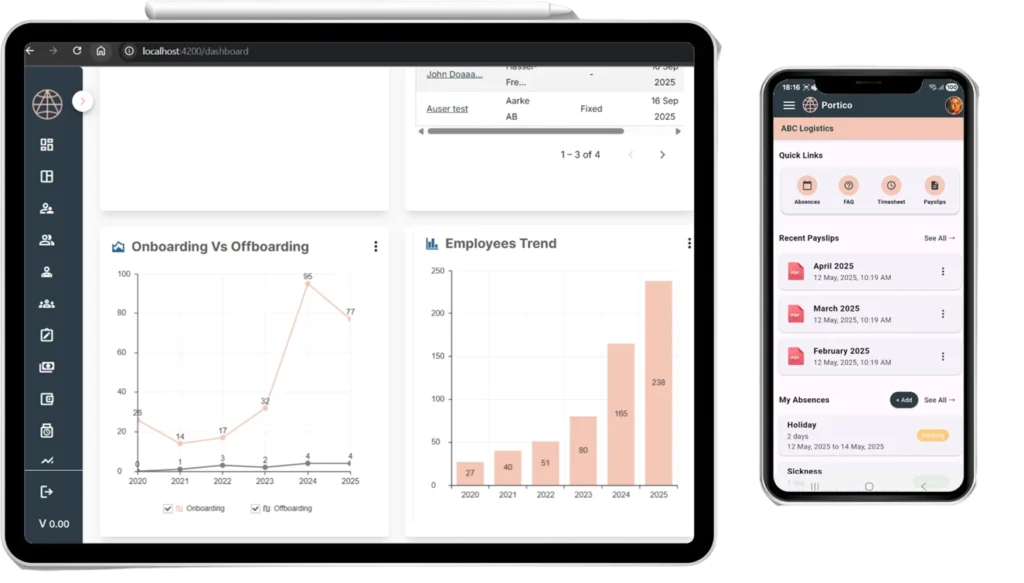
We don’t hide fees or sneak price increases. We run Czech payroll in-house and file under your own employer registration rather than a bureau’s, so the same team that files your monthly report answers your calls. You get a named account manager, one consolidated monthly invoice covering salaries, contributions, taxes and fees, and one live Portico view of the Czech Republic beside every other country we run for you. Portico syncs with your time-tracking, leave and HR systems via API – set up by our onboarding team, not left to yours. GDPR, SOC 2 and ISO 27001 certified.

Other services
Accelerating your growth in the Czech Republic and beyond
TopSource goes far beyond payroll, acting as your end-to-end partner in global workforce management. From Employer of Record (EOR) services and seamless entity setup to localized accountancy and fractional HR support, we cover every aspect of international employment.

Meet our experts for the Czech Republic
Whether you’re entering the market or scaling operations, our specialists provide the insight and guidance you need to succeed in one of the world’s most dynamic and regulated employment landscapes. With TopSource, you’re backed by real experts, every step of the way.

Beyond a payroll serviceA globalization accelerator
Payroll platform
Global payroll simplified
Your intuitive hub for paying global teams. Simple, powerful, and designed to scale with you — no complexity, just clarity.
Audit
Eliminate barriers to growth
Avoid compliance issues across your global workforce and uncover opportunities to improve profitability. On a quarterly basis we’ll help you audit your global talent strategy to ensure it aligns with your business goals.
Intelligence
Build a data-driven talent strategy
Grow confidently and profitably with access to the latest TopSource insights & data on hiring markets, salary benchmarking & benefits.
Advisory
Expert guidance that turns complexity into clarity.
Whether you’re managing a global acquisition or entering a new market, you get clear guidance to navigate complex decisions, avoid delays, and accelerate your global expansion.



Czech payroll FAQs
Employers pay 33.8% on top of gross salary in 2026: 24.8% social security, made up of 21.5% pension insurance, 2.1% sickness insurance and 1.2% state employment policy, plus 9% health insurance. Employees pay a further 7.1% social security and 4.5% health insurance. Social security is capped at CZK 2,350,416 of annual pay; health insurance has no ceiling. There is no mandatory 13th salary.
The maximum annual assessment base for social security is CZK 2,350,416 in 2026, which is 48 times the average wage of CZK 48,967. Once an employee’s pay for the year reaches it, neither the employer nor the employee pays further social security that year. Health insurance is not capped, so the employer keeps paying 9% on all pay above the ceiling.
The employer withholds a monthly tax advance of 15% of gross pay, or 23% on the part above CZK 146,901 a month, and deducts the CZK 2,570 monthly taxpayer credit and any child credits where the employee has signed the annual tax declaration with that employer. Withheld tax is paid to the tax office by the 20th of the following month, and the employer runs the annual reconciliation on request by 31 March.
It is a single electronic report introduced by Act 323/2025 from 1 January 2026, filed with the Ministry of Labour through the Czech Social Security Administration between the 1st and the 20th of the following month. It replaces the monthly social security statement, the pension insurance record and the notices of employee starts and exits. April 2026 was the first regular month, with January to March filed by 30 June 2026.
The minimum wage is CZK 22,400 a month, or CZK 134.40 an hour on a 40-hour week, from 1 January 2026. It is now indexed automatically to the average wage. Since January 2025 the guaranteed wage tiers apply only in the public sector, so private employers are bound by the national minimum. The minimum wage is also the minimum assessment base for health insurance.
The employer pays wage compensation for the first 14 calendar days of incapacity, for the working days the employee misses, at 60% of average hourly earnings after the 2026 reduction thresholds of CZK 285.78, 428.58 and 856.98. From day 15 the Czech Social Security Administration pays sickness benefit. Maternity and paternity benefits are also paid by the state.
The notice period is at least two months. Since the Labour Code amendment of 1 June 2025 it runs from the day notice is delivered, rather than from the first day of the following month, and it can be one month where the employer gives notice for poor performance or breach of duties. Probation can last up to four months, or eight for managers.
Yes, on redundancy and other organisational grounds. Statutory severance is at least one month’s average earnings for less than one year of service, two months for one to two years and three months for two years or more. Where employment ends because of a work injury or occupational disease, the employee receives a lump sum of at least twelve months’ average earnings instead.
In 2026 employers can provide meal contributions of up to CZK 129.50 per shift, non-cash benefits such as leisure, culture and sport up to CZK 24,483.50 a year, health-related benefits up to CZK 48,967, and pension and life insurance contributions up to CZK 50,000 a year without income tax or contributions. Amounts above those limits are taxed as ordinary pay.
Social security and health insurance for a month must be credited to the Czech Social Security Administration and each health insurance company between the 1st and the 20th of the following month. Withheld income tax and the unified monthly employer report are due on the same timetable. If the 20th falls on a weekend or public holiday, the deadline moves to the next working day.
Looking at other markets too?
We help organizations employ and pay teams in 164 countries.