Payroll Services in Austria
Fully managed Austrian payroll – social insurance up to the 2026 ceiling, wage tax on 14 salaries, employer levies and the monthly contribution report filed by the 15th, with a named specialist a phone call away.

TopSource rated 5/5 by our customers

What Austrian payroll actually involves
Austrian payroll runs on 14 salaries a year, a social insurance ceiling and a set of employer levies that sit outside social insurance. Collective agreements, not statute, set minimum pay for almost every employee.
Our Partners Globally









Calculate Your Employee Costs in Austria
Enter a gross annual salary, including the 13th and 14th salaries, to see the employer cost of an employee in Vienna: 21.23% social insurance up to EUR 97,020 a year, 1.53% severance fund, 3.7% family fund, 0.36% chamber levy, 3% municipal tax and the Vienna transport levy of EUR 2 a week.
Employment Cost Calculator
*Indicative figures only and not definitive legal advice. Local regulations change frequently. Consult an expertAustria
| British Pound | Austria | |
|---|---|---|
| Base Salary (per month) | ||
| Employer Contributions | ||
| Total Cost (Annual) | ||
| Total Cost (Monthly) |
“Their expertise and understanding of the unique hiring, payment, and human resource practices in each country has been nothing short of outstanding. Our Client Success Manager, has done just that … ensured our success. Her availability and willingness to engage on a personal level has made all the difference.”

“Excellent service, especially from our account manager who has gone above and beyond to help us use the platform effectively. Our manager, significantly simplifies my workload. It is like having your own TopSource HR representative on your team.”
“TopSource has been our go-to resource for international hiring. They are responsive, thorough, respectful and knowledgeable. The Client Success team has provided us with the utmost customer service, and the more we use TopSource, the more, it gives us access to more resources and knowledge.”
Employer Costs in Austria Explained
An Austrian employee costs about 30% on top of gross salary: 20.98% employer social insurance, or 21.23% in Vienna, plus 1.53% to the severance fund, 3.7% to the family fund, a chamber levy of around 0.35% and 3% municipal tax. Social insurance stops at the 2026 ceiling of EUR 6,930 a month, so the rate falls for high earners, but the levies never cap. Salaries are paid 14 times a year. Here’s the breakdown.
The employer pays 20.98% of gross pay in social insurance in 2026: 3.78% health, 12.55% pension, 2.95% unemployment, 1.10% accident insurance, 0.10% insolvency fund and 0.50% housing contribution. The employee pays 18.07%: 3.87% health, 10.25% pension, 2.95% unemployment, 0.50% chamber of labour and 0.50% housing. Vienna raised the housing contribution to 1.5% from January 2026, split 0.75% each way.
Contributions are calculated up to the maximum contribution base of EUR 6,930 a month, and on the 13th and 14th salaries up to EUR 13,860 a year. Employees earning up to EUR 2,225 a month pay no unemployment contribution, and those up to EUR 2,630 pay a reduced rate. Employment up to EUR 551.10 a month is marginal and carries accident insurance only for the employee.
On top of social insurance, the employer pays 1.53% of gross pay to the employee’s severance fund from the second month of employment, which replaces statutory severance for contracts since 2003. It also pays 3.7% to the family burden equalisation fund, a chamber levy on that base of between 0.31% and 0.40% depending on the federal state, and 3% municipal tax. Employers in Vienna add EUR 2 per employee for each week or part week.
None of these levies has a ceiling, which is why the employer cost of a senior hire falls to about 25% rather than further.
Wage tax is withheld monthly on the progressive 2026 scale: nothing on annual income up to EUR 13,539, then 20%, 30%, 40%, 48% and 50%, with 55% above EUR 1 million. The brackets rose by two thirds of inflation for 2026.
The 13th and 14th salaries are taxed separately and much more lightly. After an allowance of EUR 620 a year, special payments within a sixth of regular annual pay are taxed at 6%, which is why Austrian employees compare offers on annual gross across 14 payments. Overtime premiums are tax-free up to EUR 170 a month in 2026.
Employees must be registered with the health insurance fund before they start work. Each month the employer submits the contribution report, mBGM, and pays social insurance by the 15th of the following month, and pays wage tax, the family fund contribution and the chamber levy to the tax office and municipal tax to the municipality by the same date.
After the year ends, the annual pay slip for each employee, form L16, goes to the tax office electronically by the end of February, and the municipal tax return is due by 31 March. A foreign company without an Austrian entity can register as an employer with the health insurance fund and run Austrian payroll directly.
Employees are entitled to five weeks of paid leave, 25 working days, rising to six weeks after 25 years of service. Sick pay is continued in full for six weeks in the first year of service, rising to eight weeks after one year, ten after 15 and twelve after 25, followed by four weeks at half pay.
Employer notice runs from six weeks in the first two years to five months after 25 years, normally ending on a quarter day unless the contract allows the 15th or last day of a month. The same rules have applied to blue-collar and white-collar employees since October 2021, although some collective agreements set shorter periods for seasonal sectors.
Austrian social insurance and employer levies, 2026
| Contribution | Employer | Employee | Applies to |
|---|---|---|---|
| Health insurance | 3.78% | 3.87% | Up to EUR 6,930 a month |
| Pension insurance | 12.55% | 10.25% | Same ceiling |
| Unemployment insurance | 2.95% | Up to 2.95% | Reduced employee rate up to EUR 2,630 a month |
| Accident insurance | 1.10% | — | Same ceiling |
| Insolvency fund, housing and chamber of labour | 0.60% | 1.00% | Housing 0.75% each way in Vienna |
| Severance fund | 1.53% | — | All gross pay, from the second month |
| Family fund and chamber levy | 3.7% plus 0.31% to 0.40% | — | All gross pay, no ceiling |
| Municipal tax | 3% | — | All gross pay, no ceiling |
Wage tax brackets, 2026
| Annual taxable income | Rate | Note |
|---|---|---|
| Up to EUR 13,539 | 0% | |
| EUR 13,539 to 21,992 | 20% | |
| EUR 21,992 to 36,458 | 30% | |
| EUR 36,458 to 70,365 | 40% | |
| EUR 70,365 to 104,859 | 48% | 50% up to EUR 1 million, 55% above |
Employer cost of an employee in Vienna by gross salary, 2026
| Monthly gross salary, paid 14 times | Social insurance a year | Levies a year | Total a year | On top of gross pay |
|---|---|---|---|---|
| EUR 3,000 | EUR 8,917 | EUR 3,712 | EUR 12,628 | 30.07% |
| EUR 4,500 | EUR 13,375 | EUR 5,516 | EUR 18,891 | 29.99% |
| EUR 6,930 | EUR 20,597 | EUR 8,438 | EUR 29,035 | 29.93% |
| EUR 9,000 | EUR 20,597 | EUR 10,927 | EUR 31,525 | 25.02% |
Social insurance at the Vienna employer rate of 21.23%, up to EUR 97,020 a year across 14 payments. Levies are the 1.53% severance fund, 3.7% family fund, 0.36% Vienna chamber levy, 3% municipal tax and the Vienna levy of about EUR 104 a year. These are TopSource calculations from the verified 2026 rates.
Rates, ceilings and statutory amounts shown are for 2026 and were verified on 21 September 2026. The contribution ceiling and tax brackets are reset every January, and collective agreement minimums change on their own dates. This page is general information, not tax or legal advice.
How our Austrian payroll service works
Why TopSource for Austrian Payroll
TopSource for payroll, Employer of Record or any other of our services represents a simpler, more reliable and transparent option.
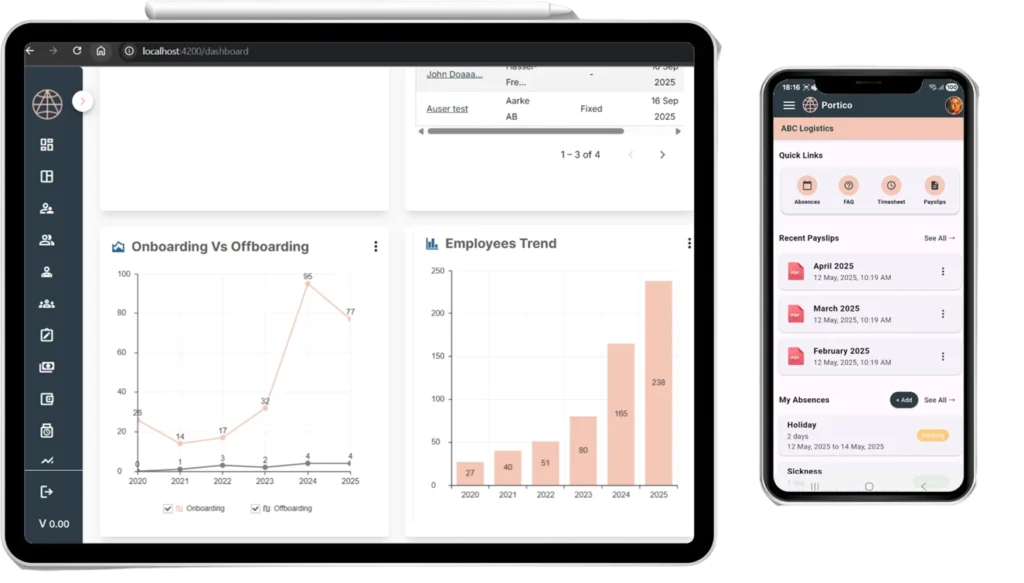
We don’t hide fees or sneak price increases. We run Austrian payroll in-house and file under your own registrations rather than a bureau’s, so the same team that files your returns answers your calls. You get a named account manager, one consolidated monthly invoice covering salaries, contributions, taxes and fees, and one live Portico view of Austria beside every other country we run for you. Portico syncs with your time-tracking, leave and HR systems via API – set up by our onboarding team, not left to yours. GDPR, SOC 2 and ISO 27001 certified.

Other services
Accelerating your growth in Austria and beyond
TopSource goes far beyond payroll, acting as your end-to-end partner in global workforce management. From Employer of Record (EOR) services and seamless entity setup to localized accountancy and fractional HR support, we cover every aspect of international employment.

Meet our experts for Austria
Whether you’re entering the market or scaling operations, our specialists provide the insight and guidance you need to succeed in one of the world’s most dynamic and regulated employment landscapes. With TopSource, you’re backed by real experts, every step of the way.

Beyond a payroll serviceA globalization accelerator
Payroll platform
Global payroll simplified
Your intuitive hub for paying global teams. Simple, powerful, and designed to scale with you — no complexity, just clarity.
Audit
Eliminate barriers to growth
Avoid compliance issues across your global workforce and uncover opportunities to improve profitability. On a quarterly basis we’ll help you audit your global talent strategy to ensure it aligns with your business goals.
Intelligence
Build a data-driven talent strategy
Grow confidently and profitably with access to the latest TopSource insights & data on hiring markets, salary benchmarking & benefits.
Advisory
Expert guidance that turns complexity into clarity.
Whether you’re managing a global acquisition or entering a new market, you get clear guidance to navigate complex decisions, avoid delays, and accelerate your global expansion.


Austrian payroll FAQs
About 30% on top of gross salary. Employer social insurance is 20.98% in 2026, or 21.23% in Vienna, and the employer also pays 1.53% to the severance fund, 3.7% to the family fund, a chamber levy of around 0.35% and 3% municipal tax. Social insurance stops at EUR 6,930 a month; the levies have no ceiling.
The employer pays 20.98%: health 3.78%, pension 12.55%, unemployment 2.95%, accident 1.10%, insolvency fund 0.10% and housing 0.50%. The employee pays 18.07%. In Vienna the housing contribution is 0.75% each, making 21.23% and 18.32%.
The maximum contribution base is EUR 6,930 a month in 2026. The 13th and 14th salaries have their own ceiling of EUR 13,860 a year. Pay above those amounts carries no social insurance, although the employer levies still apply.
They are not required by statute, but collective agreements provide them for almost every employee. After an allowance of EUR 620 a year, special payments within a sixth of regular annual pay are taxed at a reduced 6%.
No. Austria has no statutory minimum wage. Collective agreements set minimum pay by sector and job grade for around 98% of employees, and they are updated every year.
The monthly contribution report and social insurance, wage tax, the family fund contribution, the chamber levy and municipal tax are all due by the 15th of the following month. The annual L16 pay slips go to the tax office by the end of February.
Annual income up to EUR 13,539 is tax-free. Above that the rates are 20%, 30%, 40%, 48% and 50%, with the 48% band starting at EUR 70,365 and 50% at EUR 104,859. Income above EUR 1 million is taxed at 55%.
For contracts since 2003 there is no statutory severance at termination. Instead the employer pays 1.53% of gross pay every month into an employee severance fund, starting in the second month of employment.
Employees are entitled to five weeks of paid leave a year, 25 working days for a five-day week, rising to six weeks after 25 years of service.
Employer notice is six weeks in the first two years of service, two months after two years, three after five, four after 15 and five after 25 years. Since October 2021 the same periods apply to blue-collar employees, with some sector exceptions.
Looking at other markets too?
We help organizations employ and pay teams in 164 countries.