Payroll Services in Greece
Fully managed Greek payroll: e-EFKA contributions up to the 2026 ceiling, the Christmas and Easter bonuses and holiday allowance, income tax withheld on the new 2026 scale and monthly filings with e-EFKA and AADE, with a named specialist a phone call away.

TopSource rated 5/5 by our customers

What Greek payroll actually involves
Greek payroll runs on 14 salary payments a year, social security contributions paid to e-EFKA up to a monthly ceiling and income tax withheld on a scale that the 2026 tax reform cut, most of all for families and young workers. Hires, contract changes and working hours are reported to the ERGANI system.
Our Partners Globally









Calculate Your Employee Costs in Greece
Enter a gross annual salary, including the Christmas bonus, Easter bonus and holiday allowance, to see the employer cost of a Greek employee in 2026: 21.79% contributions for the main pension, health care, the auxiliary pension and unemployment, on earnings up to €7,761.94 a month across 14 salary payments a year.
Employment Cost Calculator
*Indicative figures only and not definitive legal advice. Local regulations change frequently. Consult an expertGreece
| British Pound | Greece | |
|---|---|---|
| Base Salary (per month) | ||
| Employer Contributions | ||
| Total Cost (Annual) | ||
| Total Cost (Monthly) |
“Their expertise and understanding of the unique hiring, payment, and human resource practices in each country has been nothing short of outstanding. Our Client Success Manager, has done just that … ensured our success. Her availability and willingness to engage on a personal level has made all the difference.”

“Excellent service, especially from our account manager who has gone above and beyond to help us use the platform effectively. Our manager, significantly simplifies my workload. It is like having your own TopSource HR representative on your team.”
“TopSource has been our go-to resource for international hiring. They are responsive, thorough, respectful and knowledgeable. The Client Success team has provided us with the utmost customer service, and the more we use TopSource, the more, it gives us access to more resources and knowledge.”
Employer Costs in Greece Explained
A Greek employee costs 21.79% on top of salary in employer contributions, paid on all 14 salary payments a year. The rate is flat up to €7,761.94 a month, so the share falls only for salaries above the ceiling: at €10,000 a month it is 16.9%. Income tax and the employee’s 13.37% are withheld from pay. Here’s the breakdown.
For a standard private-sector employee, employers pay 21.79% and employees 13.37% of earnings, 35.16% in total since a one-point cut in health contributions in January 2025. The employer share covers the main pension (13.33%), health care through EOPYY (4.05%), the auxiliary pension (3%) and unemployment and related funds managed by DYPA (1.41%). Contributions apply up to a ceiling of €7,761.94 a month from 1 January 2026, raised by 2.5% in line with inflation. Heavy and unhealthy occupations carry higher rates.
The employer reports pay and contributions for each employee in the monthly Analytical Periodic Declaration (APD) to e-EFKA and pays the contributions by the end of the following month. The Christmas bonus, Easter bonus and holiday allowance carry contributions like salary.
Greek law adds three payments to the 12 monthly salaries. The Christmas bonus equals one month’s salary for employees who worked from 1 May to 31 December and is paid by 21 December. The Easter bonus equals half a month’s salary for the period from 1 January to 30 April and is paid by Holy Wednesday. The holiday allowance equals up to half a month’s salary and is paid with annual leave. Employees who worked only part of each period receive a proportional amount.
For tax, the employer treats the year as 14 salaries: the annual salary after employee contributions sets the tax, one fourteenth is withheld each month and from the Christmas bonus, and half that amount from the Easter bonus and from the holiday allowance.
Law 5246/2025 set a new scale for employment income from 1 January 2026: 9% on the first €10,000, 20% from €10,000 to €20,000, 26% to €30,000, 34% to €40,000, 39% to €60,000 and 44% above €60,000. The 20% band falls to 18% with one dependent child, 16% with two and 9% with three, and the first two bands fall to 0% with four or more children. The 26% band also falls, from 24% with one child to 18% with four. Workers aged up to 25 pay 0% on their first €20,000 of taxable income, and those aged 26 to 30 pay 9%.
Salaried employees also receive a tax reduction of €777 a year, or more with dependent children, which shrinks by €20 for every €1,000 of income above €12,000. Overtime, other bonuses and retroactive pay are withheld at a flat 20%, and the final tax is settled in the employee’s annual return.
For an employee on €2,000 a month, the employer pays €435.80 of contributions on each of the 14 payments: €2,435.80 per payment and €34,101.20 a year, 21.79% on top of the €28,000 annual salary. At €5,000 a month the contributions are €1,089.50 per payment. At €10,000 a month they stop at the €7,761.94 ceiling, at €1,691.33, and the employer cost falls to 16.9% on top of salary.
The national minimum wage is €920 a month for salaried employees and €41.09 a day for manual workers from 1 April 2026, a 4.55% rise. With 14 payments, the minimum annual salary is €12,880. Sectoral collective agreements can set higher pay scales.
The standard working week is 40 hours over five days, and overtime is paid at a 40% premium. Working time is reported through the ERGANI system and, in the sectors where it applies, the digital work card. Employees on a five-day week are entitled to 20 working days of paid annual leave after a year of service, or 24 on a six-day week, rising to 25 days after ten years with the same employer or twelve years in total.
Indefinite contracts can include an agreed probation period of up to six months. Severance is due once an employee has 12 months of service and rises with length of service, and an employer who gives the statutory written notice pays half. Every dismissal must be reported to ERGANI.
Greek employer contributions and payroll costs, 2026
| Contribution | Employer | Employee | Applies to |
|---|---|---|---|
| Main pension (e-EFKA) | 13.33% | 6.67% | Earnings up to €7,761.94 a month |
| Health care (EOPYY) | 4.05% | 2.05% | Earnings up to €7,761.94 a month |
| Auxiliary pension | 3% | 3% | Earnings up to €7,761.94 a month |
| Unemployment and related funds (DYPA) | 1.41% | 1.65% | Earnings up to €7,761.94 a month |
| Total contributions | 21.79% | 13.37% | Standard private-sector employee |
| Christmas bonus, Easter bonus, holiday allowance | Two extra months’ pay | — | Paid in December, at Easter and with leave |
| Income tax | — | 9% to 44% | Withheld monthly; lower rates for families and under-30s |
Greek income tax scale for employment income, 2026
| Taxable income | Standard rate | One child | Two children | Three children | Four children |
|---|---|---|---|---|---|
| Up to €10,000 | 9% | 9% | 9% | 9% | 0% |
| €10,000 to €20,000 | 20% | 18% | 16% | 9% | 0% |
| €20,000 to €30,000 | 26% | 24% | 22% | 20% | 18% |
| €30,000 to €40,000 | 34% | 34% | 34% | 34% | 34% |
| €40,000 to €60,000 | 39% | 39% | 39% | 39% | 39% |
| Above €60,000 | 44% | 44% | 44% | 44% | 44% |
Employer cost of monthly salaries in Greece, 2026
| Monthly salary | Employer contributions | Cost per payment | Annual cost (14 payments) | On top of salary |
|---|---|---|---|---|
| €2,000 | €435.80 | €2,435.80 | €34,101.20 | 21.79% |
| €5,000 | €1,089.50 | €6,089.50 | €85,253.00 | 21.79% |
| €10,000 | €1,691.33 | €11,691.33 | €163,678.62 | 16.9% |
Workers aged up to 25 pay 0%, and those aged 26 to 30 pay 9%, on their first €20,000 of taxable income, and each child beyond four takes two more points off the 26% band. The cost table counts the Christmas bonus, Easter bonus and holiday allowance as two extra monthly payments; at €10,000 contributions stop at the €7,761.94 ceiling. These are TopSource calculations from the verified 2026 rates.
Rates, ceilings and amounts shown are for 2026 and were verified on 5 October 2026 against the e-EFKA contribution tables and 2026 ceiling circular, Law 5246/2025, the 2026 minimum wage decision and published tax sources. This page is general information, not tax or legal advice.
How our Greek payroll service works
Why Choose TopSource as Your Payroll Company in Greece
TopSource for payroll, Employer of Record or any other of our services represents a simpler, more reliable and transparent option.
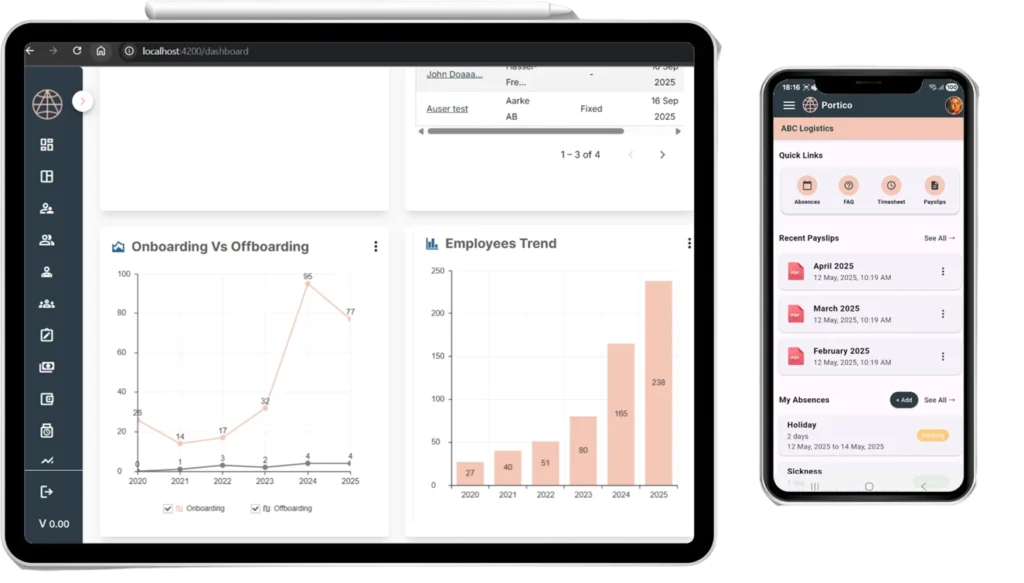
We don’t hide fees or sneak price increases. We run Greek payroll in-house and file under your own e-EFKA and tax registrations rather than a bureau’s, so the same team that files your monthly APD answers your calls. You get a named account manager, one consolidated monthly invoice covering salaries, contributions, taxes and fees, and one live Portico view of Greece beside every other country we run for you. Portico syncs with your time-tracking, leave and HR systems via API – set up by our onboarding team, not left to yours. GDPR, SOC 2 and ISO 27001 certified.

Other services
Accelerating your growth in Greece and beyond
TopSource goes far beyond payroll, acting as your end-to-end partner in global workforce management. From Employer of Record (EOR) services and seamless entity setup to localized accountancy and fractional HR support, we cover every aspect of international employment.

Meet our experts for Greece
Whether you’re entering the market or scaling operations, our specialists provide the insight and guidance you need to succeed in one of the world’s most dynamic and regulated employment landscapes. With TopSource, you’re backed by real experts, every step of the way.

Beyond a payroll serviceA globalization accelerator
Payroll platform
Global payroll simplified
Your intuitive hub for paying global teams. Simple, powerful, and designed to scale with you — no complexity, just clarity.
Audit
Eliminate barriers to growth
Avoid compliance issues across your global workforce and uncover opportunities to improve profitability. On a quarterly basis we’ll help you audit your global talent strategy to ensure it aligns with your business goals.
Intelligence
Build a data-driven talent strategy
Grow confidently and profitably with access to the latest TopSource insights & data on hiring markets, salary benchmarking & benefits.
Advisory
Expert guidance that turns complexity into clarity.
Whether you’re managing a global acquisition or entering a new market, you get clear guidance to navigate complex decisions, avoid delays, and accelerate your global expansion.



Greek payroll FAQs
For a standard private-sector employee, employers pay 21.79% and employees 13.37% of earnings up to €7,761.94 a month. The employer share covers the main pension, health care, the auxiliary pension and unemployment and related funds. Heavy and unhealthy occupations pay more.
Contributions apply to earnings up to €7,761.94 a month from 1 January 2026, 2.5% more than in 2025. Above the ceiling no further contributions are due, so the employer cost falls as a share of salary.
Employment income is taxed at 9% up to €10,000, 20% to €20,000, 26% to €30,000, 34% to €40,000, 39% to €60,000 and 44% above that. Lower rates apply to taxpayers with dependent children and to workers aged up to 30.
Law 5246/2025 cut the 22%, 28% and 36% bands to 20%, 26% and 34%, added a 39% band from €40,000 to €60,000 and cut rates further for each dependent child. Workers aged up to 25 pay no tax on their first €20,000 and those aged 26 to 30 pay 9%.
Fourteen: 12 monthly salaries, a Christmas bonus of one month’s pay by 21 December, an Easter bonus of half a month by Holy Wednesday and a holiday allowance of up to half a month paid with annual leave. All three carry social security contributions and income tax.
The national minimum wage is €920 a month for salaried employees and €41.09 a day for manual workers from 1 April 2026. Paid 14 times a year, it comes to €12,880.
Employers submit the monthly Analytical Periodic Declaration (APD) to e-EFKA and pay the contributions by the end of the following month. Tax withheld from salaries is declared and paid to AADE monthly through myAADE.
Employees on a five-day week are entitled to 20 working days of paid annual leave after a year of service, or 24 on a six-day week, rising to 25 working days after ten years with the same employer or twelve years in total. The holiday allowance is paid with the leave.
Indefinite contracts can include an agreed probation period of up to six months. Severance is due once an employee has 12 months of service and rises with length of service, and it is halved when the employer gives the statutory written notice. Every dismissal must be reported to ERGANI.
Registering as an employer with e-EFKA requires a local entity, such as a Greek company or a registered branch. Without one, the usual route is an Employer of Record. TopSource can run payroll for your Greek entity or employ your team through our Employer of Record service.
Looking at other markets too?
We help organizations employ and pay teams in 164 countries.